
Reading a Counting Figure
A counting figure is a Venn diagram with a number written in every part. Each circle is one group of people, and the number in a part tells you how many people sit in exactly that part. Here is one about 50 guests at a party and the drinks they like.
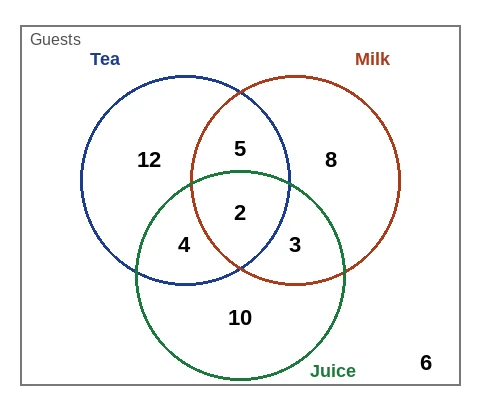
The parts and their names
Three circles cut the page into eight parts. Learn their names once and every question becomes a matter of reading the right number.
- Only tea: 12. Inside the tea circle, outside the other two. These guests like tea and nothing else on the list. Only milk is 8 and only juice is 10.
- Tea and milk but not juice: 5. The part shared by tea and milk, outside juice. In the same way, tea and juice but not milk is 4, and milk and juice but not tea is 3.
- All three: 2. The centre, where all three circles meet.
- None: 6. Inside the box but outside every circle. These guests like none of the three drinks. The box stands for everyone asked, and its name ("Guests") tells you who they are.
Each person is counted once
This is the key fact about a counting figure. A guest who likes tea and milk is counted in the 5 and nowhere else. So you never subtract anything when you read a figure. You only add the parts the question asks for.
"Which number represents …"
Some questions do not ask for a count at all. They describe a group in words and ask which number in the figure stands for it. For example: "Which number represents the guests who like milk and juice but not tea?" Find the part (shared by milk and juice, outside tea) and read its number: 3. The options will hold the numbers of the parts next to it, such as 2 (the centre) and 5, so put your finger on the exact part before you answer.
Time check: a counting question on a figure should take 25 to 35 seconds.
Solved Questions
Question 1
Study the given Venn diagram and answer the question that follows.
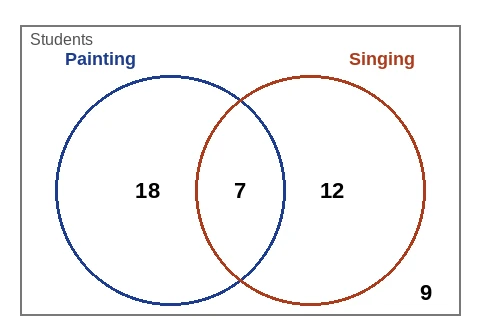
How many students like painting but not singing?
(a) 25 (b) 18 (c) 7 (d) 30
Answer. The painting circle holds 18 + 7 = 25 students. The 7 in the shared part like singing too, so "but not singing" leaves them out. That leaves only the 18 in the painting-only part. So the answer is (b) 18.
Question 2
Study the given Venn diagram and answer the question that follows.
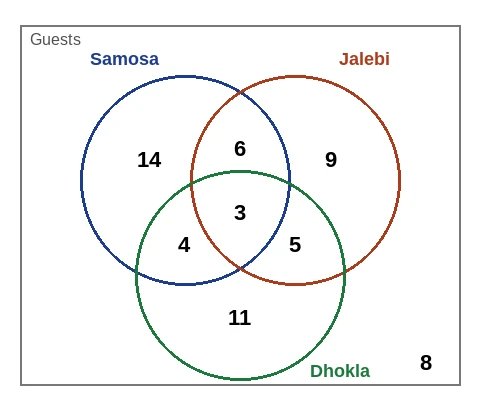
How many guests like samosa and jalebi but not dhokla?
(a) 9 (b) 3 (c) 20 (d) 6
Answer. Find the part shared by the samosa and jalebi circles, then stay outside the dhokla circle. That part holds 6. The centre, 3, is inside dhokla, so it is left out. Adding it would give 9, which answers a different question: "samosa and jalebi" with no "but not". So the answer is (d) 6.
Question 3
In the given Venn diagram, which number represents the students who play cricket and hockey but not football?
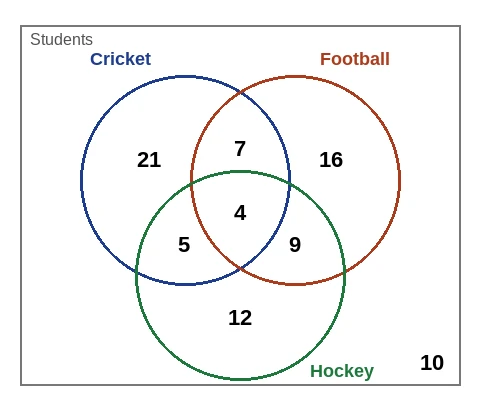
(a) 5 (b) 9 (c) 4 (d) 7
Answer. Put your finger on the part where the cricket and hockey circles meet, then check it is outside the football circle. That part holds 5. The 4 is the centre, inside all three circles, and 9 belongs to football and hockey. Time check: a "which number" question needs no adding, so it sits at the low end of 25–35 seconds. So the answer is (a) 5.
Words That Trip People
The figure is easy to read. The words in the question are where marks are lost. Each phrase below points to a fixed set of parts. The last column uses the tea, milk and juice figure from the first part of this section.
| The question says | Add these parts | In that figure |
|---|---|---|
| only tea | the only-tea part | 12 |
| tea and milk (or both tea and milk) | tea and milk but not juice, plus the centre | 5 + 2 = 7 |
| tea and milk but not juice | just that shared part | 5 |
| all three | the centre | 2 |
| exactly two | the three parts shared by exactly two circles | 5 + 4 + 3 = 12 |
| at least two | exactly two, plus the centre | 12 + 2 = 14 |
| exactly one (or only one) | the three only parts | 12 + 8 + 10 = 30 |
| at least one | every part inside the circles | 44 |
| at most one | exactly one, plus none | 30 + 6 = 36 |
| none (or none of the three) | the number outside the circles | 6 |
| neither tea nor milk | only juice, plus none | 10 + 6 = 16 |
| either only tea or only milk | only tea, plus only milk | 12 + 8 = 20 |
| tea or milk (or both) | every part inside the tea circle or the milk circle | 12 + 8 + 5 + 4 + 3 + 2 = 34 |
"And" takes in the centre
"How many like tea and milk?" asks for everyone who likes both, and that includes the guests who also like juice. So it is 5 + 2, not 5 alone. Only the words "but not juice" or "only tea and milk" shut the centre out.
"Neither … nor" is about two circles
"Neither tea nor milk" leaves out everything inside the tea circle and the milk circle. What is left is the juice-only part and the none part. Students often give just the none part, 6. That would be the answer to "none of the three".
"Either … or"
When a question says "either only tea or only milk", add the two only parts. When it says "tea or milk or both", take everyone inside either circle. A bare "either tea or milk", with neither "only" nor "or both", can be read two ways: everyone inside either circle (34 here), or those in exactly one of the two (34 − 7 = 27). That is why careful questions add one of those words. If you meet the bare form, work out both and see which one the options hold.
At least and at most
"At least two" means two or more, so the centre counts. "At most one" means one or zero, so the none part counts. Say the meaning to yourself in those plain words before you add.
Question 4
Study the given Venn diagram and answer the question that follows.
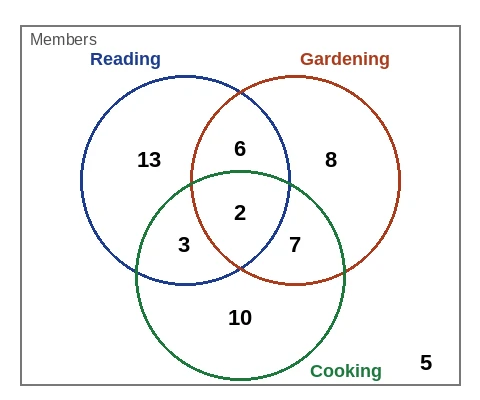
How many members enjoy exactly two of the three hobbies?
(a) 18 (b) 31 (c) 16 (d) 2
Answer. Exactly two means the parts shared by two circles and no more. They are reading and gardening 6, reading and cooking 3, and gardening and cooking 7. So 6 + 3 + 7 = 16. The centre, 2, is three hobbies, so it does not count here. So the answer is (c) 16.
Question 5
Study the given Venn diagram and answer the question that follows.
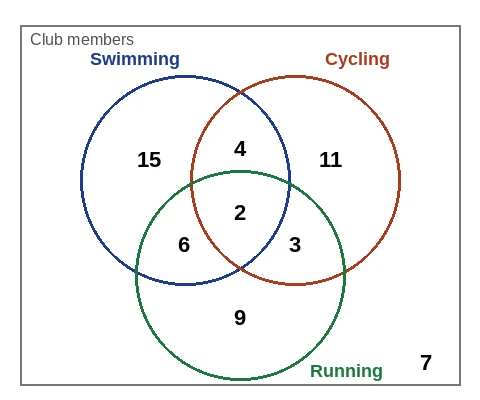
How many club members do at least two of these activities?
(a) 13 (b) 15 (c) 35 (d) 2
Answer. At least two means two or three. The two-only parts are 4, 6 and 3, which make 13. The centre adds 2 more for the members who do all three. 13 + 2 = 15. So the answer is (b) 15.
Question 6
Study the given Venn diagram and answer the question that follows.
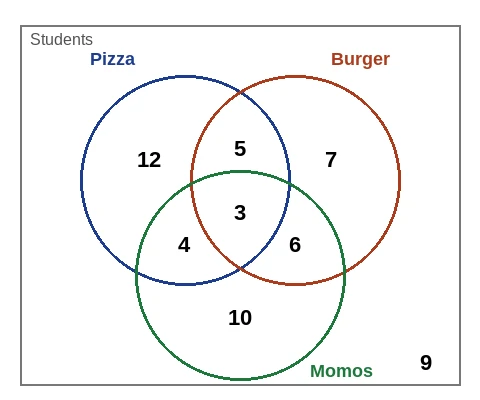
How many students like neither pizza nor burger?
(a) 9 (b) 10 (c) 23 (d) 19
Answer. Leave out everything inside the pizza circle and everything inside the burger circle. What is left is the momos-only part, 10, and the 9 outside all the circles. So 10 + 9 = 19. Giving just 9 is the usual slip: that would be students who like none of the three. So the answer is (d) 19.
Question 7
Study the given Venn diagram and answer the question that follows.
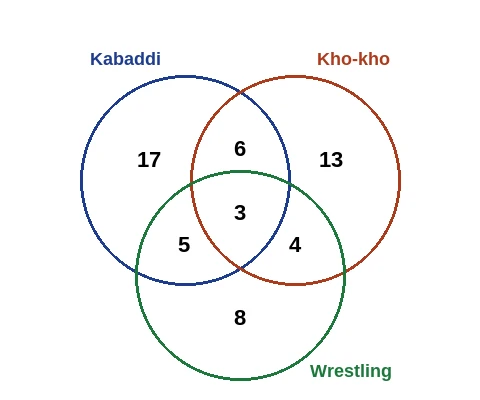
How many people play either only kabaddi or only kho-kho?
(a) 30 (b) 36 (c) 38 (d) 17
Answer. The word "only" sits on both sides, so take the two only parts and nothing shared. Only kabaddi is 17 and only kho-kho is 13. 17 + 13 = 30. So the answer is (a) 30.
Totals for One Set and for the Union
The total for one circle
"How many guests like tea?" means everyone inside the tea circle, whatever else they like. Add the four parts inside it: only tea, the two parts tea shares with one other circle, and the centre. In the tea, milk and juice figure, that is 12 + 5 + 4 + 2 = 23. The total for milk is 8 + 5 + 3 + 2 = 18.
A common slip is to answer 12. That is "only tea". The question did not say only.
The union of two circles
"How many like tea or milk?" means everyone inside at least one of those two circles. There are two ways to get it.
- Add every part inside the two circles: 12 + 8 + 5 + 4 + 3 + 2 = 34.
- Add the two totals and take away the people counted twice. Tea is 23, milk is 18, and the 7 who like both were counted in each, so 23 + 18 − 7 = 34.
The first way is quicker on a figure. The second way is the one you need when there is no figure, in the next part of this section.
Everyone in the figure
The total number of people is every number in the figure, including the one outside the circles: 44 inside the circles plus 6 outside gives 50. If the question tells you the total, add the parts anyway as a check.
How many more
"How many more guests like tea than milk?" is the tea total minus the milk total: 23 − 18 = 5. There is a shortcut. The parts that tea and milk share (the 5 and the centre 2) sit in both totals, so they cancel. You only need the parts that belong to one circle and not the other: (12 + 4) − (8 + 3) = 16 − 11 = 5.
[SSC Tip] Before adding, say the question in plain words: "inside tea, anything else allowed" or "only tea, nothing else". That one sentence tells you whether to take one part or four.
Question 8
Study the given Venn diagram and answer the question that follows.
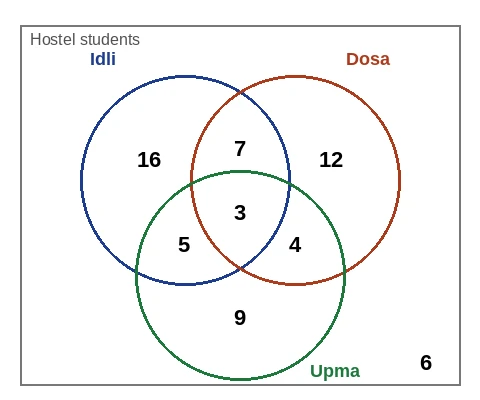
How many hostel students like dosa?
(a) 12 (b) 23 (c) 26 (d) 19
Answer. The question does not say "only", so take everyone inside the dosa circle. That is the dosa-only part 12, the idli-and-dosa part 7, the dosa-and-upma part 4 and the centre 3. 12 + 7 + 4 + 3 = 26. So the answer is (c) 26.
Question 9
Study the given Venn diagram and answer the question that follows.
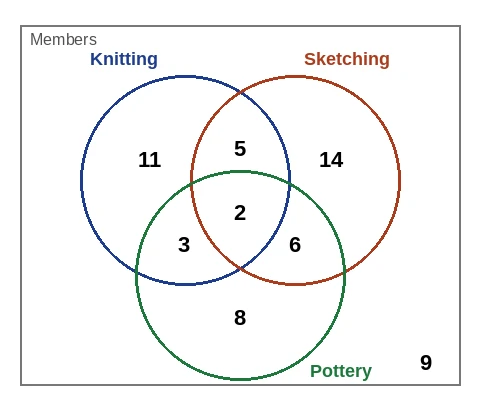
How many members like knitting or sketching or both?
(a) 30 (b) 41 (c) 49 (d) 25
Answer. Take every part that is inside the knitting circle or the sketching circle. Only knitting 11, only sketching 14, knitting and sketching 5, knitting and pottery 3, sketching and pottery 6, and the centre 2. So 11 + 14 + 5 + 3 + 6 + 2 = 41. A faster way: all the numbers inside the circles add to 49, and only the pottery-only part, 8, is outside both, so 49 − 8 = 41. So the answer is (b) 41.
Question 10
Study the given Venn diagram and answer the question that follows.
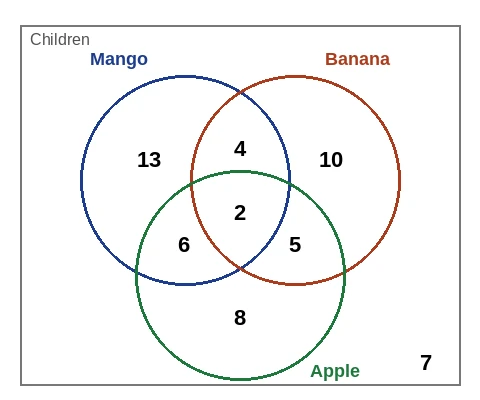
How many children like at most one of the three fruits?
(a) 31 (b) 7 (c) 45 (d) 38
Answer. At most one means one fruit or none at all. The only parts are 13, 10 and 8, which make 31. The 7 children outside the circles like none of the three, and they count too. 31 + 7 = 38. So the answer is (d) 38.
Two-Set Word Problems
Here there is no figure. The question gives totals in words, like this: "In a group of 60 students, 35 like badminton, 28 like chess and 10 like both. How many like neither?"
What the numbers mean
"35 like badminton" counts every student who likes badminton, including those who also like chess. The 10 who like both are inside the 35 and inside the 28. Only the word "only" ("15 like only chess") would shut them out.
The one rule
Number who like badminton or chess = number who like badminton + number who like chess − number who like both.
The both-group is taken away once because it was counted twice, once in each total. Here: 35 + 28 − 10 = 53.
Then: neither = total − (badminton or chess) = 60 − 53 = 7.
Draw it anyway
A quick figure stops mistakes. Put the both-number in the middle first, then work outwards.
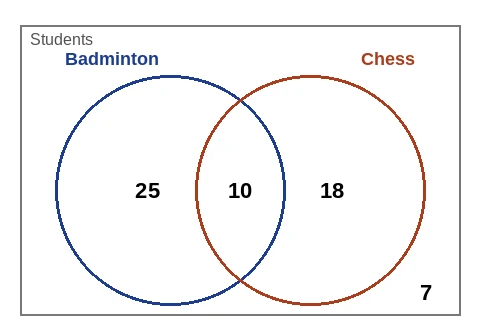
- Both: 10.
- Only badminton: 35 − 10 = 25.
- Only chess: 28 − 10 = 18.
- Neither: 60 − (25 + 10 + 18) = 7.
From this one picture you can answer any question on the group: exactly one is 25 + 18 = 43, and at most one is 43 + 7 = 50.
Other ways the same rule is used
- Both is missing. If you know the total, the neither number and the two totals, then both = badminton + chess − (total − neither).
- Everyone likes at least one. Then neither is 0 and the union is the whole group.
- At least how many like both. If 35 of 60 like badminton and 28 like chess, at least 35 + 28 − 60 = 3 must like both, because 63 likes cannot fit into 60 people without some of them liking both.
Every number in your finished figure must be a whole number and none can be negative. If one comes out negative, you have used a number twice, so read the question again.
Time check: a two-set word problem should take 40 to 60 seconds. Most of that is reading, so read once, slowly.
Question 11
In a class of 48 students, 27 play cricket and 19 play kabaddi. Of these, 8 play both games. How many students play neither game?
(a) 10 (b) 2 (c) 18 (d) 38
Answer. The 8 who play both are counted in the 27 and again in the 19. So the number who play at least one game is 27 + 19 − 8 = 38. The rest play neither: 48 − 38 = 10. So the answer is (a) 10.
Question 12
In a breakfast survey of 70 people, 42 said they like poha and 31 said they like cornflakes, while 9 like neither. How many like poha but not cornflakes?
(a) 12 (b) 19 (c) 30 (d) 33
Answer. First find how many like at least one: 70 − 9 = 61. The two totals add to 42 + 31 = 73, which is 12 more than 61. Those 12 were counted twice, so 12 people like both. Poha but not cornflakes is 42 − 12 = 30. Time check: two short steps, about 45 seconds. So the answer is (c) 30.
Question 13
A hobby club has 55 members. 30 of them enjoy photography and 22 enjoy baking, and 7 enjoy both. How many members enjoy exactly one of these two hobbies?
(a) 45 (b) 31 (c) 10 (d) 38
Answer. Photography only is 30 − 7 = 23. Baking only is 22 − 7 = 15. Exactly one means one of the two and not both, so 23 + 15 = 38. The 55 is not needed here: it only tells you that 55 − 45 = 10 members enjoy neither. So the answer is (d) 38.
Question 14
Every one of the 64 girls in a hostel likes at least one of two sweets, rasgulla and gulab jamun. 41 like rasgulla and 37 like gulab jamun. How many like both sweets?
(a) 14 (b) 23 (c) 27 (d) 4
Answer. Since every girl likes at least one sweet, nobody is outside the circles, and the two circles together hold all 64. But 41 + 37 = 78, which is 14 more than 64. The extra 14 were counted twice, once in each total, so 14 girls like both. Filling in the figure checks it: rasgulla only 41 − 14 = 27, gulab jamun only 37 − 14 = 23, and 27 + 14 + 23 = 64.
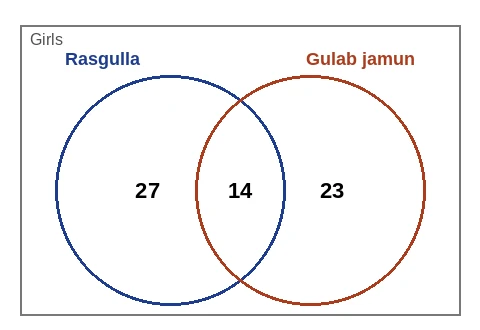
So the answer is (a) 14.
Three-Set Problems: Fill From the Centre
With three sets, the question usually gives you each total, each pair total and the all-three number. Every pair number includes the people who are in all three, so the trick is to start in the middle and work out.
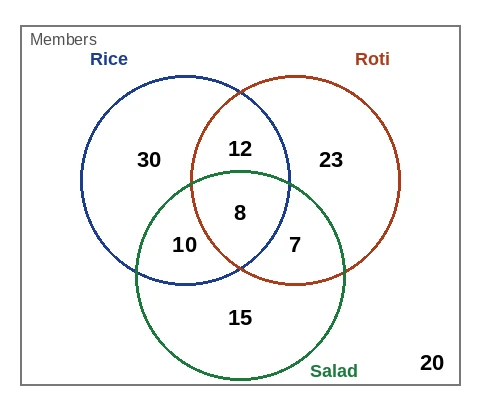
For example: in a club of 125 members, 60 like rice, 50 like roti and 40 like salad. 20 like rice and roti, 15 like roti and salad, 18 like rice and salad, and 8 like all three. How many like none of the three?
Step 1: the centre
All three: 8.
Step 2: the pair parts
Each pair number includes the centre, so take it away.
- Rice and roti but not salad: 20 − 8 = 12.
- Roti and salad but not rice: 15 − 8 = 7.
- Rice and salad but not roti: 18 − 8 = 10.
Step 3: the only parts
Take away from each total the three inner parts of that circle.
- Only rice: 60 − 12 − 10 − 8 = 30.
- Only roti: 50 − 12 − 7 − 8 = 23.
- Only salad: 40 − 7 − 10 − 8 = 15.
Step 4: none
Inside the circles: 30 + 23 + 15 + 12 + 7 + 10 + 8 = 105. None: 125 − 105 = 20.
A check in one line
The number inside at least one circle is also the three totals, minus the three pair numbers, plus the all-three number: 60 + 50 + 40 − 20 − 15 − 18 + 8 = 105. The two answers must agree. If they do not, one subtraction has gone wrong.
Why the centre comes first
If you start from the outside, you have to guess how much of each total sits in the overlaps. Starting from the centre, every step uses a number you already know. Once the figure is full, any question about the group ("exactly two", "only salad", "at least one") is just a matter of reading parts, as in the earlier parts of this section.
Question 15
In a sports camp of 100 children, 45 learn karate, 38 learn gymnastics and 30 learn skipping. 12 learn karate and gymnastics, 10 learn gymnastics and skipping, and 9 learn karate and skipping (each of these pair numbers includes the children who learn all three). 4 children learn all three. How many children learn exactly one of the three?
(a) 86 (b) 19 (c) 63 (d) 14
Answer. Fill the figure from the centre. All three: 4. Each pair number includes those 4, so the pair parts are 12 − 4 = 8, 10 − 4 = 6 and 9 − 4 = 5. Now the only parts: karate only is 45 − 8 − 5 − 4 = 28, gymnastics only is 38 − 8 − 6 − 4 = 20, skipping only is 30 − 6 − 5 − 4 = 15. Exactly one is 28 + 20 + 15 = 63. As a check, all seven parts add to 86, so 14 children learn none, and the whole figure adds to 100.
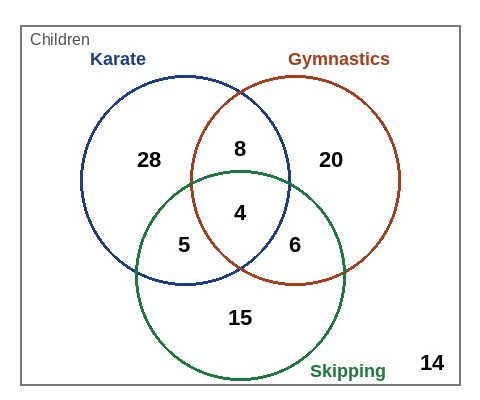
So the answer is (c) 63.
Question 16
In a group of 90 college students, every student likes at least one of three dishes: rajma, chole and kadhi. 50 like rajma, 42 like chole and 36 like kadhi, and 6 like all three. How many students like exactly two of the three dishes?
(a) 38 (b) 32 (c) 20 (d) 26
Answer. Here the pair numbers are not given, so count how many times each student is counted. Adding the three totals gives 50 + 42 + 36 = 128. A student who likes one dish is counted once, a student who likes two is counted twice, and a student who likes all three is counted three times. There are only 90 students, so the extra counts are 128 − 90 = 38. Each exactly-two student adds 1 extra count, and each all-three student adds 2 extra counts, so the 6 all-three students make 12 of the 38. That leaves 38 − 12 = 26 extra counts, one for each student who likes exactly two dishes. So the answer is (d) 26.
Question 17
Study the given Venn diagram and answer the question that follows.
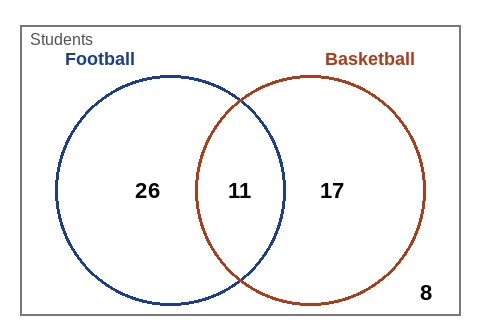
How many more students play football than basketball?
(a) 11 (b) 15 (c) 9 (d) 20
Answer. Football is 26 + 11 = 37 and basketball is 17 + 11 = 28, so the difference is 37 − 28 = 9. The 11 in the middle sits in both totals, so it cancels: 26 − 17 gives the same 9 straight away. So the answer is (c) 9.
Question 18
In the given Venn diagram, which number represents the gym members who do aerobics and zumba but not yoga?
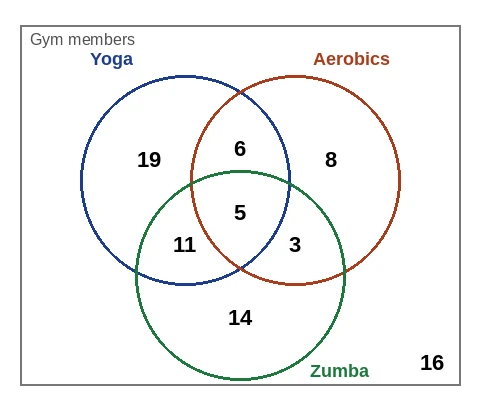
(a) 5 (b) 3 (c) 11 (d) 6
Answer. Find the part where the aerobics and zumba circles meet, and stay outside the yoga circle. That part holds 3. The centre, 5, is inside yoga too, and 11 is yoga and zumba. Time check: about 25 seconds. So the answer is (b) 3.