
What a Venn Diagram of Classes Shows
A class is a group of things that share one name: doctors, parrots, mothers, goats. In this type of question you get three classes and four drawings, each made of three circles. You pick the drawing in which the circles sit the way the classes really sit in everyday life. A second form turns this round: one drawing, four sets of classes, and you pick the set that fits.
One circle for each class
Each circle holds every member of one class and nothing else. The doctors circle holds every doctor there is. The parrots circle holds every parrot.
Three ways two circles can sit
- Inside. One circle sits wholly inside the other. Every member of the small class is also in the big class. Every parrot is a bird, so the parrots circle sits inside the birds circle.
- Overlapping. The circles cross and share a middle part. Some members belong to both classes, and each class also has members outside the other. Some women are doctors, some women are not, and some doctors are men.
- Separate. The circles do not touch. Nothing belongs to both classes. No father is a mother.
Size and position mean nothing
A big circle does not mean a big class, and left or right means nothing. Only three things matter: which circles sit inside others, which ones cross, and which ones stay apart. A drawing with the mothers circle on the right says the same thing as one with it on the left, as long as it sits inside the women circle.
Every part must be possible
Circles cut the page into parts. A part means "members of these circles and of no other circle". Hold every drawing to two checks:
- Every part the drawing shows must be able to hold a real member.
- Every kind of member you can think of must have a part to sit in.
For example, if a drawing lets the fathers circle cross the mothers circle, the shared part stands for people who are fathers and mothers at the same time. Nobody can sit there, so the drawing is wrong for those classes.
Plain everyday meaning
Read each class the way an ordinary person would. Parrots are birds, mothers are women, surgeons are doctors, kittens are cats. The question wants the plain meaning of the words, not rare exceptions or facts only a specialist knows.
One word to watch is "animals". In everyday talk many people say "animals and birds" as if the two were apart, so the sets in this course use "living beings" or "mammals" when they need a class that holds birds or fish as well.
Two Classes: Three Pictures
Three circles are only three pairs of circles, so get the pairs right first. Any two classes sit in exactly one of three ways.
Inside
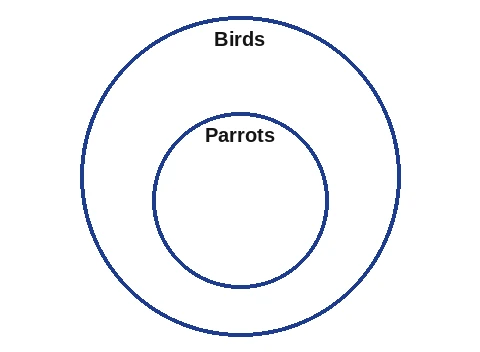
Every parrot is a bird, but many birds (crows, hens, pigeons) are not parrots. So the parrots circle goes inside the birds circle. The test is simple: try to find a member of the small class that is not in the big one. If you cannot, the small circle goes inside.
Other pairs that sit like this: mothers inside women, surgeons inside doctors, goats inside mammals, bus drivers inside drivers.
Overlapping
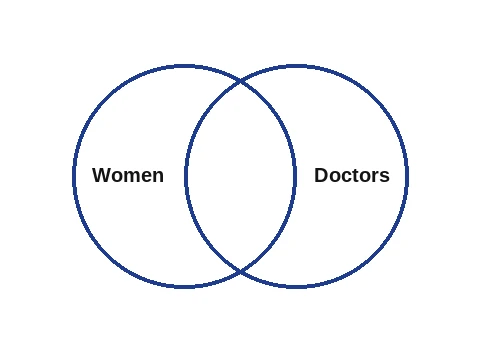
Some women are doctors. Some women are not doctors. Some doctors are men. All three facts hold, so the circles cross. The middle part holds women doctors, the left part women who are not doctors, and the right part doctors who are not women.
Most pairs of a job and a family word sit like this: nurses and fathers, teachers and mothers, pilots and brothers. Pets and dogs overlap too: many dogs are pets, street dogs are not, and many pets are cats or parrots.
Separate
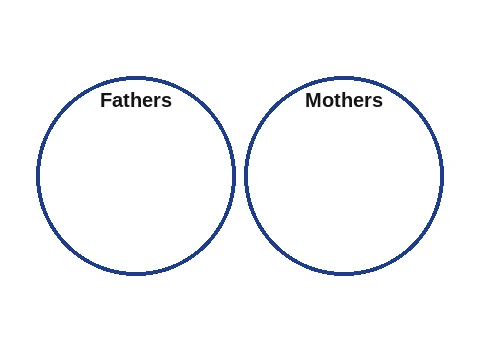
No father is a mother, so the circles stay apart. People and animals stay apart in the same way: no tailor is a goat and no nurse is a parrot. Two different kinds of creature stay apart as well, like cows and owls.
The two-question test
For any two classes X and Y, ask in this order:
- Can anything be an X and a Y at the same time? If nothing can, draw them separate.
- If something can, is every X a Y (or every Y an X)? If yes, draw one inside the other. If no, draw them crossing.
Say the answer in a short sentence: "every surgeon is a doctor", "some pilots are brothers", "no cow is an owl". The sentence decides the picture.
Three Classes: Take Them in Pairs
With three classes, never try to see the whole picture in one go. Break it into pairs.
The method
- Write the three pairs: first and second, first and third, second and third.
- Decide each pair with the two-question test: inside, crossing or separate.
- If two or three circles cross, ask one more thing: can a single member belong to all three classes? If yes, the circles meet in the middle.
- Now find the drawing that shows all of this at once.
For example: Parents, Mothers, Nurses.
- Parents and mothers: every mother is a parent. Mothers go inside parents.
- Parents and nurses: some nurses are parents, some are not, and most parents are not nurses. They cross.
- Mothers and nurses: some mothers are nurses, some are not, and some nurses are not mothers. They cross.
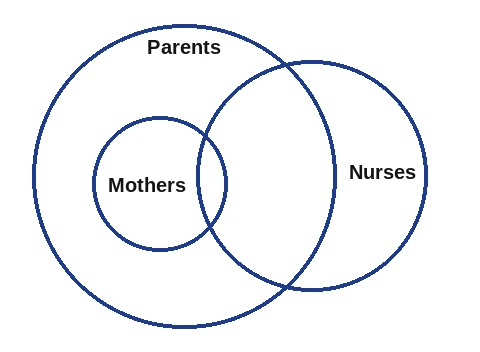
So the mothers circle sits inside parents, and the nurses circle cuts across both. It also sticks out past the parents circle, because some nurses have no children.
The pictures you will meet
| The picture | What it says | Classes that fit |
|---|---|---|
| Three circles, all apart | no two classes share a member | Nurses, Parrots, Horses |
| Three circles, each inside the next | small inside middle inside big | Humans, Women, Mothers |
| Two separate circles inside a big one | two classes with nothing shared, both inside a third | Birds, Crows, Parrots |
| Two crossing circles inside a big one | two classes that share members, both inside a third | Humans, Women, Doctors |
| One circle inside another, third apart | one pair inside, the third class alone | Birds, Parrots, Tigers |
| One inside another, third crossing only the big one | the third class meets the big class but never the small one | Parents, Grandfathers, Women |
| Three crossing circles that all meet | every pair overlaps and one member can be in all three | Fathers, Teachers, Cyclists |
| Two crossing circles, third apart | one overlapping pair, the third class alone | Women, Nurses, Owls |
| A chain | the middle class crosses both ends, the ends never meet | Uncles, Teachers, Aunts |
| One inside another, third crossing both | the third class meets the small class and also sticks out of the big one | Parents, Mothers, Nurses |
| Two crossing circles, third inside their shared part | the small class belongs to both of the others | Women, Parents, Grandmothers |
One of these turns up in two looks. "One inside another, third crossing only the big one" can also be drawn as two crossing circles with a small circle inside one of them, clear of the crossing. Both drawings say the same thing, so treat them as one shape.
Near misses
The wrong drawings in the options are usually the right drawing with one circle moved: a small circle slid out of the big one, two crossing circles pulled apart, or a third circle pushed across a line it should not cross. So settle every pair before you look at the options, then match. If you look first, a drawing that is nearly right can pull you in.
Solved Questions
Question 1
Select the Venn diagram that best illustrates the relationship between the following classes.
Grandparents, Humans, Parents
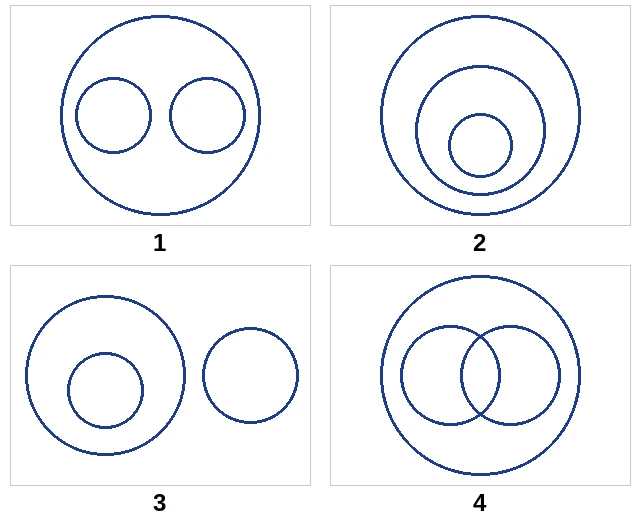
(a) Diagram 1 (b) Diagram 2 (c) Diagram 3 (d) Diagram 4
Answer. Take the pairs one at a time. Every grandparent is a parent, because a grandparent is the parent of someone's mother or father. Every parent is a human, so parents sit inside humans, and grandparents sit inside parents. Three circles, each one inside the next: that is Diagram 2. Diagram 1 puts two small circles side by side inside the big one, which would mean no grandparent is a parent. So the answer is (b) Diagram 2.
Question 2
Select the Venn diagram that best illustrates the relationship between the following classes.
Owls, Cows, Birds
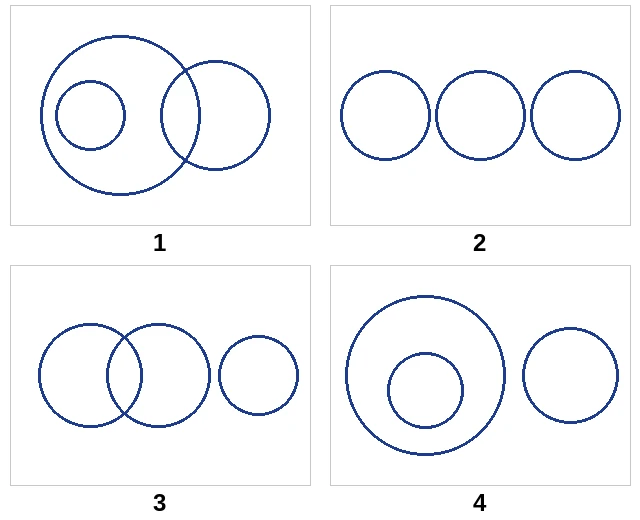
(a) Diagram 1 (b) Diagram 2 (c) Diagram 3 (d) Diagram 4
Answer. Every owl is a bird, so the owls circle goes inside the birds circle. A cow is not a bird, and so it is not an owl either. The cows circle stays away from both. One circle inside another, with a third circle on its own, is Diagram 4. In Diagram 1 the third circle cuts into the big one, which would make some cows birds. So the answer is (d) Diagram 4.
Question 3
Which of the following Venn diagrams best represents the relationship between the given classes?
Uncles, Human beings, Aunts
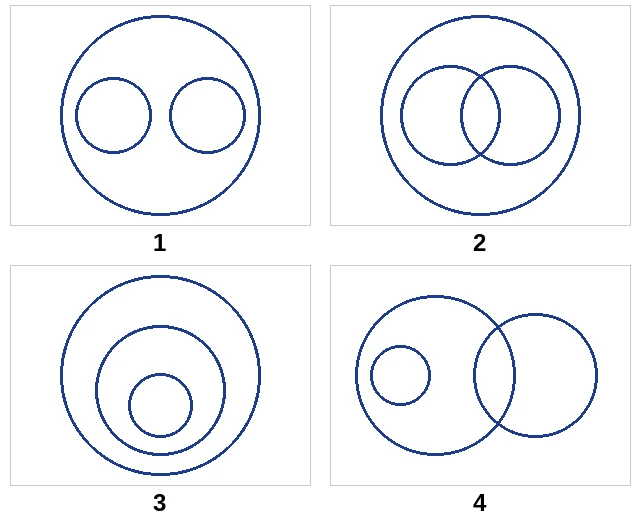
(a) Diagram 1 (b) Diagram 2 (c) Diagram 3 (d) Diagram 4
Answer. Every uncle is a human being and every aunt is a human being, so both small circles go inside the human beings circle. Nobody is an uncle and an aunt at once, because an uncle is male and an aunt is female. So the two small circles must not touch. Two separate circles inside a big one is Diagram 1. Diagram 2 lets the small circles cross, and that would mean some uncles are aunts. So the answer is (a) Diagram 1.
Question 4
Select the Venn diagram that best illustrates the relationship between the following classes.
Goats, Tailors, Butterflies
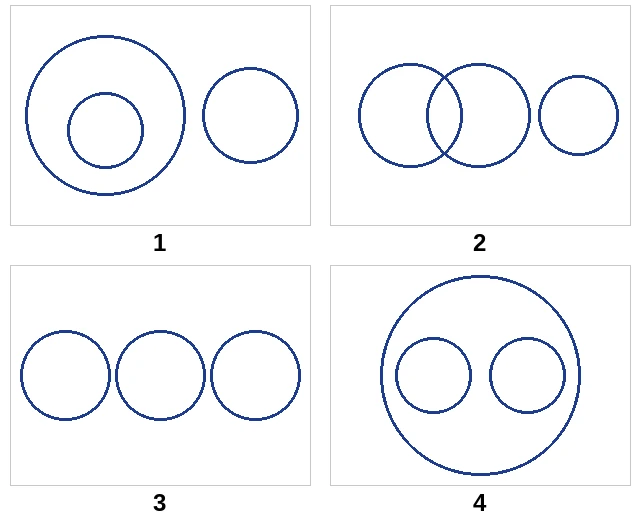
(a) Diagram 1 (b) Diagram 2 (c) Diagram 3 (d) Diagram 4
Answer. A goat is not a tailor, a tailor is not a butterfly, and a butterfly is not a goat. No pair shares even one member, so all three circles stay apart, as in Diagram 3. Time check: a set like this sits at the low end of the 20–30 seconds. So the answer is (c) Diagram 3.
Question 5
Select the Venn diagram that best illustrates the relationship between the following classes.
Painters, Men, Camels
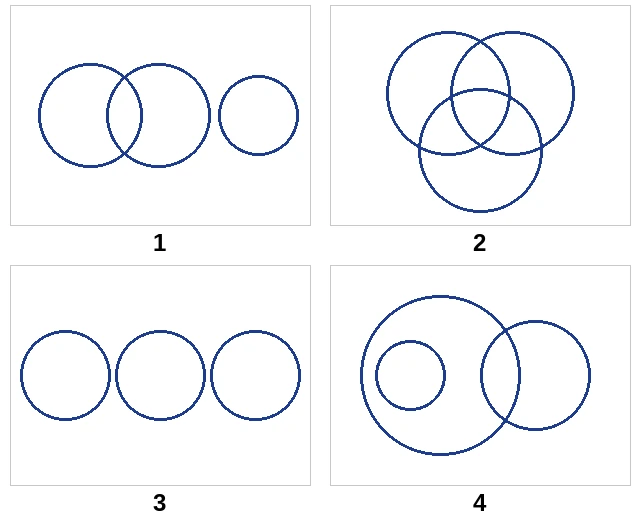
(a) Diagram 1 (b) Diagram 2 (c) Diagram 3 (d) Diagram 4
Answer. Painters and men: some painters are men, some painters are women, and most men do not paint. So these two circles cross. Camels are animals, so no camel is a painter or a man, and the camels circle stays on its own. Two crossing circles and one apart is Diagram 1. So the answer is (a) Diagram 1.
Question 6
Select the Venn diagram that best illustrates the relationship between the following classes.
Fathers, Nurses, Mothers
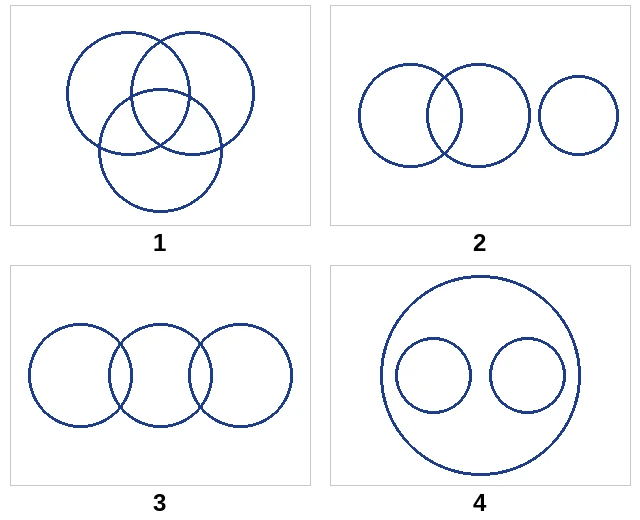
(a) Diagram 1 (b) Diagram 2 (c) Diagram 3 (d) Diagram 4
Answer. Fathers and mothers: nobody is both, so these two stay apart. Nurses and fathers cross, since some fathers work as nurses. Nurses and mothers cross too, since many mothers are nurses. Many nurses are neither fathers nor mothers, so the nurses circle has its own part as well. That is a chain: the middle circle crosses both ends and the ends never meet, as in Diagram 3. Diagram 1 lets all three meet in the centre, which would need someone who is a father and a mother at once. So the answer is (c) Diagram 3.
Question 7
Select the Venn diagram that best illustrates the relationship between the following classes.
Women, Doctors, Cat owners
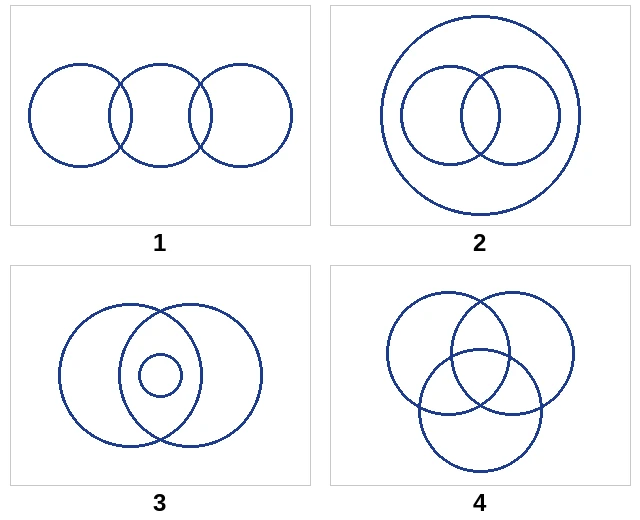
(a) Diagram 1 (b) Diagram 2 (c) Diagram 3 (d) Diagram 4
Answer. Every pair here overlaps. Some women are doctors and some are not. Some women own cats and some do not. Some doctors own cats and some do not. One person can be all three, say a woman doctor who keeps a cat. Each class also has members outside the other two, like a man who owns a cat and is not a doctor. So all three circles cross and meet in the middle, which is Diagram 4. Time check: once you have said the three pairs in your head, this takes about 25 seconds. So the answer is (d) Diagram 4.
Pairs That Are Often Misread
Most mistakes come from three or four kinds of pair. Once you know them, you will stop losing marks on them.
A class that sits inside two crossing classes
Take Women, Parents, Grandmothers. Every grandmother is a woman and every grandmother is a parent. So the grandmothers circle has to be inside the women circle and inside the parents circle at the same time. The only place that is inside both is their shared part.
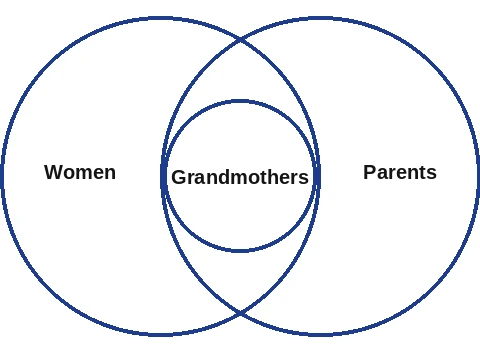
Women and parents cross: mothers are in both, fathers are parents but not women, and many women have no children. So the picture is two crossing circles with the third tucked into the middle.
A class that touches only one of the others
Take Parents, Grandfathers, Women. Grandfathers sit inside parents. Women cross parents, because mothers are parents and many women are not. But no grandfather is a woman. So the women circle must cross the parents circle while staying clear of the grandfathers circle. Many students draw the third circle cutting across both, out of habit. Always check the small inner circle against the third class on its own.
Jobs and family words overlap
Women and doctors, mothers and teachers, fathers and nurses, brothers and pilots: these pairs always cross. A job is open to men and women, and to people with or without children. Do not put nurses inside women or pilots inside men. Plenty of men are nurses and plenty of women fly planes.
Words that reach beyond people
"Females" takes in women and girls, so aunts, mothers and baby girls all sit inside it. "Males" takes in men and boys. A baby has no job, so baby girls and doctors never meet.
In plain English these words reach animals too: a hen is a female bird, and people speak of a mother cat or two brother puppies. So a set that puts "Females", "Mothers" or "Brothers" next to an animal class could be drawn two ways, and the sets in this course avoid it. Here such words always stand beside people classes, and they mean people.
People and animals
A set that puts a person class next to an animal class (tailors and goats, lawyers and pets) wants those circles apart. A pet is never a person, so a pets circle never touches a lawyers circle.
[SSC Tip] Say each pair as a short sentence that starts with "every", "some" or "no". Every sentence that starts with "every" puts one circle inside another, and those inside pairs fix most of the drawing before you check the crossing ones.
Question 8
Select the Venn diagram that best illustrates the relationship between the following classes.
Grandfathers, Men, Parents
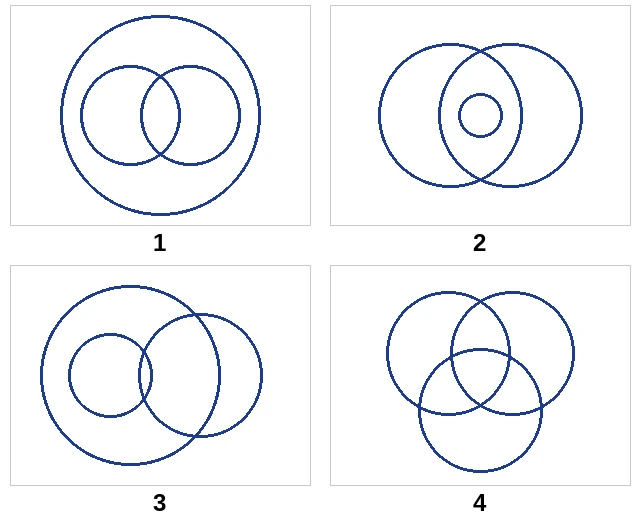
(a) Diagram 1 (b) Diagram 2 (c) Diagram 3 (d) Diagram 4
Answer. Start with the pairs that use "every". Every grandfather is a man, and every grandfather is a parent. So the grandfathers circle has to be inside the men circle and inside the parents circle together. Now men and parents: some men are fathers, some men have no children, and some parents are mothers. So those two circles cross, and grandfathers sit in their shared part. That is Diagram 2. Diagram 1 would need one class to hold both the others, and neither men nor parents holds the other. So the answer is (b) Diagram 2.
Question 9
Select the Venn diagram that best illustrates the relationship between the following classes.
Males, Pilots, Baby boys
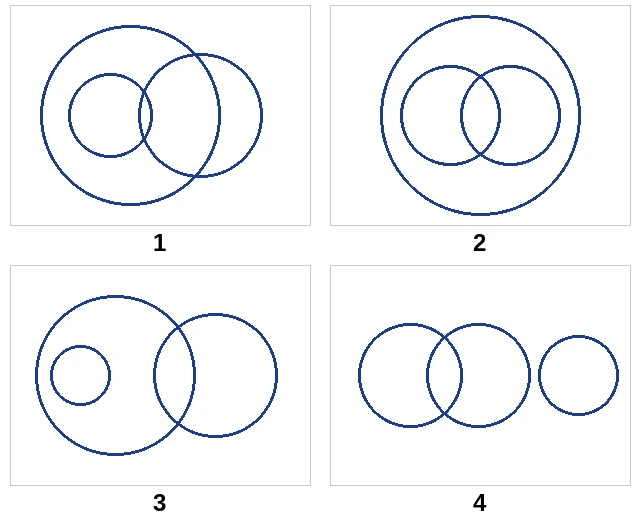
(a) Diagram 1 (b) Diagram 2 (c) Diagram 3 (d) Diagram 4
Answer. Every baby boy is a male, so baby boys go inside males. Some pilots are men and some are women, so pilots and males cross. Now the careful step: a baby boy cannot be a pilot. So the baby boys circle stays inside males but well away from the pilots circle. Diagram 3 shows two crossing circles with a small circle inside one of them, clear of the crossing. Diagram 1 is the trap, because there the small circle also cuts into the third circle. So the answer is (c) Diagram 3.
Question 10
Which of the following Venn diagrams best represents the relationship between the given classes?
Teachers, Females, Aunts
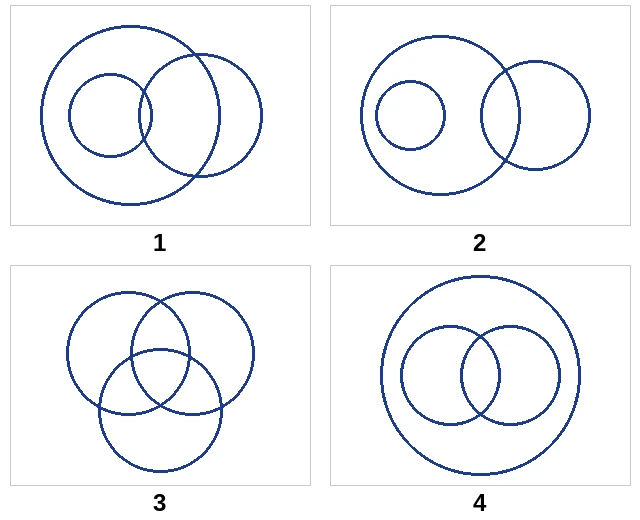
(a) Diagram 1 (b) Diagram 2 (c) Diagram 3 (d) Diagram 4
Answer. Every aunt is a female, so aunts go inside females. Teachers and females cross, as there are women teachers and men teachers. Teachers and aunts cross as well: some aunts teach, some do not, and most teachers are not aunts. So the teachers circle cuts across the aunts circle and also sticks out past the females circle for the men teachers. One circle inside another, with a third crossing both, is Diagram 1. Diagram 2 keeps the third circle away from the small one, and that would mean no aunt is a teacher. So the answer is (a) Diagram 1.
Question 11
Select the Venn diagram that best illustrates the relationship between the following classes.
Cats, Pets, Living beings
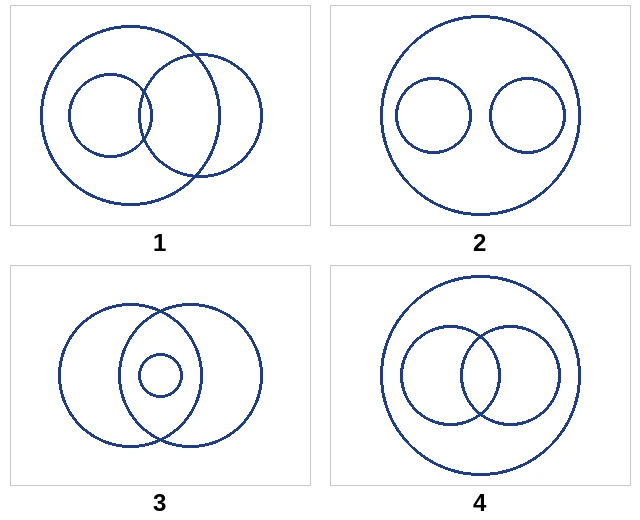
(a) Diagram 1 (b) Diagram 2 (c) Diagram 3 (d) Diagram 4
Answer. Every cat is a living being and every pet is a living being, so both go inside the living beings circle. Cats and pets cross: some cats are pets, street cats are not, and many pets are dogs or parrots. Two crossing circles inside a big one is Diagram 4. In Diagram 1 one circle pokes out of the big one, which would mean some cats or some pets are not living beings. So the answer is (d) Diagram 4.
Question 12
Select the Venn diagram that best illustrates the relationship between the following classes.
Birds, Ostriches, Things that fly
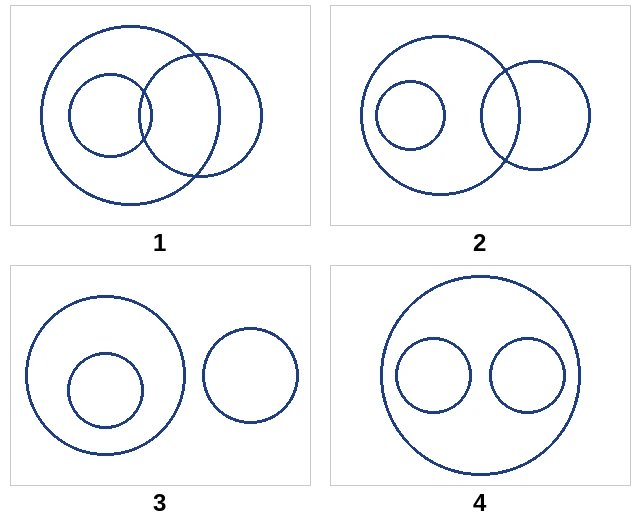
(a) Diagram 1 (b) Diagram 2 (c) Diagram 3 (d) Diagram 4
Answer. Every ostrich is a bird, so ostriches sit inside birds. Birds and things that fly cross: a sparrow is both, a penguin is a bird that cannot fly, and an aeroplane flies but is not a bird. An ostrich cannot fly, so the ostriches circle must stay clear of the things-that-fly circle. Diagram 2 has a small circle inside a big one and a third circle that crosses only the big one. So the answer is (b) Diagram 2.
Question 13
Select the Venn diagram that best illustrates the relationship between the following classes.
Dogs, Pets, Parrots
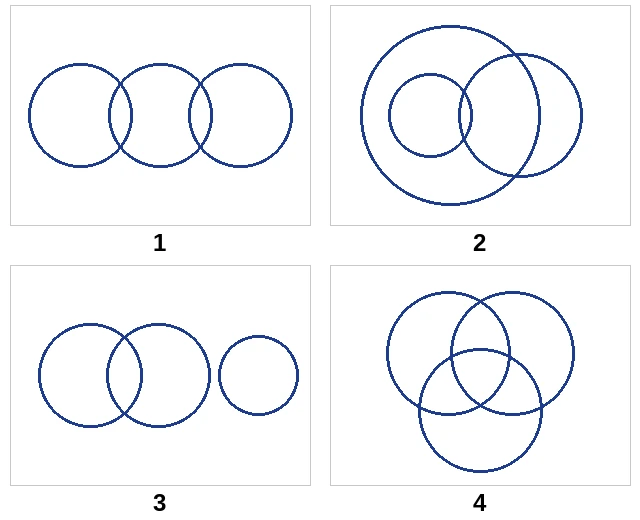
(a) Diagram 1 (b) Diagram 2 (c) Diagram 3 (d) Diagram 4
Answer. Dogs and pets cross: many dogs are pets, street dogs are not, and many pets are not dogs. Parrots and pets cross in the same way, because some parrots live in homes and most live in the wild. A dog is never a parrot, so those two circles stay apart. Pets also has members that are neither, such as cats. So pets sits in the middle of a chain, as in Diagram 1. Time check: about 20 seconds once you spot that dogs and parrots never meet. So the answer is (a) Diagram 1.
The Reverse Question and Habits for Speed
One drawing, four sets of classes
Here the drawing is fixed and the options are sets of three classes. The circles carry no names, so a set fits if its classes can be placed in the circles in some order that works.
- Read the drawing as pairs first. Say it in words: "one circle inside another, the third apart", or "a chain".
- Take each option and decide its pairs with the two-question test.
- Cross out an option the moment one pair disagrees with the drawing. You rarely need to check all three pairs of a wrong option.
For example, suppose the drawing shows one circle inside another and a third circle apart. The set "Sparrows, Birds, Tailors" fits: sparrows inside birds, tailors away from both. The set "Sparrows, Birds, Pets" does not, because pets cross birds (a pet parrot is both). The set "Mothers, Women, Nurses" does not either, because nurses cross women.
A useful first look
Count the circles that sit wholly inside another one. That number cuts the options down quickly.
- No circle inside another: the answer is three separate circles, a chain, two crossing with one apart, or three crossing.
- One circle inside another: look at what the third class does.
- Two circles inside the big one: they are either apart or crossing inside it, or one is inside the other.
Habits for speed
- Find the "every" pairs first. They give you the insides, which fix most of the drawing.
- Look for a class that stands alone, often an animal next to two people classes.
- For a crossing pair, ask whether one member could belong to all three classes. That decides whether the circles meet in the middle.
- Decide the pairs in your head before your eyes go to the options.
- Use plain meaning. If you find yourself thinking of a rare exception, you are reading too much into the words.
Time check
Aim for 20 to 30 seconds on a pick-the-diagram or reverse question. The Reasoning section gives you 15 minutes for 25 questions, about 36 seconds each, so these questions are where you bank time for the longer ones. A right answer earns 2 marks and a wrong one costs 0.5, so if a set of classes looks unclear after a careful read, move on and come back.
Question 14
Select the set of classes, the relationship among which is best illustrated by the following Venn diagram.
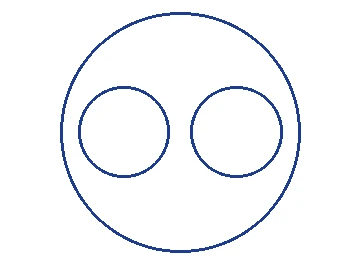
(a) Living beings, Insects, Ants (b) Butterflies, Insects, Birds (c) Insects, Ants, Butterflies (d) Ants, Butterflies, Birds
Answer. Read the drawing first: two circles that do not touch, both inside a big circle. So we need two classes with nothing in common, both inside a third. In option (a), ants sit inside insects and insects inside living beings, which is three circles one inside the next. In option (b), butterflies sit inside insects but birds are outside insects. Option (c) works: every ant is an insect, every butterfly is an insect, and no ant is a butterfly. Option (d) is three separate classes. So the answer is (c) Insects, Ants, Butterflies.
Question 15
Which set of classes is best represented by the Venn diagram given below?
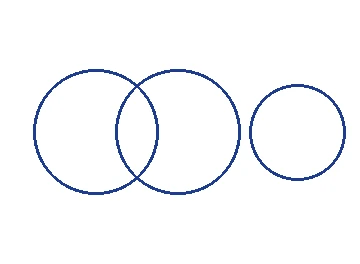
(a) Kittens, Cats, Lawyers (b) Kittens, Pets, Lawyers (c) Puppies, Pets, Cats (d) Kittens, Pets, Living beings
Answer. The drawing shows two crossing circles and a third circle apart. In option (a) every kitten is a cat, so that pair is inside, not crossing. In option (b) some kittens are pets, some are strays, and most pets are not kittens, so kittens and pets cross. Lawyers are people, so they stay apart from both. That fits. Option (c) makes a chain with pets in the middle, and in option (d) kittens and pets both sit inside living beings. So the answer is (b) Kittens, Pets, Lawyers.
Question 16
Select the set of classes, the relationship among which is best illustrated by the following Venn diagram.
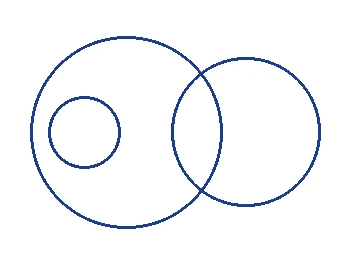
(a) Females, Engineers, Aunts (b) Boys, Baby boys, Girls (c) Hens, Ducks, Engineers (d) Boys, Baby boys, Students
Answer. The drawing shows two crossing circles, and a small circle inside one of them that stays clear of the other. In option (a) aunts sit inside females, but some aunts are engineers, so the small circle would cut into the engineers circle. In option (b) baby boys sit inside boys, but no girl is a boy, so the third circle would stand apart instead of crossing. Option (c) is three separate classes. In option (d) some boys are students and some are not, and many students are girls or grown-ups, so boys and students cross. Every baby boy is a boy, and a baby is too young to be a student, so the baby boys circle sits inside boys and clear of students. That fits. So the answer is (d) Boys, Baby boys, Students.
Question 17
Select the set of classes, the relationship among which is best illustrated by the following Venn diagram.

(a) Living beings, Birds, Crows (b) Birds, Crows, Sparrows (c) Living beings, Birds, Pets (d) Crows, Birds, Fish
Answer. The drawing is three circles, each one inside the next. Option (a) fits: every crow is a bird and every bird is a living being. In option (b) crows and sparrows are both inside birds but apart from each other. In option (c) birds and pets cross. In option (d) fish sit outside birds. Time check: the low end of 20–30 seconds, since only one option has an "every" chain running through all three classes. So the answer is (a) Living beings, Birds, Crows.
Question 18
Select the set of classes, the relationship among which is best illustrated by the following Venn diagram.
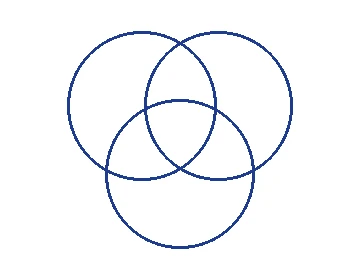
(a) Lawyers, Grandfathers, Grandmothers (b) Lawyers, Men, Grandfathers (c) Lawyers, Grandfathers, Horse riders (d) Horse riders, Teachers, Horses
Answer. The drawing is three circles that all cross and meet in the middle. In option (a) nobody is a grandfather and a grandmother, so two circles must stay apart. In option (b) every grandfather is a man, so one circle sits inside another. Option (c) fits: some grandfathers are lawyers, some lawyers ride horses, some grandfathers ride horses, and one grandfather can be a lawyer who rides. Each class also has members outside the other two. In option (d) horses are animals, so that circle stays apart. So the answer is (c) Lawyers, Grandfathers, Horse riders.