
Reading a Syllogism Question
A syllogism question gives you one, two or three short statements about classes of things: pens, files, desks, or plain letters like A and B. Under the statements come two or more conclusions. You pick the conclusions that must be true whenever the statements are true.
Most questions open with a long instruction like this one: "Assuming the statements to be true, even if they seem to be at variance with commonly known facts, decide which of the conclusions logically follow(s) from the statements." Read it carefully once and you will recognise it every time after that. It carries two rules.
Believe the statements
If a statement says "All pens are rivers", then in this question every pen is a river. Do not argue with it, and do not bring in what you know about real pens. A conclusion that is true in real life but does not come out of the statements does not follow.
"Follows" means "must be true"
A conclusion follows only when the statements leave no other way. "It could be true" is not enough. If you can arrange the classes in a way that fits every statement and still makes the conclusion false, the conclusion does not follow.
Every class has members
SSC reads every class named in a question as having at least one member. If the statements talk about clips, there is at least one clip. This small point decides several answers. For example, it is the reason "All clips are pins" lets you say "Some clips are pins".
The picture method
Draw each class as a circle. Each statement tells you how two circles sit: one inside the other, overlapping, or apart. Draw the smallest picture the statements allow and read each conclusion off it. Then try to redraw the picture so that the conclusion fails while every statement still holds. Most slips happen when students skip this second step, and the whole of this section practises it.
Time check: once the four pictures in the next part are second nature, a one- or two-statement question takes about 25–35 seconds. The Reasoning section has 25 questions on its own 15-minute clock, so a quick and sure syllogism buys time for slower questions.
The Four Statement Forms and Their Pictures
Every statement in these questions takes one of four shapes. For each one, learn the picture, and also learn what the picture leaves open. The questions test the open parts.
All A are B
Every A is a B. Draw the A circle inside the B circle.
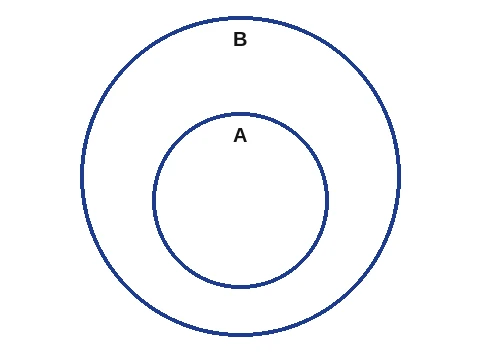
This is the smallest picture, not the only one. B may have members that are not A, or A and B may be the very same class. Both fit "All A are B". So the statement says nothing about B having members outside A.
Some A are B
At least one A is a B. Draw two overlapping circles. The members in the shared part are both A and B.
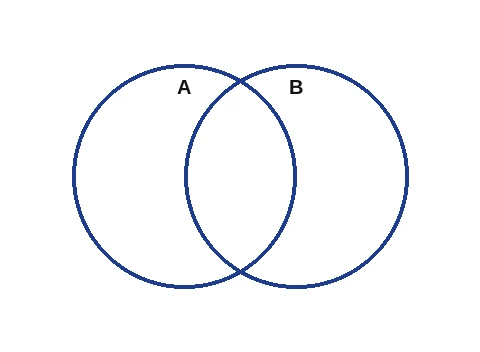
The shared part is the only part the statement promises. The rest of A may be empty, which means all A could be B. The rest of B may be empty too. Read "some" as "at least one, maybe all".
No A is B
Not a single A is a B. Draw the two circles apart.
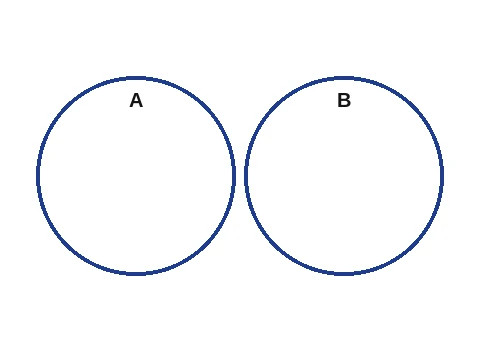
This is the one form with a fixed picture. Whatever else the question says, these two circles never touch.
Some A are not B
At least one A is outside B. Draw A with a part sticking out of B. Nothing more is fixed. A may overlap B, A may be completely apart from B, or B may sit inside A. In all three pictures, some A are outside B.
| Statement | Smallest picture | Left open |
|---|---|---|
| All A are B | A inside B | whether B has members outside A |
| Some A are B | A and B overlap | whether A or B has members outside the shared part |
| No A is B | A and B apart | nothing |
| Some A are not B | a part of A outside B | whether A and B share any members |
Solved Questions
Question 1
One statement is given, followed by two conclusions numbered I and II. Assuming the statement to be true, even if it seems to be at variance with commonly known facts, decide which of the conclusions logically follow(s) from the statement.
Statement:
All markers are pens.
Conclusions:
I. Some pens are markers.
II. All pens are markers.
(a) Only conclusion I follows (b) Only conclusion II follows (c) Both conclusions I and II follow (d) Neither conclusion I nor II follows
Answer. Draw markers inside pens. There is at least one marker, and it is a pen, so some pens are markers. I follows. For II, make the pens circle bigger than the markers circle, with a few pens that are not markers. The statement is still true, but II fails. So the answer is (a) Only conclusion I follows.
Question 2
One statement is given, followed by two conclusions numbered I and II. Assuming the statement to be true, even if it seems to be at variance with commonly known facts, decide which of the conclusions logically follow(s) from the statement.
Statement:
No desk is a shelf.
Conclusions:
I. No shelf is a desk.
II. Some desks are not shelves.
(a) Only conclusion I follows (b) Only conclusion II follows (c) Neither conclusion I nor II follows (d) Both conclusions I and II follow
Answer. Desks and shelves are two circles that never touch. If no desk is a shelf, then no shelf can be a desk either, so I follows. There is at least one desk, and it is not a shelf, so some desks are not shelves. II follows too. So the answer is (d) Both conclusions I and II follow.
Question 3
One statement is given, followed by two conclusions numbered I and II. Assuming the statement to be true, even if it seems to be at variance with commonly known facts, decide which of the conclusions logically follow(s) from the statement.
Statement:
Some folders are not binders.
Conclusions:
I. Some binders are not folders.
II. Some folders are binders.
(a) Only conclusion I follows (b) Both conclusions I and II follow (c) Neither conclusion I nor II follows (d) Only conclusion II follows
Answer. All we know is that part of the folders circle is outside binders. To break I, put the whole binders circle inside folders. Some folders are still outside binders, so the statement holds, but now every binder is a folder. To break II, draw folders and binders apart. The statement still holds, and no folder is a binder. Both conclusions can be broken. So the answer is (c) Neither conclusion I nor II follows.
What One Statement Gives, and What It Does Not
A single statement already gives a few conclusions. Most of them come from turning it round, that is, swapping the two classes. The four forms behave differently when you do that.
All A are B
There is at least one A, and it sits inside B. So "Some A are B" follows, and so does "Some B are A".
"All B are A" does not follow, since the B circle may be bigger. "Some B are not A" does not follow either, since A and B may be the same class. So "All" turns round only into "Some".
No A is B
Two circles that are apart are apart both ways, so "No B is A" follows. Each class has a member, and none of those members is shared, so "Some A are not B" and "Some B are not A" both follow too.
Some A are B
The member in the shared part belongs to both classes, so "Some B are A" follows.
"Some A are not B" does not follow. All of A could be inside B.
Some A are not B
Nothing turns round. "Some B are not A" can fail, because B could sit inside A. "Some A are B" and "Some B are A" can fail, because A and B could be apart. "No A is B" can fail, because they could overlap.
| Statement | Gives | Does not give |
|---|---|---|
| All A are B | Some A are B, Some B are A | All B are A, Some B are not A |
| No A is B | No B is A, Some A are not B, Some B are not A | Some A are B, Some B are A |
| Some A are B | Some B are A | Some A are not B, All A are B, All B are A |
| Some A are not B | nothing new | Some B are not A, Some A are B, No A is B |
This is how SSC reads it
In formal logic a class is sometimes allowed to be empty, and then "All A are B" would not give "Some A are B". SSC questions do not work that way. Every class they name has members, and their answer keys follow that reading. Use it in the exam.
Solved Questions: What One Statement Gives
Question 4
One statement is given, followed by three conclusions numbered I, II and III. Assuming the statement to be true, even if it seems to be at variance with commonly known facts, decide which of the conclusions logically follow(s) from the statement.
Statement:
Some clips are pins.
Conclusions:
I. Some pins are clips.
II. Some clips are not pins.
III. All pins are clips.
(a) Only conclusions I and II follow (b) Only conclusion I follows (c) Only conclusions I and III follow (d) All conclusions follow
Answer. The clips and pins circles overlap, and the shared part has at least one member. That member is a pin and a clip at once, so I follows. II says some clips are outside pins. Put the whole clips circle inside pins and the statement still holds, so II can fail. III can fail the other way round: let pins stick out of clips. Only I is safe. So the answer is (b) Only conclusion I follows.
Question 5
Assuming the given statement to be true, even if it seems to be at variance with commonly known facts, which of the following conclusions logically follows from it?
Statement:
All D are K.
(a) All K are D (b) No K is D (c) Some K are not D (d) Some K are D
Answer. D sits inside K, and D has at least one member, so some K are D. Now test the rest. "All K are D" fails when K is bigger than D. "Some K are not D" fails when D and K are the same circle, which "All D are K" allows. "No K is D" is plainly false. So the answer is (d) Some K are D.
Question 6
Assuming the given statement to be true, even if it seems to be at variance with commonly known facts, which of the following conclusions does NOT logically follow from it?
Statement:
No envelope is a stamp.
(a) No stamp is an envelope (b) Some stamps are envelopes (c) Some envelopes are not stamps (d) Some stamps are not envelopes
Answer. Envelopes and stamps are apart. Apart works both ways, so "No stamp is an envelope" follows. Each class has members and none of them are shared, so some envelopes are not stamps, and some stamps are not envelopes. Those two follow as well. "Some stamps are envelopes" needs a shared member, which the statement rules out completely. So the answer is (b) Some stamps are envelopes.
Question 7
One statement is given, followed by three conclusions numbered I, II and III. Assuming the statement to be true, even if it seems to be at variance with commonly known facts, decide which of the conclusions logically follow(s) from the statement.
Statement:
All G are B.
Conclusions:
I. Some B are G.
II. Some B are not G.
III. Some G are not B.
(a) Only conclusions I and II follow (b) Only conclusion III follows (c) Only conclusion I follows (d) All conclusions follow
Answer. G sits inside B, and G has at least one member, so some B are G. I follows. II is the tempting one. It needs B to have members outside G, but the statement allows G and B to be the very same class, and then II fails. III says some G are outside B, which the statement forbids. So the answer is (c) Only conclusion I follows.
Two Statements: Joining Through the Common Class
With two statements, look first for the class they share. Call it the middle class. The conclusions usually link the other two classes, and that link can only pass through the middle.
For example: Some cards are tags. All tags are labels. The middle class is tags. Draw tags inside labels, then let cards overlap tags. The cards in the shared part are tags, and every tag is a label, so those cards are labels. "Some cards are labels" follows.
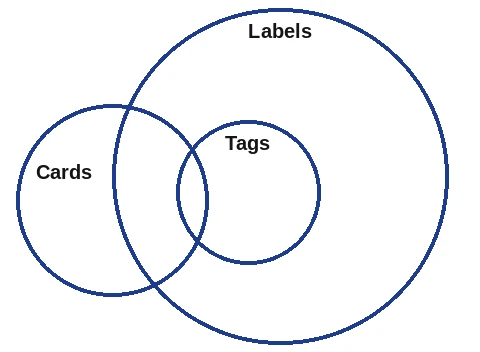
Now look at the cards outside tags. They may sit inside labels or outside, and the statements do not say which. So "All cards are labels" does not follow.
Pairs that give a definite result
In this table A and C are the outer classes and B is the middle class.
| First statement | Second statement | What follows about A and C |
|---|---|---|
| All A are B | All B are C | All A are C |
| All A are B | No B is C | No A is C |
| Some A are B | All B are C | Some A are C |
| Some A are B | No B is C | Some A are not C |
| No A is B | All C are B | No A is C |
| No A is B | All B are C | Some C are not A |
| All B are A | All B are C | Some A are C |
| All B are A | No B is C | Some A are not C |
Look closely at the sixth row. The result runs from C to A. The B part of C has no A in it, so some C are not A. A itself may sit in the rest of C or outside C, so nothing definite is said about A being C or not being C.
The last two rows start from the middle class. If every B is an A and every B is a C, the members of B are both, so some A are C.
When a statement does not match a row, turn it round first where that is safe: "Some B are A" says the same as "Some A are B", and "No C is B" says the same as "No B is C".
Pairs that give nothing definite about A and C
- All A are B and All C are B. Both sit inside B, but they may meet or stay apart.
- Some A are B and Some B are C. The two shared parts can be in different places in B.
- All A are B and Some B are C. C can meet B in the part that has no A.
- No A is B and No B is C. A and C are both outside B, and nothing ties them to each other.
Even then, each statement still gives its own results. From "Some B are C" you still get "Some C are B". So check every conclusion, not only the ones about A and C.
Solved Questions: Two Statements
Question 8
Two statements are given, followed by three conclusions numbered I, II and III. Assuming the statements to be true, even if they seem to be at variance with commonly known facts, decide which of the conclusions logically follow(s) from the statements.
Statements:
All crayons are chalks.
All chalks are dusters.
Conclusions:
I. All crayons are dusters.
II. Some dusters are crayons.
III. All dusters are chalks.
(a) Only conclusion I follows (b) Only conclusions I and II follow (c) Only conclusions II and III follow (d) All conclusions follow
Answer. Crayons sit inside chalks, and chalks sit inside dusters, so the three circles nest one inside another. Crayons are then inside dusters, and I follows. There is at least one crayon, and it is a duster, so II follows. III turns the second statement round. Dusters can be bigger than chalks, so III fails. So the answer is (b) Only conclusions I and II follow.
Time check: a nested All + All pair like this one should sit at the low end of the 25–35 seconds you have for a two-statement question.
Question 9
Two statements are given, followed by three conclusions numbered I, II and III. Assuming the statements to be true, even if they seem to be at variance with commonly known facts, decide which of the conclusions logically follow(s) from the statements.
Statements:
All lockers are cabinets.
No cabinet is a drawer.
Conclusions:
I. No drawer is a locker.
II. Some cabinets are not drawers.
III. Some drawers are cabinets.
(a) Only conclusions I and II follow (b) Only conclusion II follows (c) Only conclusions II and III follow (d) Only conclusion I follows
Answer. Lockers are inside cabinets, and drawers are completely outside cabinets. So drawers cannot reach any locker, and I follows. Every cabinet is outside drawers, and there is at least one cabinet, so II follows. III says some drawers are cabinets, which the second statement forbids. So the answer is (a) Only conclusions I and II follow.
Question 10
Read the given statements and conclusions carefully. Assuming that the information given in the statements is true, even if it appears to be at variance with commonly known facts, decide which of the given conclusions logically follow(s) from the statements.
Statements:
Some files are folders.
All folders are trays.
Conclusions:
I. Some trays are files.
II. Some files are not trays.
(a) Both conclusions I and II follow (b) Only conclusion I follows (c) Only conclusion II follows (d) Neither conclusion I nor II follows
Answer. Folders sit inside trays, and files overlap folders. The files in the shared part are folders, so they are trays as well. That means some trays are files, and I follows. For II, look at the files outside folders. They could be outside trays, but they could just as well be inside. Put the whole files circle inside trays and both statements still hold, so II fails. So the answer is (b) Only conclusion I follows.
Question 11
Read the given statements and conclusions carefully. Assuming that the information given in the statements is true, even if it appears to be at variance with commonly known facts, decide which of the given conclusions logically follow(s) from the statements.
Statements:
Some notebooks are diaries.
No diary is a register.
Conclusions:
I. Some notebooks are not registers.
II. No notebook is a register.
(a) Only conclusion II follows (b) Neither conclusion I nor II follows (c) Both conclusions I and II follow (d) Only conclusion I follows
Answer. The notebooks that are diaries cannot be registers, because no diary is a register. So at least those notebooks are not registers, and I follows. II goes further. The notebooks outside diaries are free, and some of them could be registers. Draw a registers circle that touches notebooks away from diaries, and II fails. So the answer is (d) Only conclusion I follows.
Solved Questions: More Pairs
Question 12
Read the given statements and conclusions carefully. Assuming that the information given in the statements is true, even if it appears to be at variance with commonly known facts, decide which of the given conclusions logically follow(s) from the statements.
Statements:
No E is H.
All H are K.
Conclusions:
I. Some K are not E.
II. No K is E.
(a) Only conclusion I follows (b) Only conclusion II follows (c) Both conclusions I and II follow (d) Neither conclusion I nor II follows
Answer. H sits inside K, and E is apart from H. The H part of K has no E in it, so some K are not E. I follows. Now try to break II. Let E overlap the part of K that is outside H. E still never touches H, so both statements hold, but some K are E. II fails. So the answer is (a) Only conclusion I follows.
Question 13
Two statements are given, followed by three conclusions numbered I, II and III. Assuming the statements to be true, even if they seem to be at variance with commonly known facts, decide which of the conclusions logically follow(s) from the statements.
Statements:
All J are F.
All J are M.
Conclusions:
I. Some F are M.
II. All F are M.
III. Some M are J.
(a) Only conclusion III follows (b) Only conclusions I and II follow (c) Only conclusions I and III follow (d) All conclusions follow
Answer. Here J is the middle class, and it sits inside both F and M. So F and M must overlap at least where J is. J has a member, and that member is both an F and an M, so I follows. III follows the same way, since that member is an M and a J. II fails, because F can spread far outside M. So the answer is (c) Only conclusions I and III follow.
Question 14
Two statements are given, followed by three conclusions numbered I, II and III. Assuming the statements to be true, even if they seem to be at variance with commonly known facts, decide which of the conclusions logically follow(s) from the statements.
Statements:
All tags are labels.
All stickers are labels.
Conclusions:
I. Some tags are stickers.
II. All tags are stickers.
III. Some labels are stickers.
(a) Only conclusions I and III follow (b) Only conclusion I follows (c) All conclusions follow (d) Only conclusion III follows
Answer. Tags and stickers both sit inside labels, and nothing joins them to each other. They may overlap inside labels, or they may sit in two different corners. Put them in different corners and I fails. The same picture breaks II, since there no tag is a sticker. III follows: there is at least one sticker, and it is a label. So the answer is (d) Only conclusion III follows.
Question 15
Read the given statements and conclusions carefully. Assuming that the information given in the statements is true, even if it appears to be at variance with commonly known facts, decide which of the given conclusions logically follow(s) from the statements.
Statements:
Some boards are slates.
Some slates are benches.
Conclusions:
I. Some boards are benches.
II. Some benches are slates.
(a) Only conclusion II follows (b) Only conclusion I follows (c) Both conclusions I and II follow (d) Neither conclusion I nor II follows
Answer. Two "some" statements do not join. Boards meet slates in one place, and benches may meet slates somewhere else. Draw it that way and I fails. II is the second statement turned round, so it follows. So the answer is (a) Only conclusion II follows.
The "Try to Break It" Habit
The table is quick, but the habit that never lets you down is to attack each conclusion. Read it, then look for a picture that keeps every statement true and makes the conclusion false. If you find one, the conclusion does not follow. If every attempt runs into one of the statements, it follows.
For example: All A are B. Some B are C.
Take the conclusion "Some C are A". Draw B with A inside it on the left, and let C meet B only on the right, away from A. Both statements still hold, and no C is an A. The conclusion is broken, so it does not follow.
Now take "Some B are A". To break it you would need a B circle with no A in it. But there is at least one A, and every A is in B. It cannot be broken, so it follows.
Moves for breaking a conclusion
- Slide a class into the empty part of the middle class, away from the other outer class.
- Make two classes the same circle. "All A are B" allows A and B to be identical, which breaks "Some B are not A".
- Let one class swallow another. "Some A are B" allows all of A to sit inside B, which breaks "Some A are not B".
- Move a loose class right outside. If nothing ties a class to another one, put it far away.
Slips to avoid
- Turning "All A are B" into "All B are A".
- Taking "Some A are B" to mean that some A are not B as well.
- Joining two "Some" statements and getting a result out of them.
- Using a fact from real life that the statements never gave.
[SSC Tip] Give every conclusion one honest attempt to break it, even when it sounds plainly right. A conclusion that agrees with real life but not with the statements is exactly the kind of trap these questions set.
Solved Questions: Breaking Conclusions
Question 16
Read the given statements and conclusions carefully. Assuming that the information given in the statements is true, even if it appears to be at variance with commonly known facts, decide which of the given conclusions logically follow(s) from the statements.
Statements:
All rulers are scales.
Some scales are tapes.
Conclusions:
I. Some tapes are rulers.
II. Some scales are rulers.
(a) Only conclusion I follows (b) Both conclusions I and II follow (c) Only conclusion II follows (d) Neither conclusion I nor II follows
Answer. Draw rulers inside scales. Tapes meet scales somewhere, but nothing says where. Try to break I by putting tapes in the part of scales that has no rulers.
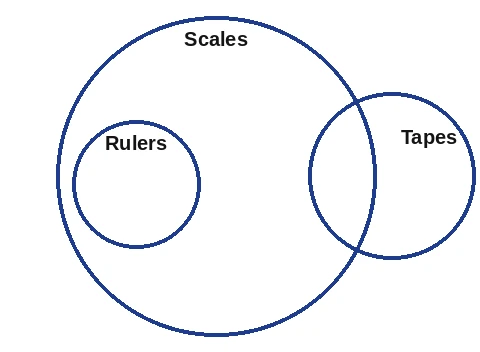
Both statements still hold, and no tape is a ruler, so I is broken. II cannot be broken. There is at least one ruler, and it is a scale. So the answer is (c) Only conclusion II follows.
Question 17
Read the given statements and conclusions carefully. Assuming that the information given in the statements is true, even if it appears to be at variance with commonly known facts, decide which of the given conclusions logically follow(s) from the statements.
Statements:
No lamp is a globe.
No globe is a map.
Conclusions:
I. No lamp is a map.
II. Some maps are not globes.
(a) Only conclusion I follows (b) Both conclusions I and II follow (c) Neither conclusion I nor II follows (d) Only conclusion II follows
Answer. Lamps and maps are both outside globes, but the statements say nothing about lamps and maps together. Draw lamps and maps overlapping, well away from globes, and I fails. II comes from the second statement alone. There is at least one map, and it is not a globe. So the answer is (d) Only conclusion II follows.
Question 18
Two statements are given, followed by three conclusions numbered I, II and III. Assuming the statements to be true, even if they seem to be at variance with commonly known facts, decide which of the conclusions logically follow(s) from the statements.
Statements:
Some C are not F.
All F are L.
Conclusions:
I. Some L are not C.
II. Some C are L.
III. Some L are F.
(a) Only conclusions II and III follow (b) Only conclusion III follows (c) Only conclusion II follows (d) Only conclusions I and III follow
Answer. Start with what is sure. F sits inside L, and F has a member, so some L are F. III follows. The first statement only says part of C is outside F. To break II, put C right outside L. Part of C is still outside F, so both statements hold, and no C is an L. To break I, draw L inside C. C can still have members outside F, so both statements hold, and every L is a C. So the answer is (b) Only conclusion III follows.