
Caste Division — Special to India
We have seen two instances of social divisions expressed in politics — gender (largely positive) and religion (largely negative). Our final case, caste and politics, has both positive and negative aspects.
Unlike gender and religion, caste division is special to India. All societies have some social inequality and some division of labour, and in most societies occupations pass from one generation to another. The caste system is an extreme form of this. What makes it different is that here the hereditary occupational division was sanctioned by rituals. Members of the same caste group were supposed to form a social community that practised the same occupation, married within the caste group (endogamy), and did not eat with members of other castes.
The caste system was based on the exclusion of and discrimination against 'outcaste' groups, who were subjected to the inhuman practice of untouchability. That is why reformers and leaders like Jotiba Phule, Gandhiji, B.R. Ambedkar and Periyar Ramaswami Naicker worked to establish a society free of caste inequalities.
Changes in the Caste System
Partly due to the efforts of these reformers and partly due to socio-economic change, castes in modern India have undergone great changes. With economic development, large-scale urbanisation, the growth of literacy and education, occupational mobility and the weakening of the position of landlords in villages, the old notions of caste hierarchy are breaking down.
- Urbanisation is the shift of population from rural to urban areas.
- Occupational mobility is the shift from one occupation to another, usually when a new generation takes up work different from that of its ancestors.
- Caste hierarchy is a ladder-like formation in which all caste groups are placed from the 'highest' to the 'lowest'.
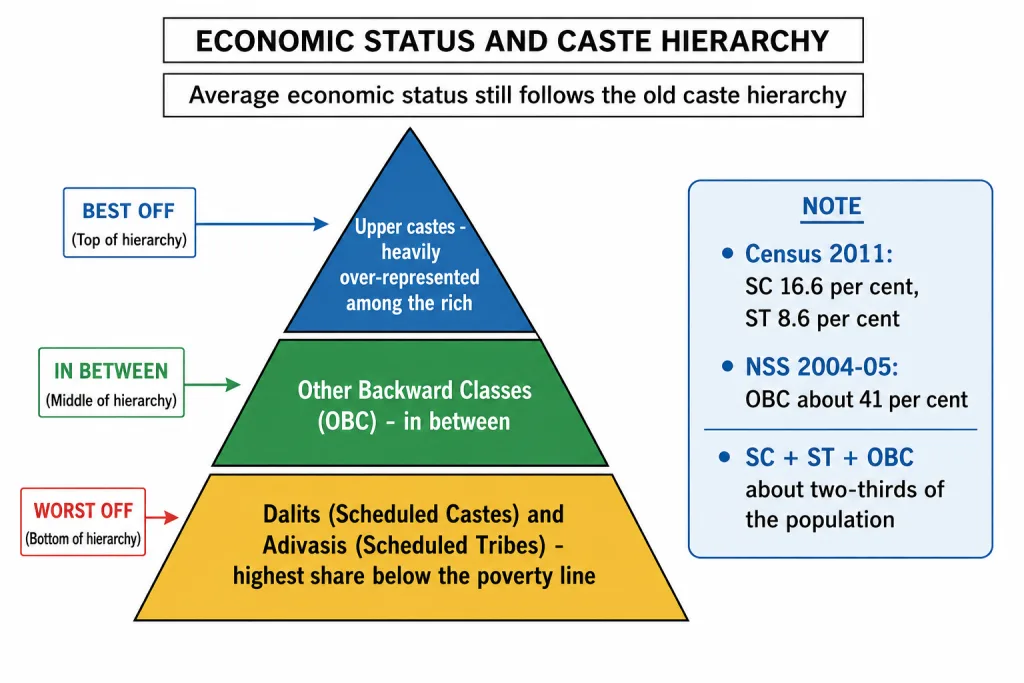
The Constitution of India prohibited caste-based discrimination and laid the foundations of policies to reverse the injustices of the caste system. In the 2011 Census, the Scheduled Castes (Dalits) were 16.6 per cent and the Scheduled Tribes (Adivasis) were 8.6 per cent of the population. The National Sample Survey of 2004-05 estimated the Other Backward Classes (OBC) at around 41 per cent. Together, the SC, ST and OBC make up about two-thirds of the country's population.
Caste and Economic Status Today
Yet caste has not disappeared from contemporary India. Some older aspects persist: most people still marry within their own caste or tribe, untouchability has not ended completely despite constitutional prohibition, and the effects of centuries of advantage and disadvantage continue to be felt. Groups that had access to education under the old system have done well in acquiring modern education, while those denied it have lagged behind. This is why there is a disproportionately large presence of 'upper castes' among the urban middle classes.
Caste remains closely linked to economic status. As evidence from the National Sample Survey shows:
- The average economic status of caste groups still follows the old hierarchy — the 'upper' castes are best off, the Dalits and Adivasis are worst off, and the backward classes are in between.
- The proportion living in extreme poverty (below the poverty line) is much higher for the lowest castes and much lower for the upper castes.
- The upper castes are heavily over-represented among the rich, while the lower castes are severely under-represented.
Today it is possible to find rich and poor people in every caste, which was rare a few decades ago — but the overall link between caste and economic status remains strong.
Questions and Answers
Q1. What makes the caste system special to India?
Answer: All societies have inequality and a division of labour, but the caste system is an extreme form in which hereditary occupational division was sanctioned by rituals. Members of a caste were expected to follow the same occupation, marry within the group, and not eat with other castes, while 'outcaste' groups faced untouchability. This ritual-based, hereditary division makes caste special to India.
Q2. State how caste inequalities are still continuing in India.
Answer: Caste inequalities continue in several ways:
- Most people still marry within their own caste.
- Untouchability has not ended completely despite constitutional prohibition.
- Upper castes are over-represented among the urban middle classes and the rich, while Dalits and Adivasis remain worst off.
- The proportion of people below the poverty line is much higher among the lowest castes. Thus caste remains strongly linked to economic status.
Q3. Which factors have weakened the old caste hierarchy in modern India?
Answer: Several factors have weakened the old caste hierarchy: economic development, large-scale urbanisation, the growth of literacy and education, occupational mobility, and the weakening of the position of landlords in the villages. Along with the efforts of reformers like Phule, Gandhiji, Ambedkar and Periyar, and the constitutional ban on caste discrimination, these have broken down the old notions of caste hierarchy.