
Religion and Politics
Let us now turn to a very different kind of social division — the division based on religious differences. This division is not as universal as gender, but religious diversity is fairly widespread in the world. Many countries, including India, have followers of different religions. Unlike gender differences, religious differences are often expressed in the field of politics.
Consider three examples:
- Gandhiji used to say that religion can never be separated from politics. By religion he did not mean any particular religion like Hinduism or Islam, but the moral values that inform all religions. He believed politics must be guided by ethics drawn from religion.
- Human rights groups in our country have demanded that the government take special steps to prevent communal riots and protect religious minorities.
- The women's movement has argued that the family laws of all religions discriminate against women, and has demanded that the government make these laws more equitable.
All these instances involve a relationship between religion and politics, but they do not seem wrong or dangerous. Ideas, ideals and values drawn from religion can — perhaps should — play a role in politics. People should be able to express their needs and demands as members of a religious community, and those in power should sometimes regulate religious practice to prevent discrimination. These acts are not wrong as long as they treat every religion equally.
When Religion Becomes a Problem — Communal Politics
The problem begins when religion is seen as the basis of the nation. The example of Northern Ireland shows the dangers of such an approach to nationalism.
The problem becomes more acute when religion is expressed in politics in exclusive and partisan terms — when one religion and its followers are pitted against another. This happens:
- when the beliefs of one religion are presented as superior to those of other religions,
- when the demands of one religious group are formed in opposition to another, and
- when state power is used to establish the domination of one religious group over the rest.
This manner of using religion in politics is called communal politics.
The Forms of Communalism
Communalism is based on the idea that religion is the principal basis of social community. It involves the belief that the followers of a particular religion must belong to one community with the same fundamental interests, and that people of different religions cannot belong to the same social community. This belief is fundamentally flawed, because people of one religion do not have the same interests in every context — there are many voices inside every community, and all of them have a right to be heard.
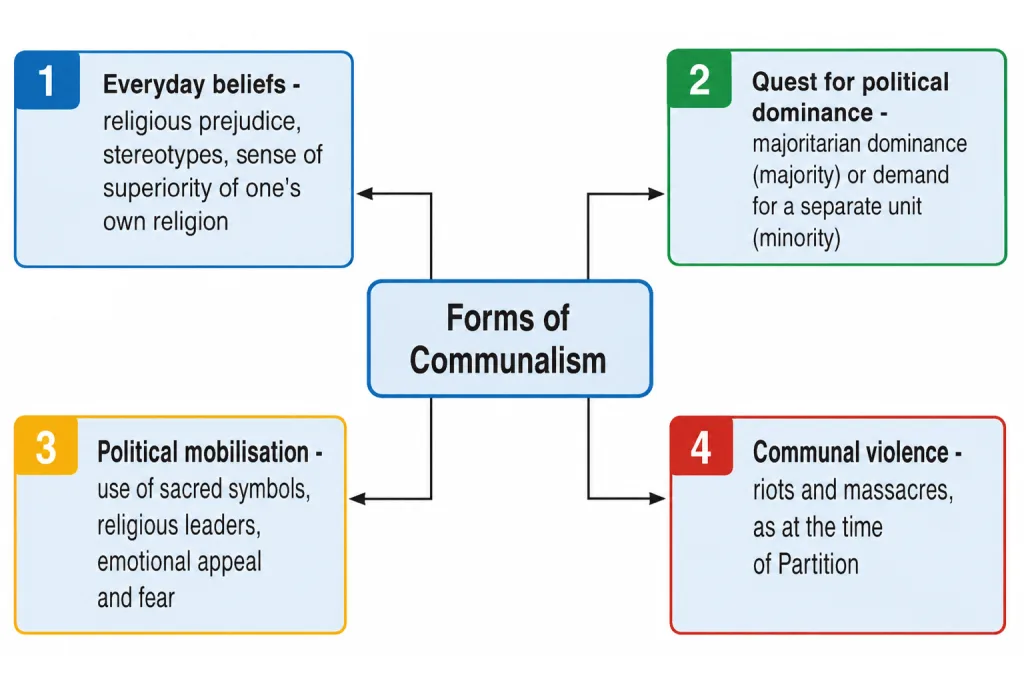
Communalism can take various forms in politics:
- The most common expression is in everyday beliefs — religious prejudices, stereotypes of religious communities, and belief in the superiority of one's own religion. This is so common that we often fail to notice it.
- A communal mind seeks political dominance of its own religious community — majoritarian dominance for a majority community, and a desire to form a separate political unit for a minority community.
- Political mobilisation on religious lines uses sacred symbols, religious leaders, emotional appeal and even plain fear to bring followers of one religion together in the political arena.
- In its most ugly form, communalism takes the form of communal violence, riots and massacre. India and Pakistan suffered some of the worst communal riots at the time of Partition.
Questions and Answers
Q1. What is communalism?
Answer: Communalism is a way of using religion in politics based on the idea that religion is the principal basis of social community. It assumes that followers of one religion form a single community with the same interests, that people of different religions cannot belong to the same community, and, in its extreme form, that they cannot live as equal citizens in one nation. It leads to prejudice, demands for political dominance, and sometimes violence.
Q2. State different forms of communal politics with one example each.
Answer: Communal politics takes several forms:
- Everyday beliefs — religious prejudices and belief that one's own religion is superior.
- Quest for political dominance — majoritarian dominance by a majority community or a demand for a separate unit by a minority.
- Political mobilisation — using sacred symbols, religious leaders and emotional appeals during elections.
- Communal violence — riots and massacres, such as those during the Partition of India and Pakistan.
Q3. Give three examples where religion and politics are related but the relationship is not wrong or dangerous.
Answer: (i) Gandhiji said politics should be guided by the moral values common to all religions. (ii) Human rights groups demand government action to prevent communal riots and protect minorities. (iii) The women's movement demands reform of family laws that discriminate against women. Such acts are acceptable as long as they treat every religion equally.