
Caste in Politics
Like communalism, casteism is rooted in the belief that caste is the sole basis of social community — that people of the same caste form a natural community with identical interests not shared with other castes. As with communalism, this belief is not borne out by experience: caste is only one aspect of our lives, not the only or the most important one.
Caste can take various forms in politics:
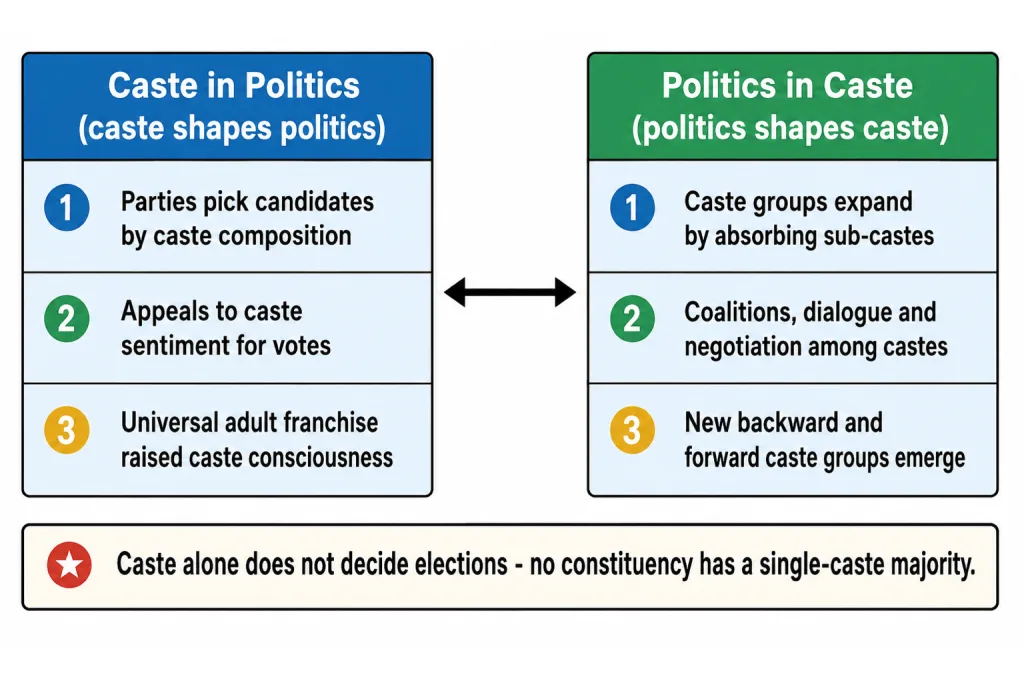
- When parties choose candidates in elections, they keep in mind the caste composition of the electorate and nominate candidates from different castes to gather support. When governments are formed, parties usually ensure that representatives of different castes and tribes find a place.
- Parties and candidates make appeals to caste sentiment to muster support, and some parties are seen as representatives of particular castes.
- Universal adult franchise and the principle of one-person-one-vote compelled leaders to mobilise support, and brought a new consciousness among castes earlier treated as inferior.
Caste Alone Cannot Determine Elections
The focus on caste can give the impression that elections are all about caste and nothing else. That is far from true. Consider the following:
- No parliamentary constituency has a clear majority of one single caste, so every candidate and party must win the confidence of more than one caste and community.
- No party wins the votes of all the voters of one caste. When a caste is called a 'vote bank' of a party, it merely means a large proportion of its voters support that party.
- Many parties may put up candidates from the same caste, so some voters have several candidates from their caste while others have none.
- The ruling party and sitting MP or MLA frequently lose elections — which could not happen if caste preferences were frozen.
Clearly, caste matters, but so do many other factors: strong attachment to political parties (often stronger than caste), differing economic interests within a caste (rich and poor, men and women often vote differently), and people's assessment of the government's performance and the popularity of leaders.
Politics in Caste
So far we have looked at what caste does to politics. But the relationship is not one-way: politics too influences the caste system by bringing caste identities into the political arena. As it is put, it is not politics that gets caste-ridden; it is caste that gets politicised. This takes several forms:
- Each caste group tries to become bigger by including neighbouring castes or sub-castes earlier excluded from it.
- Caste groups must enter into coalitions with other castes or communities, and so into dialogue and negotiation.
- New kinds of caste groups have appeared in the political arena, such as 'backward' and 'forward' caste groups.
Thus caste plays different roles in politics. In some situations, the expression of caste differences gives disadvantaged communities the space to demand their share of power — caste politics has helped Dalits and OBCs gain better access to decision-making. But exclusive attention to caste can produce negative results: as with religion, politics based on caste identity alone is not healthy in a democracy. It can divert attention from pressing issues like poverty, development and corruption, and in some cases lead to tension, conflict and even violence.
Questions and Answers
Q1. State two reasons to say that caste alone cannot determine election results in India.
Answer: (i) No parliamentary constituency has a clear majority of one single caste, so every candidate must win the confidence of more than one caste and community. (ii) No party wins the votes of all voters of a caste, and the ruling party and sitting MPs or MLAs frequently lose elections — which could not happen if caste preferences were fixed. Other factors like party loyalty, economic interest, government performance and leaders' popularity also decide elections.
Q2. What is meant by a caste being a 'vote bank'?
Answer: When people say a caste is a 'vote bank' of a party, it does not mean that everyone of that caste votes for the party. It simply means that a large proportion of the voters from that caste tend to vote for that particular party. No party actually wins the votes of all members of any caste.
Q3. What is meant by 'politics in caste'? Give two examples.
Answer: Politics in caste means that politics influences the caste system — caste gets politicised. Examples: (i) each caste group tries to become bigger by including neighbouring castes and sub-castes; (ii) caste groups form coalitions with other castes and enter into dialogue and negotiation; and new 'backward' and 'forward' caste groups emerge in the political arena.