
Gender and Politics — Is Household Work Political?
The existence of social diversity does not threaten democracy. The political expression of social differences is possible and sometimes even desirable in a democratic system. In this chapter we study three kinds of social differences that can take the form of social divisions and inequalities — those based on gender, religion and caste — and how each gets expressed in politics.
Let us begin with gender division. This is a form of hierarchical social division seen everywhere, but it is rarely recognised in the study of politics. The gender division tends to be understood as natural and unchangeable. However, it is not based on biology but on social expectations and stereotypes.
Students often ask: why are we discussing things like household work in a Political Science textbook? Is this politics? The answer is that politics is about power — and if there is male dominance in the household and in society, then that dominance is very much a political matter.
The Sexual Division of Labour
Boys and girls are brought up to believe that the main responsibility of women is housework and bringing up children. This is reflected in a sexual division of labour in most families.
- Sexual division of labour is a system in which all work inside the home is either done by the women of the family, or organised by them through domestic helpers.
Women do all the work inside the home — cooking, cleaning, washing clothes, tailoring, looking after children — and men do all the work outside the home. It is not that men cannot do housework; they simply think that it is for women to attend to these things. Notice that when these jobs are paid for, men are ready to take them up: most tailors and cooks in hotels are men.
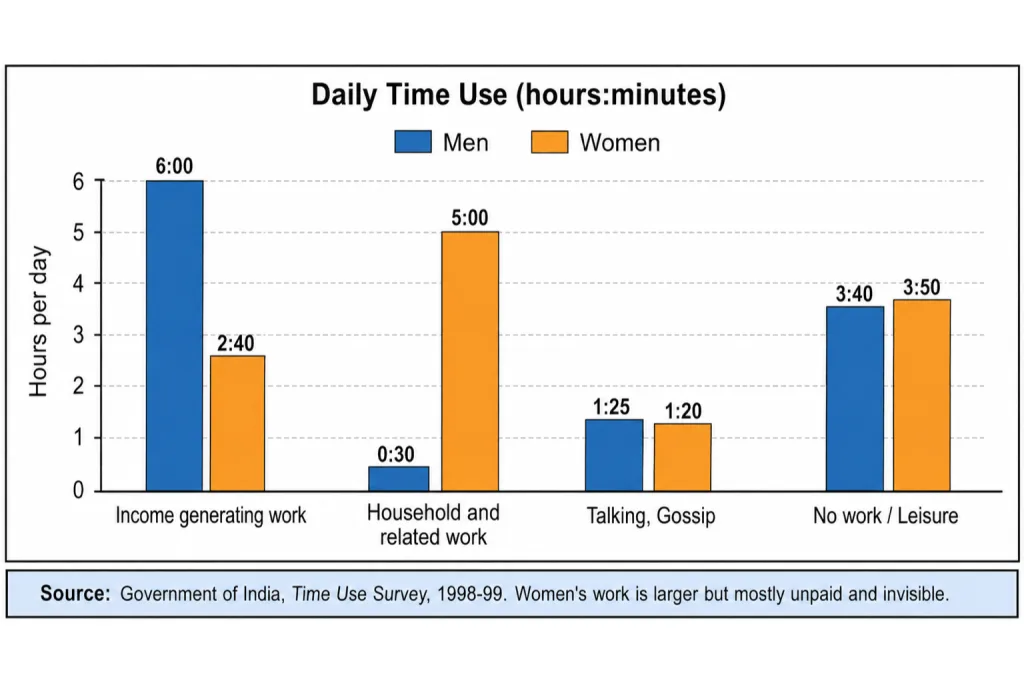
Similarly, it is not that women do not work outside the home. In villages, women fetch water, collect fuel and work in the fields. In urban areas, poor women work as domestic helpers in middle-class homes, while middle-class women work in offices. In fact, the majority of women do some sort of paid work in addition to domestic labour. But their work is not valued and does not get recognition.
A Time Use Survey conducted in six states of India showed that an average woman works a little over seven and a half hours a day, while an average man works about six and a half hours. Yet the work done by men is more visible because most of it generates income, while the bulk of women's work is household-related, unpaid and invisible.
The Public/Private Division and Patriarchy
The result of this division of labour is that although women constitute half of humanity, their role in public life — especially politics — is minimal in most societies. This is often called the public/private division: men are associated with public life and women with the private world of the home.
- Patriarchy literally means 'rule by the father'. The term is used to refer to a system that values men more and gives them power over women. Ours is still a male-dominated, patriarchal society.
Earlier, only men were allowed to participate in public affairs, vote and contest for public offices. Gradually, the gender issue was raised in politics. Women in different parts of the world organised and agitated for equal rights, and there were agitations in many countries for the extension of voting rights to women. This political expression of gender division helped to improve women's role in public life.
Questions and Answers
Q1. What is meant by the sexual division of labour?
Answer: The sexual division of labour is a system in which all work inside the home is either done by the women of the family, or organised by them through domestic helpers. In most families women do the cooking, cleaning, washing and child-rearing, while men do the work outside the home. It is based not on biology but on social expectations and stereotypes.
Q2. Why do we study gender division in Political Science?
Answer: Because politics is about power, and gender division involves a hierarchy of power in which men dominate women both in the household and in public life. Male dominance in the home is therefore political. Studying it helps us see how a form of social division can be expressed in politics and how disadvantaged groups can gain when their unequal treatment becomes a political issue.
Q3. 'The gender division is natural and unchangeable.' Do you agree?
Answer: No. The gender division appears natural, but it is not based on biology; it is based on social expectations and stereotypes about what men and women should do. Because it is socially created, it can be changed — as shown by women taking up work as scientists, doctors, engineers and managers, and by the extension of voting and political rights to women.