
A Male-Dominated, Patriarchal Society
In our country, women still lag much behind men, despite some improvement since Independence. Ours is still a male-dominated, patriarchal society in which women face disadvantage, discrimination and oppression in various ways. All of this is well known, yet issues related to women's well-being are still not given adequate attention.
Education, Wages and Work
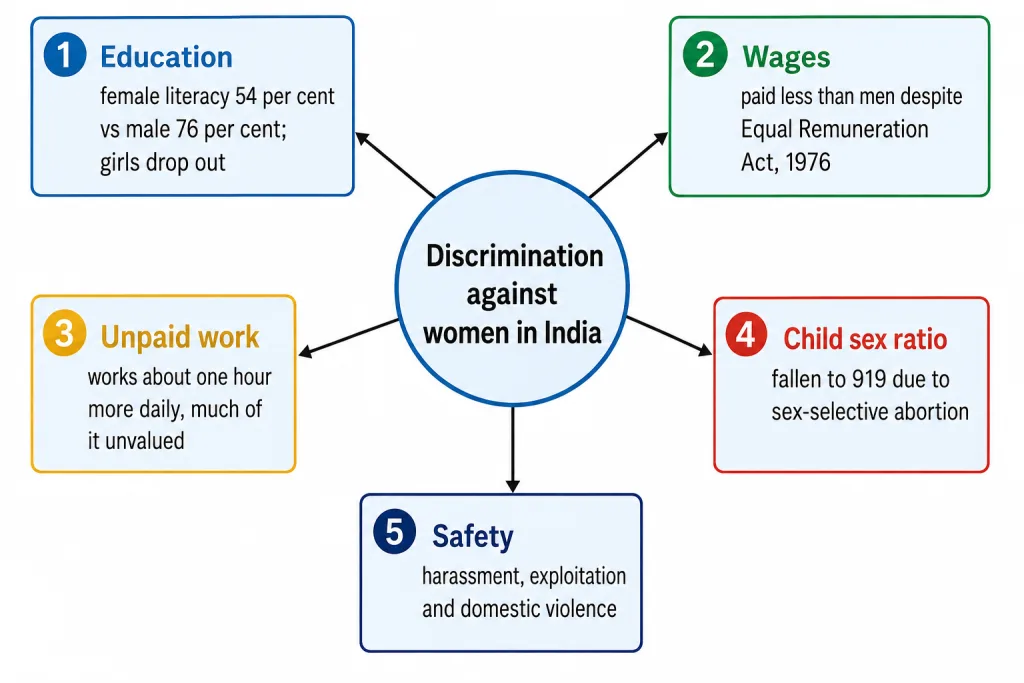
Education. The literacy rate among women is only 54 per cent compared with 76 per cent among men. A smaller proportion of girl students go for higher studies. When we look at school results, girls perform as well as boys, and better in some places — but they drop out because parents often prefer to spend their resources on their sons' education rather than spending equally on sons and daughters.
Wages. The Equal Remuneration Act, 1976 provides that equal wages should be paid for equal work. However, in almost all areas of work — from sports and cinema to factories and fields — women are paid less than men, even when both do exactly the same work.
Unpaid labour. On average, an Indian woman works about one hour more than an average man every day. Yet much of her work is not paid and therefore often not valued. No wonder the proportion of women among the highly paid and valued jobs is still very small.
Sex Ratio and Violence Against Women
Sex-selective abortion. In many parts of India, parents prefer to have sons and find ways to have the girl child aborted before birth. Such sex-selective abortion has led to a decline in the child sex ratio — the number of girl children per thousand boys — to merely 919 for the country. In some states the ratio has fallen below 850 or even 800.
Harassment and violence. There are reports of various kinds of harassment, exploitation and violence against women. Urban areas have become particularly unsafe for women. Women are not even safe within their own homes from beating, harassment and other forms of domestic violence.
All this is well known, yet women's problems do not get adequate attention. This has led many feminists and women's movements to conclude that unless women control power, their problems will not get attention — pointing to the need for more women as elected representatives.
Questions and Answers
Q1. Mention different aspects of life in which women in India are discriminated against or disadvantaged.
Answer: Women in India face disadvantage in many aspects of life:
- Education — female literacy is only 54 per cent against 76 per cent for men, and girls often drop out.
- Wages — women are paid less than men for the same work, despite the Equal Remuneration Act, 1976.
- Work — much of women's labour is unpaid and unvalued.
- Sex ratio — sex-selective abortion has lowered the child sex ratio to 919.
- Safety — women face harassment, exploitation and domestic violence.
Q2. What is the child sex ratio, and what does its decline indicate?
Answer: The child sex ratio is the number of girl children per thousand boys. Its decline to merely 919 (and below 850 or 800 in some states) indicates a strong preference for sons and the widespread practice of sex-selective abortion of the girl child, reflecting the low status of women in a patriarchal society.
Q3. What does the Equal Remuneration Act, 1976 provide, and is it fully followed?
Answer: The Equal Remuneration Act, 1976 provides that equal wages should be paid for equal work. However, it is not fully followed: in almost all areas of work — from sports and cinema to factories and fields — women are paid less than men even when both do exactly the same work.