
The Belief Behind Communalism
Communalism reasons along the following lines: the followers of a particular religion must belong to one community; their fundamental interests are the same; any differences among them are trivial; and people who follow different religions cannot belong to the same social community. If followers of different religions share some commonalities, communalism treats these as superficial, insisting that their interests are bound to differ and clash.
In its extreme form, communalism leads to the belief that people of different religions cannot live as equal citizens within one nation — either one group must dominate the rest, or they must form different nations. This is why communalism is such a serious danger to a diverse democracy like India.
Secularism and the Secular State
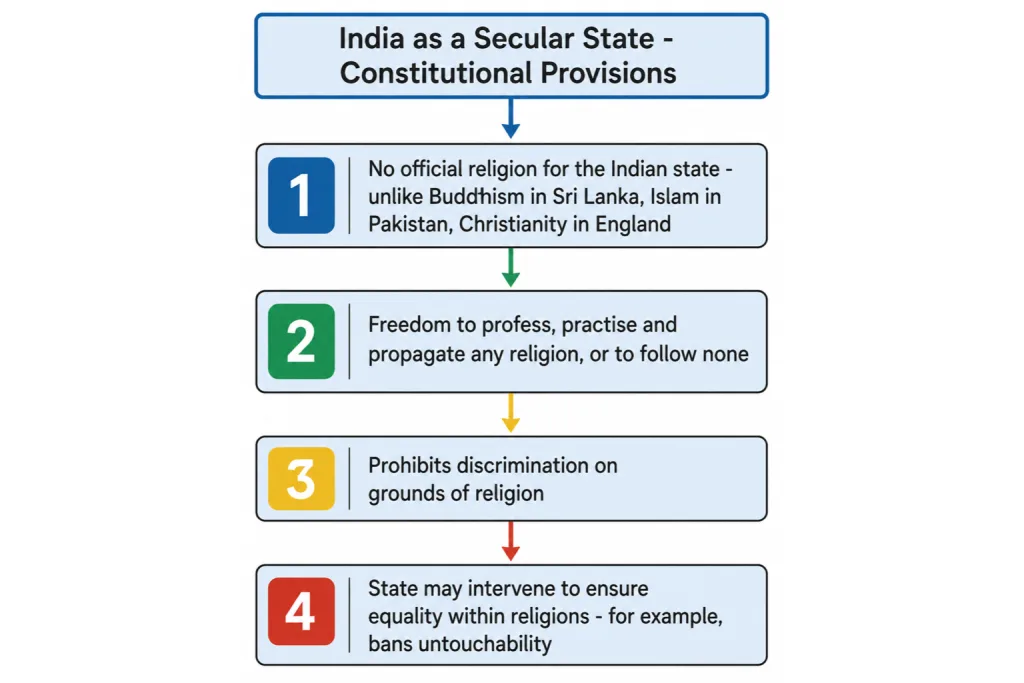
Communalism was, and continues to be, one of the major challenges to democracy in our country. The makers of our Constitution were aware of this challenge, and that is why they chose the model of a secular state. This choice is reflected in several constitutional provisions:
- There is no official religion for the Indian state. Unlike the status of Buddhism in Sri Lanka, of Islam in Pakistan, and of Christianity in England, our Constitution does not give a special status to any religion.
- The Constitution gives all individuals and communities the freedom to profess, practise and propagate any religion, or to follow none.
- The Constitution prohibits discrimination on grounds of religion.
- At the same time, the Constitution allows the state to intervene in matters of religion to ensure equality within religious communities — for example, it bans untouchability.
Combating Communalism
Understood in this way, secularism is not just the ideology of some parties or persons. It is one of the foundations of our country. Communalism should not be seen as a threat only to some people in India — it threatens the very idea of India. That is why communalism needs to be combated.
However, a secular Constitution like ours is necessary but not sufficient to combat communalism. Communal prejudices and propaganda need to be countered in everyday life, and religion-based mobilisation needs to be countered in the arena of politics. In short, the law provides the framework, but citizens and political actors must actively defend secular values.
Questions and Answers
Q1. Mention any two constitutional provisions that make India a secular state.
Answer: Two provisions are: (i) There is no official religion for the Indian state, and the Constitution gives no special status to any religion; (ii) The Constitution gives every individual the freedom to profess, practise and propagate any religion or to follow none, and prohibits discrimination on grounds of religion. It also allows the state to intervene to ensure equality within religions, for example by banning untouchability.
Q2. Why is a secular Constitution described as 'necessary but not sufficient' to fight communalism?
Answer: A secular Constitution is necessary because it provides the legal framework — no official religion, freedom of religion, and a ban on discrimination. But it is not sufficient because communal prejudices and propaganda still exist in everyday life and religion-based mobilisation still occurs in politics. These must be actively countered by citizens and political actors, not just by law.
Q3. Why is communalism described as a threat to the very idea of India?
Answer: In its extreme form, communalism holds that people of different religions cannot live as equal citizens in one nation. India is home to followers of many religions living together as equal citizens. If this belief spreads, it would destroy the shared, plural nation that India is meant to be — so communalism threatens not just some groups but the very idea of India.