
Why More Women Representatives Are Needed
Issues related to women's well-being are not given adequate attention in a male-dominated society. This has led many feminists and women's movements to conclude that unless women control power, their problems will not get adequate attention. One way to ensure this is to have more women as elected representatives.
Women's under-representation is a genuine problem of democracy: if half the population has almost no voice in the law-making bodies, then those bodies cannot fully reflect the needs of all citizens.
The Low Level of Women's Representation in India
In India, the proportion of women in the legislature has been very low.
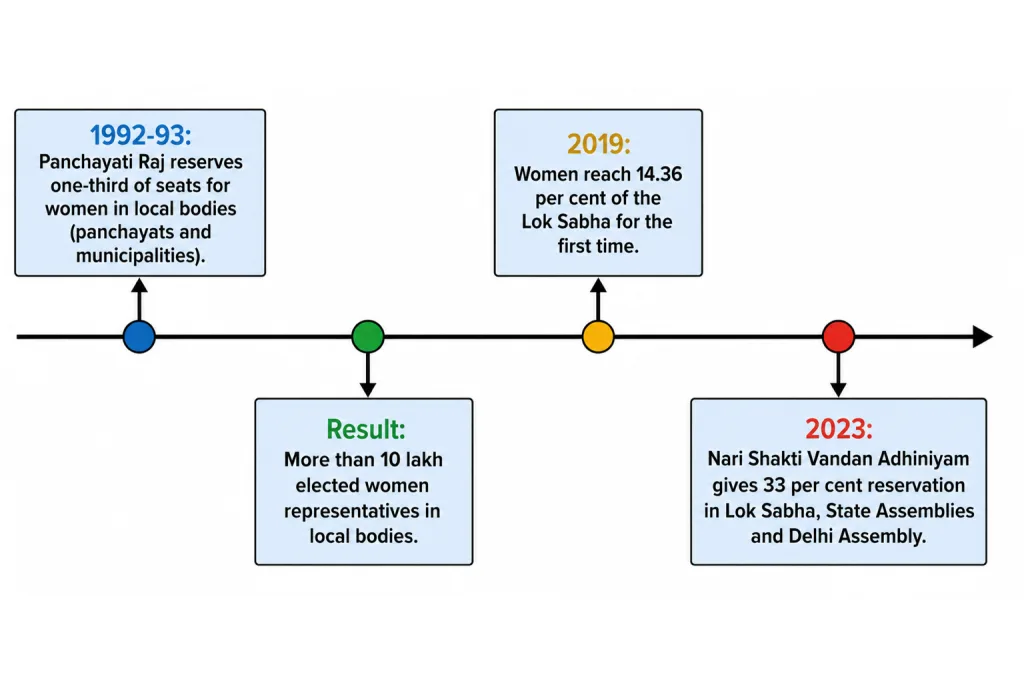
- The percentage of elected women members in the Lok Sabha touched 14.36 per cent of its total strength for the first time in 2019.
- Their share in the state assemblies is less than 5 per cent.
In this respect, India is among the bottom group of nations in the world, behind the averages for several developing countries of Africa and Latin America. In government, cabinets are largely all-male, even when a woman becomes the Chief Minister or the Prime Minister.
Reservation as a Solution
One way to solve this problem is to make it legally binding to have a fair proportion of women in the elected bodies. This is what the Panchayati Raj has done in India.
- One-third of seats in local government bodies — in panchayats and municipalities — are now reserved for women.
- As a result, there are now more than 10 lakh elected women representatives in rural and urban local bodies.
Women's organisations and activists had long demanded a similar reservation of at least one-third of seats in the Lok Sabha and State Assemblies. A bill with this proposal was pending before Parliament for many decades. In 2023, the Nari Shakti Vandan Adhiniyam (Women's Reservation Act, 2023) was passed, which will give 33 per cent reservation of seats for women in the Lok Sabha, State Legislative Assemblies and the Delhi Assembly.
The gender example shows that some social divisions need to be expressed in politics, and that disadvantaged groups benefit when their unequal treatment becomes a political issue.
Questions and Answers
Q1. What is the status of women's representation in India's legislative bodies?
Answer: Women's representation in India is very low. Elected women in the Lok Sabha reached only 14.36 per cent of its strength for the first time in 2019, and their share in the state assemblies is less than 5 per cent. India is among the bottom group of nations, and cabinets remain largely all-male. Only in local bodies — panchayats and municipalities — is one-third of seats reserved for women.
Q2. How has the Panchayati Raj system improved women's representation?
Answer: Under the Panchayati Raj, one-third of the seats in local government bodies (panchayats and municipalities) are reserved for women. Because of this legal reservation, there are now more than 10 lakh elected women representatives in rural and urban local bodies — a major increase in women's presence in politics at the grassroots.
Q3. What is the Nari Shakti Vandan Adhiniyam, 2023?
Answer: The Nari Shakti Vandan Adhiniyam (Women's Reservation Act, 2023) is a law passed in 2023 that will provide 33 per cent reservation of seats for women in the Lok Sabha, the State Legislative Assemblies and the Delhi Assembly. It fulfils a long-pending demand of women's organisations for one-third reservation in the higher legislative bodies.