
What is Biodiversity?
We share this planet with millions of other living beings — from micro-organisms, bacteria and lichens to banyan trees, elephants and blue whales. All of these together give our habitat its immense biodiversity.
Biodiversity (biological diversity) is the enormous variety of living things — wild and cultivated species — that are diverse in form and function but closely integrated in a system through a network of interdependencies.
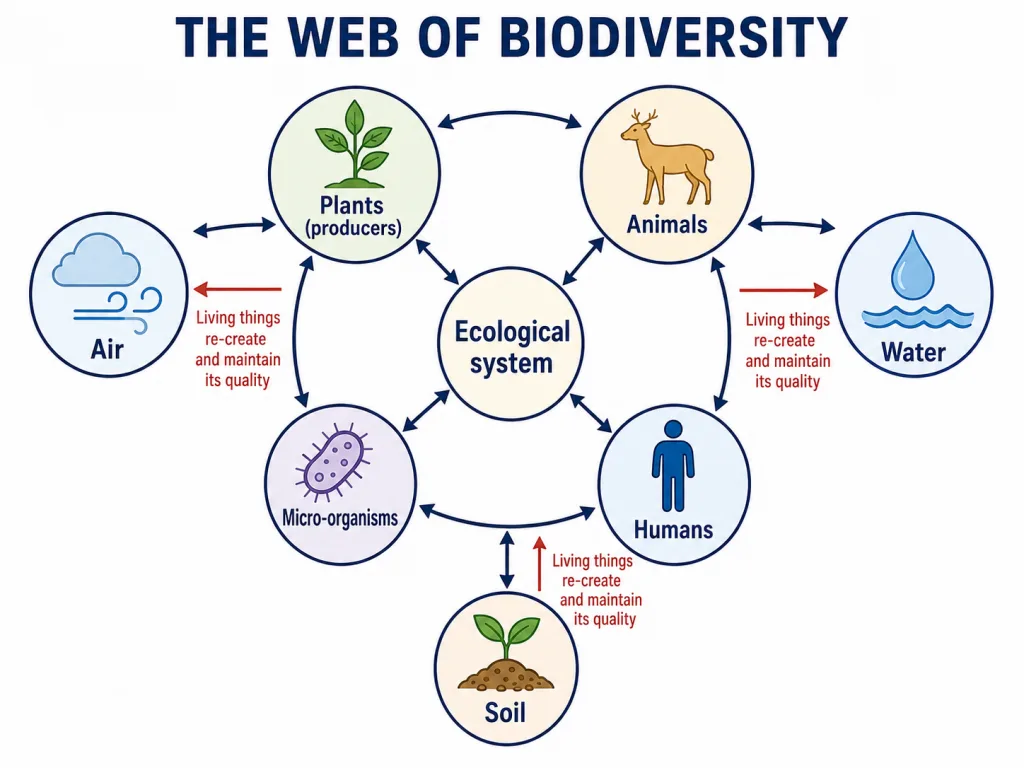
We humans, along with all other living organisms, form a complex web of ecological system in which we are only a part — and we are very much dependent on this system for our survival.
Why Biodiversity Matters
Living things keep the earth fit for life. Plants, animals and micro-organisms re-create the quality of the air we breathe, the water we drink, and the soil that produces our food — without which we could not survive.
Forests play a key role in this ecological system because they are the primary producers on which all other living beings ultimately depend. This is why the health of our forests is tied to the health of every other form of life.
India — One of the World's Richest Countries in Biodiversity
Flora means the plant life of a region and fauna means its animal life. India is one of the world's richest countries in terms of its vast array of biological diversity — and the number of species is possibly twice or thrice what has actually been discovered so far.
These diverse flora and fauna are so well integrated into our daily life that we often take them for granted. But lately they are under great stress, mainly because of human insensitivity to the environment.
Flora and Fauna Under Threat
Though India is rich in wildlife, a large share of it is now in danger. It is estimated that:
- About 10 per cent of India's recorded wild flora and
- About 20 per cent of its mammals are on the threatened list.
Many of these species may already be on the verge of extinction. This is why understanding and conserving biodiversity has become one of the most urgent tasks of our time.
Questions and Answers
Q1. What is biodiversity? Why is it important for human lives?
Answer: Biodiversity is the immense variety of living organisms — plants, animals and micro-organisms, both wild and cultivated — that are diverse in form and function but interdependent within a single ecological system. It is important because living things re-create the quality of the air, water and soil that we depend on. All species, including humans, form a web of life, so the loss of biodiversity threatens our own survival.
Q2. Distinguish between flora and fauna.
Answer: Flora refers to all the plant life of a particular region or period, while fauna refers to all the animal life. For example, sal and teak trees are part of India's flora, while tigers and elephants are part of its fauna.
Q3. Why are forests described as the primary producers of the ecological system?
Answer: Forests are called primary producers because green plants make their own food through photosynthesis and form the base of every food chain. All other living beings — herbivores, carnivores and decomposers — ultimately depend on this plant-produced energy, so forests support the entire ecological system.
Q4. What proportion of India's flora and mammals is on the threatened list?
Answer: About 10 per cent of India's recorded wild flora and about 20 per cent of its mammals are on the threatened list, and some of these may already be on the verge of extinction. This reflects the great stress that human insensitivity has placed on India's rich biodiversity.