
The Impact of Losing Biodiversity
The loss of forests and wildlife is not only an environmental problem — it is also a social and economic one. When biodiversity declines:
- Ecological balance is disturbed — the web of interdependent life begins to break down.
- Biodiversity loss is closely linked to the loss of cultural diversity, because many communities' ways of life, beliefs and knowledge are tied to particular plants, animals and forests.
Who Suffers the Most?
The impact of environmental destruction is not shared equally:
- The poorest and most forest-dependent communities suffer the most, because they rely directly on forests for food, fuel, fodder, medicine and livelihood.
- Women are usually the worst affected. In most rural societies, women are responsible for collecting fuel, fodder, water and other forest produce. As forests shrink, they must work harder and walk longer distances, which affects their health and leaves less time for other work.
Key Point: Those who contribute least to biodiversity loss — the poor and women — often bear its heaviest costs.
Case Study 1 — The Himalayan Yew in Trouble
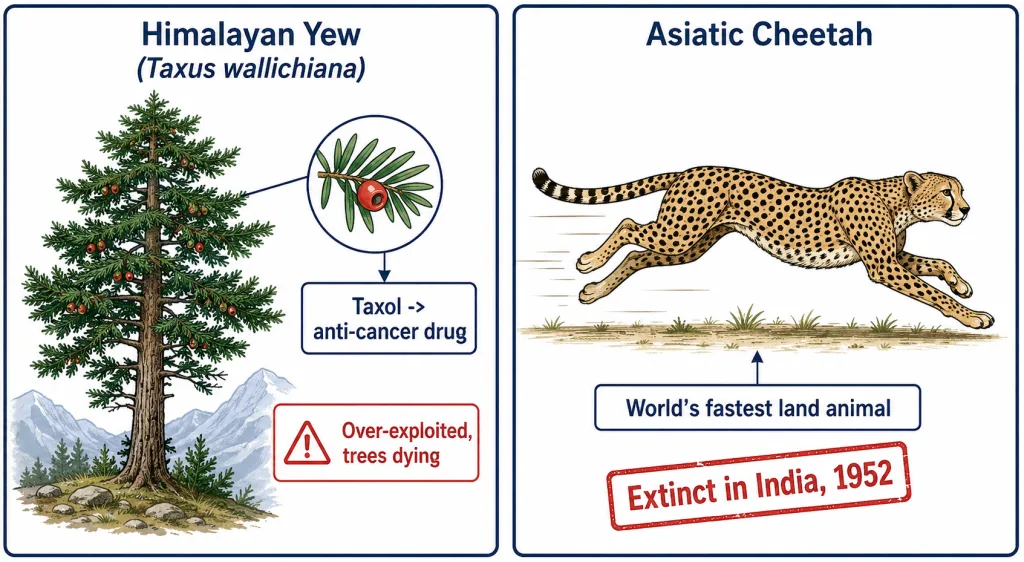
The Himalayan Yew (Taxus wallichiana) is a medicinal plant found in the Himalayas. A chemical compound called Taxol is extracted from its bark, needles, twigs and roots — and it is one of the most successful anti-cancer drugs in the world.
Because of this huge medical demand, the yew has been over-exploited. Thousands of trees have been found dying in Himachal Pradesh and Arunachal Pradesh — a clear example of how commercial pressure can push even a valuable species towards extinction.
Case Study 2 — The Asiatic Cheetah
The Asiatic cheetah (Acinonyx jubatus venaticus) is the world's fastest land animal, able to run at over 100 km per hour in short bursts.
- In India, the cheetah was hunted heavily for sport and for coursing (using it to chase deer), and its habitat was destroyed.
- As a result, the cheetah was declared extinct in India in 1952 — a striking example of how quickly human activity can wipe out a species from an entire country.
Questions and Answers
Q1. How is the loss of biodiversity linked to the loss of cultural diversity?
Answer: Many communities' lifestyles, beliefs, festivals, medicines and traditional knowledge are built around particular plants, animals and forests. When these species and forests are destroyed, the cultural practices and knowledge tied to them are also lost. Thus the loss of biodiversity often goes hand in hand with the loss of cultural diversity.
Q2. Why do the poor and women suffer most from the depletion of forests?
Answer: The poor depend directly on forests for food, fuel, fodder, medicine and livelihood, so forest loss hits them hardest. Women, who are mainly responsible for collecting fuel, fodder and water, have to work harder and travel longer distances as forests shrink. This damages their health and leaves them less time for other work, making them the worst affected.
Q3. Write a note on the Himalayan Yew and why it is threatened.
Answer: The Himalayan Yew (Taxus wallichiana) is a medicinal plant of the Himalayas. A chemical called Taxol, extracted from its bark, needles, twigs and roots, is a highly successful anti-cancer drug. This great medical demand has led to the over-exploitation of the yew, and large numbers of trees have been found dying in Himachal Pradesh and Arunachal Pradesh.
Q4. What happened to the Asiatic cheetah in India?
Answer: The Asiatic cheetah, the world's fastest land animal, was hunted for sport and coursing and lost its habitat in India. As a result of relentless hunting and habitat destruction, it was declared extinct in India in 1952 — an example of a species wiped out from an entire country by human activity.