
Why Do We Need to Conserve?
With the rapid decline in wildlife populations and forests, conservation has become essential. But why conserve at all?
- Conservation preserves the ecological diversity and our life-support systems — water, air and soil.
- It preserves the genetic diversity of plants and animals, which is vital for the better growth and breeding of species.
- Agriculture still depends heavily on traditional crop varieties, and fisheries depend on the maintenance of aquatic biodiversity. Losing this genetic wealth would harm our food security.
The Wildlife (Protection) Act, 1972
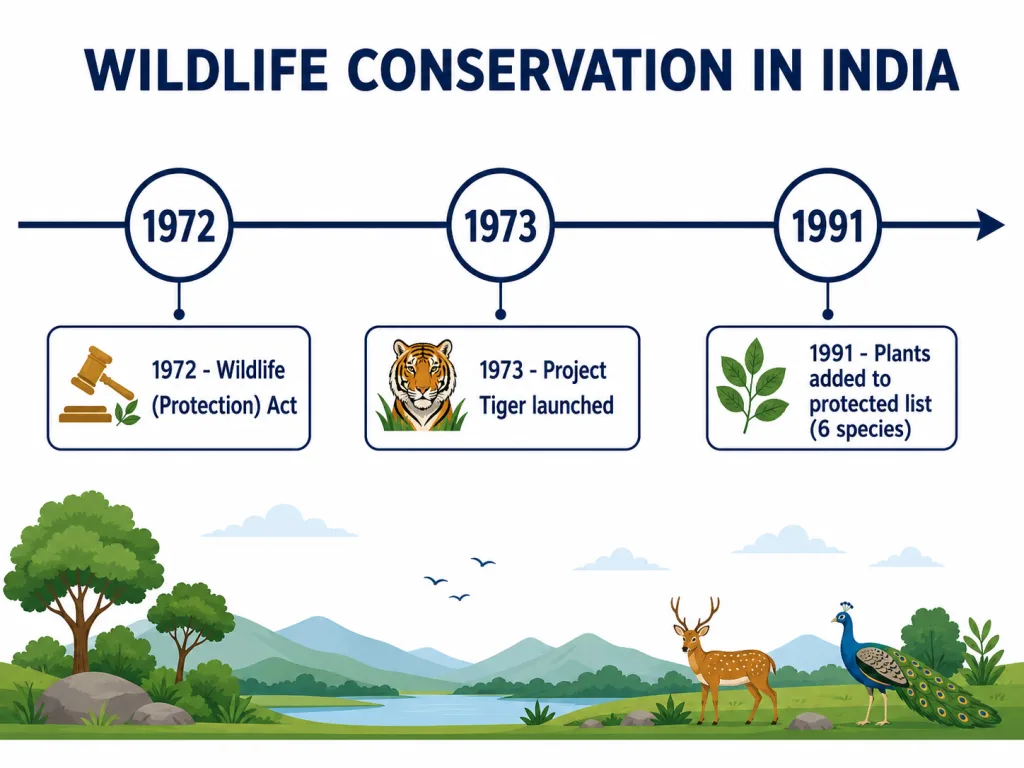
In the 1960s and 1970s, conservationists demanded a national wildlife protection programme. In response, the Indian Wildlife (Protection) Act was implemented in 1972. Its main provisions were:
- Protecting habitats of wild animals.
- Publishing an all-India list of protected species.
- Banning hunting of endangered species and giving legal protection to their habitats.
- Restricting the trade in wildlife.
After the Act, central and state governments set up national parks and wildlife sanctuaries across the country.
Projects to Protect Specific Species
The central government announced several projects to protect gravely threatened animals, including the tiger, the one-horned rhinoceros, the Kashmir stag (hangul), three types of crocodiles (freshwater crocodile, saltwater crocodile and the gharial), and the Asiatic lion.
More recently, the Indian elephant, black buck (chinkara), the great Indian bustard (godawan) and the snow leopard have been given full or partial legal protection against hunting and trade throughout India.
Conservation is now focusing on whole biodiversity rather than a few species — even insects are included. Under the Wildlife Act notifications of 1980 and 1986, several hundred butterflies, moths and beetles (and one dragonfly) were added; in 1991, plants were added for the first time, starting with six species.
Project Tiger, 1973
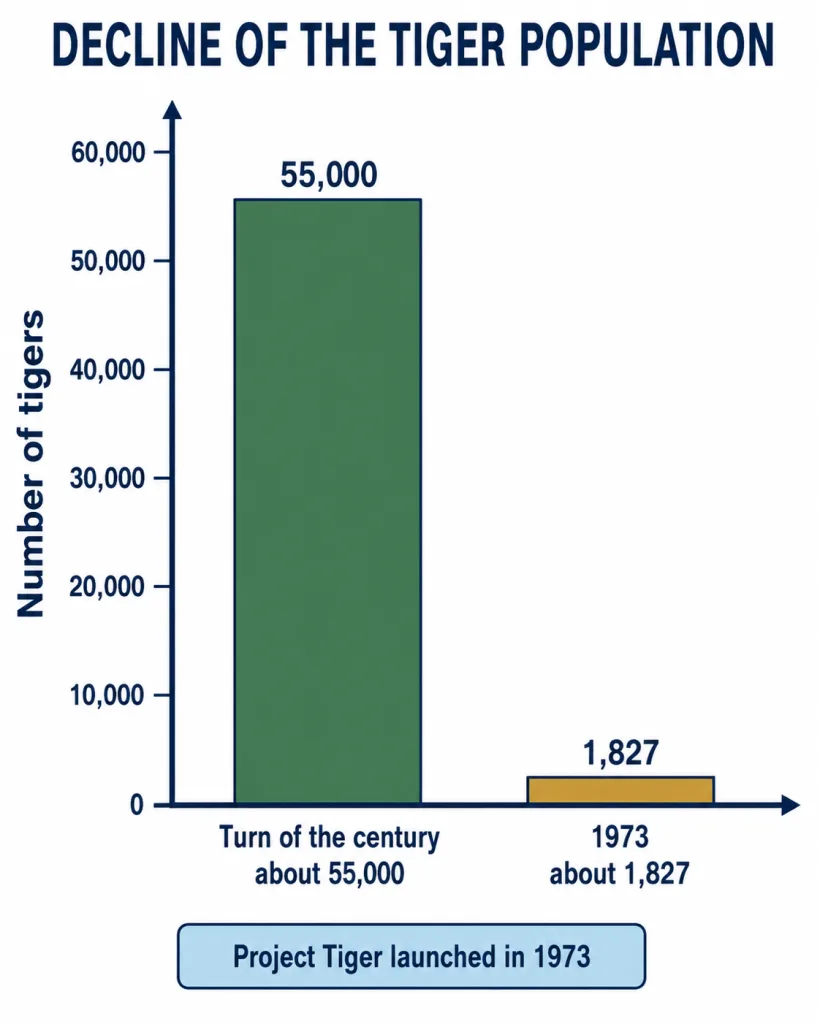
The tiger is a key species in the faunal web. By 1973, the tiger population had crashed to 1,827, from an estimated 55,000 at the turn of the century. The threats included poaching for trade, shrinking habitat, depletion of prey, and a growing human population. The trade in tiger skins and the use of tiger bones in traditional medicines pushed the tiger to the verge of extinction. Since India and Nepal are home to about two-thirds of the world's surviving tigers, they became prime targets for poaching.
"Project Tiger" — one of the world's most well-publicised wildlife campaigns — was launched in 1973. Some important tiger reserves are Corbett (Uttarakhand), Sunderbans (West Bengal), Bandhavgarh (Madhya Pradesh), Sariska (Rajasthan), Manas (Assam) and Periyar (Kerala).
Questions and Answers
Q1. Why do we need to conserve our forests and wildlife?
Answer: Conservation preserves ecological diversity and our life-support systems — water, air and soil. It also protects the genetic diversity of plants and animals, which is essential for the growth and breeding of species. Agriculture still depends on traditional crop varieties and fisheries on aquatic biodiversity, so conserving this genetic wealth safeguards our food and livelihoods.
Q2. State the main provisions of the Indian Wildlife (Protection) Act, 1972.
Answer: The Act (1) provided for protecting the habitats of wild animals; (2) published an all-India list of protected species; (3) banned hunting of endangered species and gave legal protection to their habitats; and (4) restricted the trade in wildlife. It also led to the setting up of national parks and wildlife sanctuaries.
Q3. Why was Project Tiger launched, and in which year?
Answer: Project Tiger was launched in 1973 because the tiger population had fallen drastically — to about 1,827 from an estimated 55,000 at the turn of the century — due to poaching, shrinking habitat, prey depletion and human pressure. It aimed to save the tiger, an endangered species and a key part of the faunal web, from extinction.
Q4. Name any four tiger reserves of India.
Answer: Four important tiger reserves are Corbett National Park (Uttarakhand), Sunderbans National Park (West Bengal), Bandhavgarh National Park (Madhya Pradesh) and Periyar Tiger Reserve (Kerala). Others include Sariska (Rajasthan) and Manas (Assam).