
Communities as Conservers
Conservation strategies are not new in India. Forests are home to many traditional communities, and in several areas local communities are struggling to conserve habitats — sometimes with government officials, sometimes on their own — because they know their long-term livelihood depends on it.
Two striking examples from Rajasthan:
- In the Sariska Tiger Reserve, villagers fought against mining by citing the Wildlife Protection Act.
- In the Alwar district, the inhabitants of five villages declared 1,200 hectares of forest as the Bhairodev Dakav 'Sonchuri', with their own rules banning hunting and outside encroachment.
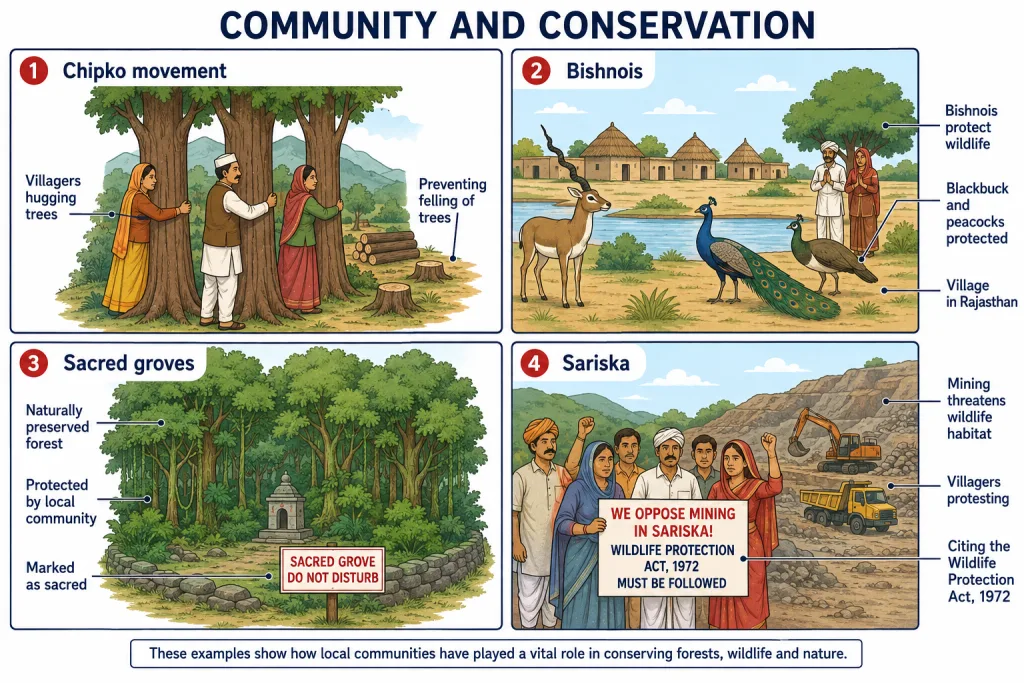
The Chipko Movement and Ecological Farming
The famous Chipko movement in the Himalayas not only successfully resisted deforestation in several areas but also showed that community afforestation with indigenous (local) species can be enormously successful.
Efforts to revive traditional conservation and to develop ecological farming are now widespread. Farmers' and citizens' groups such as the Beej Bachao Andolan in Tehri and Navdanya have shown that good levels of diversified crop production without synthetic chemicals are possible and economically viable.
Sacred Groves — Forests of the Gods
Nature worship is an age-old tribal belief that all creations of nature must be protected. Such beliefs have preserved several virgin forests in their pristine form, called Sacred Groves (the forests of gods and goddesses). Any interference with them is banned.
- The Mundas and Santhals of the Chota Nagpur region worship mahua and kadamba trees.
- The tribals of Odisha and Bihar worship the tamarind and mango trees during weddings.
- Peepal and banyan trees are considered sacred by many.
- Around temples, troops of macaques and langurs are fed and treated as part of the temple community.
The Bishnois and Wildlife Protection
In and around Bishnoi villages in Rajasthan, herds of blackbuck (chinkara), nilgai and peacocks can be seen as an integral part of the community — and nobody harms them.
The Bishnois are famous for their deep commitment to protecting animals and trees, showing how religious and cultural values can become one of the strongest forces for conservation.
Key Point: Across India, communities have protected nature through traditional beliefs, sacred groves and active movements — proving that conservation works best when local people are involved.
Questions and Answers
Q1. Describe how communities have conserved and protected forests and wildlife in India.
Answer: Local communities have protected nature in many ways: villagers of the Sariska Tiger Reserve fought mining using the Wildlife Protection Act; five villages in Alwar declared 1,200 hectares as the Bhairodev Dakav 'Sonchuri' with their own no-hunting rules; the Chipko movement resisted deforestation and promoted afforestation with indigenous species; the Bishnois protect blackbuck, nilgai and peacocks; and sacred groves preserve virgin forests through nature worship.
Q2. What are sacred groves? Give examples of trees and animals protected by communities.
Answer: Sacred groves are patches of virgin forest preserved in their pristine form as the 'forests of gods and goddesses', where any interference is banned. The Mundas and Santhals worship mahua and kadamba trees; the tribals of Odisha and Bihar worship tamarind and mango trees; peepal and banyan are widely held sacred; and macaques and langurs around temples are protected as part of the community.
Q3. Write a note on the Chipko movement.
Answer: The Chipko movement in the Himalayas was a community movement that successfully resisted deforestation in several areas by protecting trees. It also demonstrated that community afforestation with indigenous species can be highly successful, making it a landmark example of people-led conservation.
Q4. How do the Bishnois of Rajasthan contribute to wildlife conservation?
Answer: In and around Bishnoi villages in Rajasthan, animals such as blackbuck (chinkara), nilgai and peacocks are treated as an integral part of the community and are never harmed. Guided by strong religious and cultural values, the Bishnois protect both wildlife and trees, showing how tradition can drive effective conservation.