
The Problem of Vanishing Forests
The rich variety of India's flora and fauna is shrinking. Large areas of forest have been cleared and many species have disappeared or become threatened. Understanding why this depletion happens is the first step towards stopping it.
The destruction of forests and wildlife is not just a biological issue — it is closely tied to how humans use land and resources, and to who benefits from that use.
Colonial Rule and the Expansion of Agriculture
Much of the damage began during the colonial period:
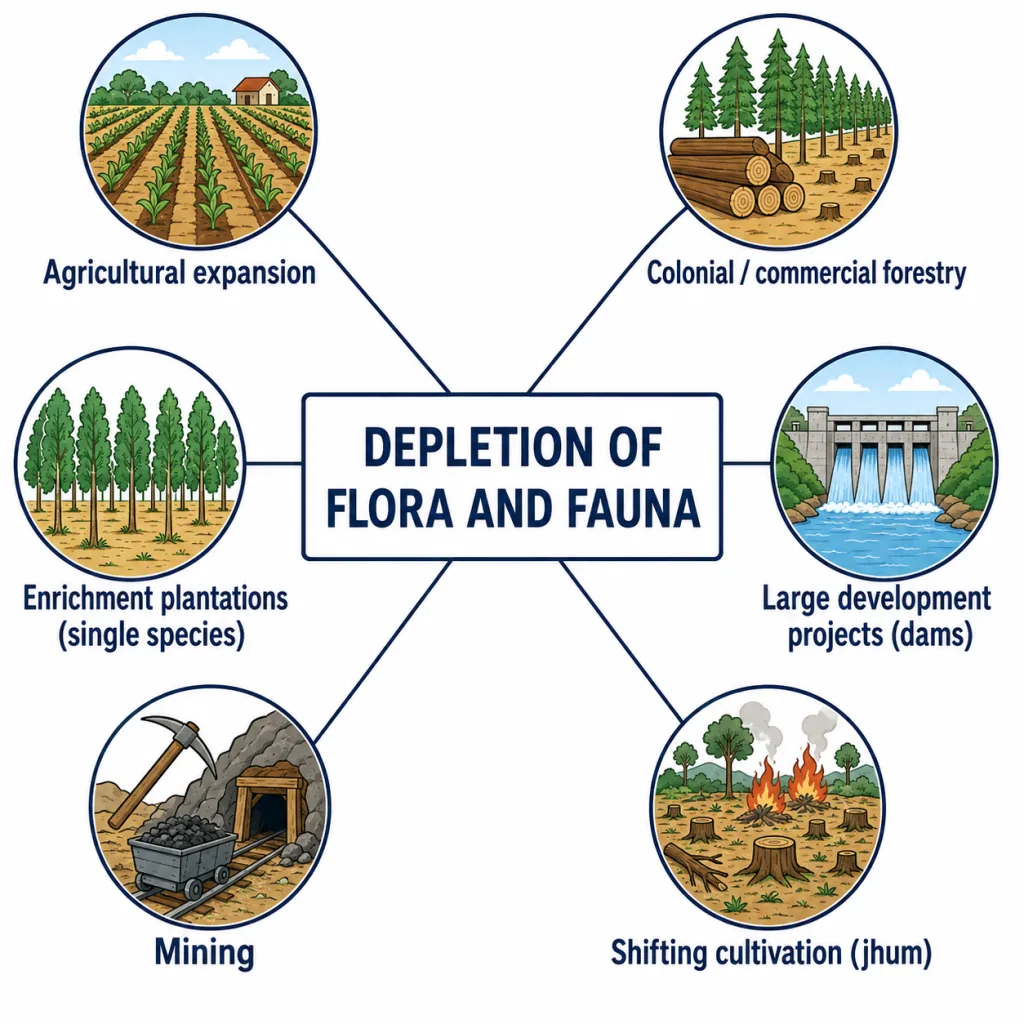
- Railways, agriculture, commercial and scientific forestry and mining all expanded rapidly and cleared huge areas of forest.
- The expansion of the railway network, agriculture and commercial forestry even before independence caused enormous deforestation.
- After independence, agricultural expansion continued to be a major cause — between 1951 and 1980, more than 26,000 sq km of forest was converted into agricultural land.
- Shifting cultivation (jhum) — a traditional practice of clearing and burning forest patches — also contributed in many tribal regions.
Plantations, Development Projects and Mining
- Enrichment plantations — planting a single commercially valuable species (such as teak or eucalyptus) in place of natural forest wiped out other species, reducing diversity.
- Large development and river-valley projects — since 1951, thousands of square kilometres of forest have been cleared for dams and canals. The Narmada Sagar Project in Madhya Pradesh alone would inundate about 40,000 hectares of forest.
- Mining — for example, dolomite mining in West Bengal's Buxa Tiger Reserve has severely threatened the Bengal tiger and blocked the migration routes of animals such as elephants.
Grazing, Fuel-wood and Unequal Access — 'The Greed of a Few'
Grazing and fuel-wood collection are often blamed for forest loss, but these are usually not the main cause — the pressures of commercial demand and development matter far more.
An important point is the unequal access to resources:
- Over-population is often blamed, but the over-consumption by richer groups causes far more ecological damage than the needs of the poor.
- The destruction of forests and wildlife therefore reflects 'the greed of a few and the loss of many' — the powerful benefit while the poor, who depend directly on forests, suffer the most.
Questions and Answers
Q1. How have human activities affected the depletion of flora and fauna? Explain.
Answer: Human activities have depleted flora and fauna through deforestation for agriculture (over 26,000 sq km cleared between 1951 and 1980), colonial expansion of railways, commercial forestry and mining, enrichment plantations of single species that wiped out others, large river-valley and development projects (such as the Narmada Sagar Project inundating about 40,000 hectares of forest), and mining (dolomite mining in the Buxa Tiger Reserve). Grazing, fuel-wood collection and unequal, greedy use of resources add to the loss.
Q2. How did colonial forest policies contribute to the depletion of forests?
Answer: During colonial rule, the rapid expansion of the railway network, agriculture, commercial and scientific forestry, and mining cleared vast areas of forest. Commercial forestry favoured a few valuable species and replaced diverse natural forests with plantations, greatly reducing biodiversity.
Q3. How do large development projects lead to loss of forests? Give an example.
Answer: Large development and river-valley projects such as dams submerge or clear extensive forest land. For example, the Narmada Sagar Project in Madhya Pradesh would inundate about 40,000 hectares of forest. Since 1951, thousands of square kilometres of forest have been cleared for such projects, destroying habitats and displacing wildlife and people.
Q4. Explain the idea of 'the greed of a few, the loss of many' in the context of biodiversity loss.
Answer: This idea points to the unequal access to resources. Although rising population is often blamed for forest loss, the over-consumption by richer and more powerful groups causes far greater ecological damage. The benefits of exploiting forests go to a few, while the losses — displacement, loss of livelihood and a degraded environment — fall on the many poor communities who depend directly on the forests.