
Grouping Species by How Safe They Are
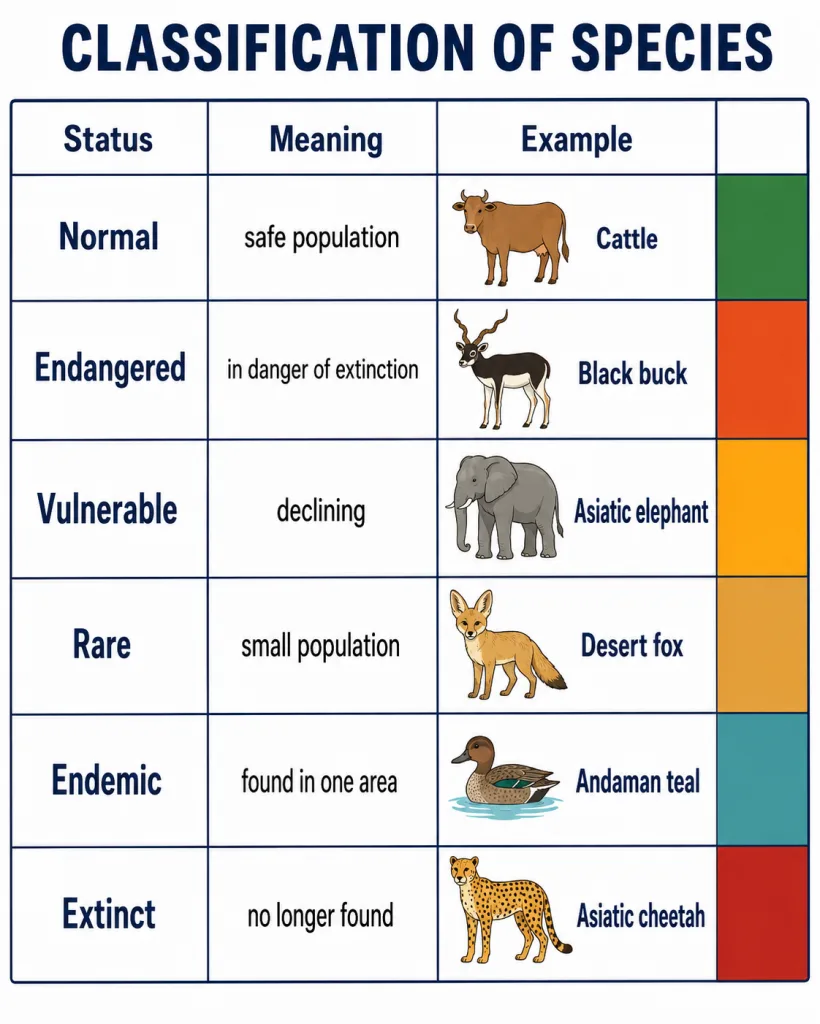
To plan conservation, scientists (led by the International Union for Conservation of Nature, IUCN) classify species according to how threatened they are. The main categories are normal, endangered, vulnerable, rare, endemic and extinct.
Knowing which category a species belongs to helps decide how urgently it must be protected.
Normal, Endangered and Vulnerable Species
- Normal species — species whose population levels are normal for their survival, such as cattle, sal, pine and rodents.
- Endangered species — species that are in danger of extinction. Their survival is difficult if the negative factors continue. Examples: black buck, crocodile, Indian wild ass, Indian rhino, lion-tailed macaque, sangai (Manipur brow-antlered deer).
- Vulnerable species — species whose population has declined to a level from which they are likely to move into the endangered category if the threats continue. Examples: blue sheep, Asiatic elephant, Gangetic dolphin.
Rare, Endemic and Extinct Species
- Rare species — species with small populations, which may move into the endangered or vulnerable category if the negative factors affecting them continue. Examples: Himalayan brown bear, wild Asiatic buffalo, desert fox, hornbill.
- Endemic species — species found only in a particular area, usually isolated by natural or geographical barriers. Examples: Andaman teal, Nicobar pigeon, Andaman wild pig, mithun (in Arunachal Pradesh).
- Extinct species — species that are no longer found at all — they may be extinct from a local area, a region, a country or the whole earth. Examples: Asiatic cheetah, pink-headed duck.
Why This Classification Matters
Key Point: The categories form a kind of warning ladder. A rare or vulnerable species can slip into the endangered category, and an endangered species can become extinct if nothing is done. Conservation aims to move species back up the ladder — from endangered towards normal.
Exam tip: Learn at least one clear example for each category; matching species to categories is a very common Board question.
Questions and Answers
Q1. Name the categories used to classify species according to their conservation status.
Answer: Species are classified as normal, endangered, vulnerable, rare, endemic and extinct, based on how threatened they are and where they are found. This classification (as used by the IUCN) helps decide which species need the most urgent protection.
Q2. Differentiate between endangered species and extinct species with examples.
Answer: Endangered species are in danger of extinction and will disappear if the threats to them continue — for example, the black buck, the Indian rhino and the lion-tailed macaque. Extinct species are those no longer found anywhere (locally, regionally or globally) — for example, the Asiatic cheetah and the pink-headed duck. Endangered species can still be saved; extinct species cannot.
Q3. What are endemic species? Give two examples.
Answer: Endemic species are species found only in a particular area, usually isolated by natural or geographical barriers such as islands or mountains. Examples include the Andaman teal and the Nicobar pigeon (also the Andaman wild pig and the mithun of Arunachal Pradesh).
Q4. What is the difference between vulnerable and rare species?
Answer: Vulnerable species are those whose population has already declined to a level from which they are likely to become endangered if the threats continue (e.g. the Asiatic elephant, blue sheep, Gangetic dolphin). Rare species have small populations and may move into the vulnerable or endangered category if the negative factors continue (e.g. the Himalayan brown bear, desert fox, hornbill).