
Managing India's Forests
Even when we want to conserve forests and wildlife, it is difficult to manage, control and regulate them. In India, much of the forest and wildlife is owned or managed by the government through the Forest Department or other departments. On this basis, forests are classified into three categories: reserved, protected and unclassed.
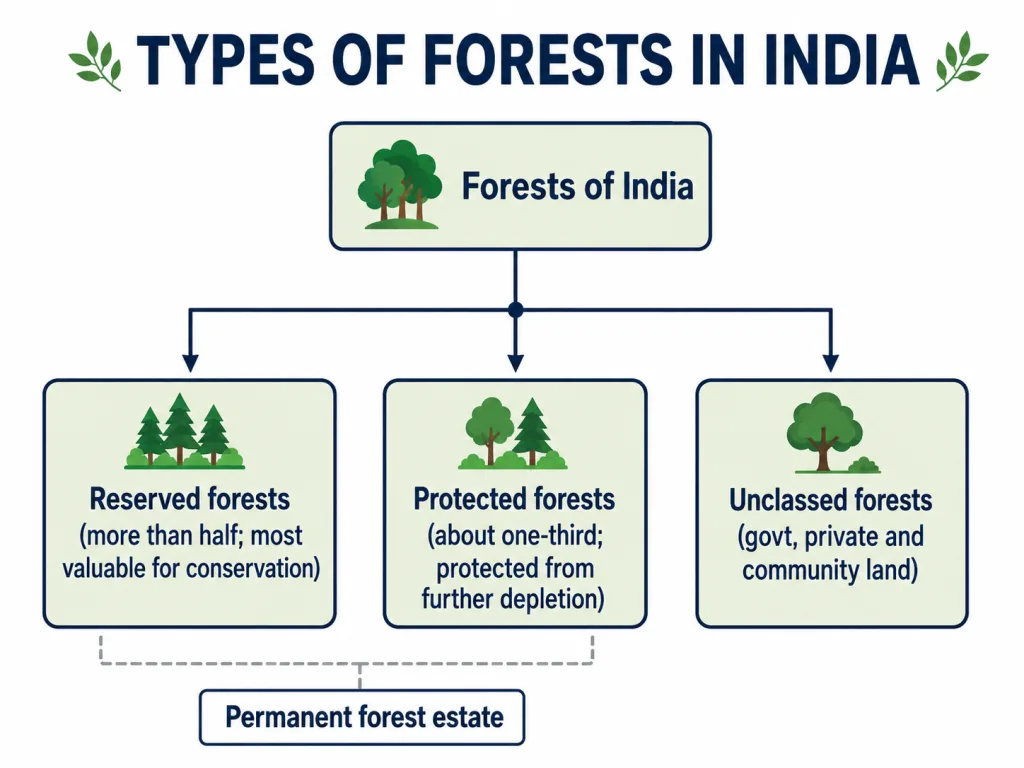
Reserved, Protected and Unclassed Forests
- Reserved Forests — More than half of India's total forest land is reserved forest. These are regarded as the most valuable forests as far as the conservation of forest and wildlife resources is concerned.
- Protected Forests — Almost one-third of the total forest area is protected forest, as declared by the Forest Department. This forest land is protected from any further depletion.
- Unclassed Forests — These are other forests and wastelands belonging to both the government and to private individuals and communities.
Exam tip: Remember the proportions — Reserved = more than half; Protected = almost one-third.
Permanent Forest Estate and Its Distribution
Reserved and protected forests together are called the "permanent forest estate." They are maintained for producing timber and other forest produce, and for protective (ecological) reasons.
- Madhya Pradesh has the largest area under permanent forests, constituting about 75 per cent of its total forest area.
- States with large percentages of reserved forests: Jammu & Kashmir, Andhra Pradesh, Uttarakhand, Kerala, Tamil Nadu, West Bengal and Maharashtra.
- States with a bulk of protected forests: Bihar, Haryana, Punjab, Himachal Pradesh, Odisha and Rajasthan.
- Unclassed forests managed by local communities: all the North-eastern states and parts of Gujarat have a very high percentage of their forests as unclassed forests.
Questions and Answers
Q1. On what basis are the forests of India classified? Name the three types.
Answer: Because most of India's forest and wildlife is owned or managed by the government, forests are classified on the basis of their status of management and ownership into three types: Reserved Forests, Protected Forests and Unclassed Forests.
Q2. Distinguish between reserved forests and protected forests.
Answer: Reserved forests make up more than half of India's forest land and are regarded as the most valuable for conserving forest and wildlife resources. Protected forests make up almost one-third of the forest area and are protected from any further depletion. Both together form the permanent forest estate.
Q3. What are unclassed forests?
Answer: Unclassed forests are all the other forests and wastelands that belong to both the government and to private individuals and communities. All the North-eastern states and parts of Gujarat have a very high percentage of their forests as unclassed forests, often managed by local communities.
Q4. What is meant by the 'permanent forest estate'? Which state has the largest area under it?
Answer: Reserved and protected forests together are called the permanent forest estate, maintained for producing timber and other forest produce and for protective (ecological) reasons. Madhya Pradesh has the largest area under permanent forests, about 75 per cent of its total forest area.