
What is Joint Forest Management?
Joint Forest Management (JFM) is a programme that involves local communities in the management and restoration of degraded forests. Instead of leaving forest protection entirely to the government, JFM makes villagers partners in looking after the forest.
The programme has been in formal existence since 1988, when the state of Odisha passed the first resolution for joint forest management.
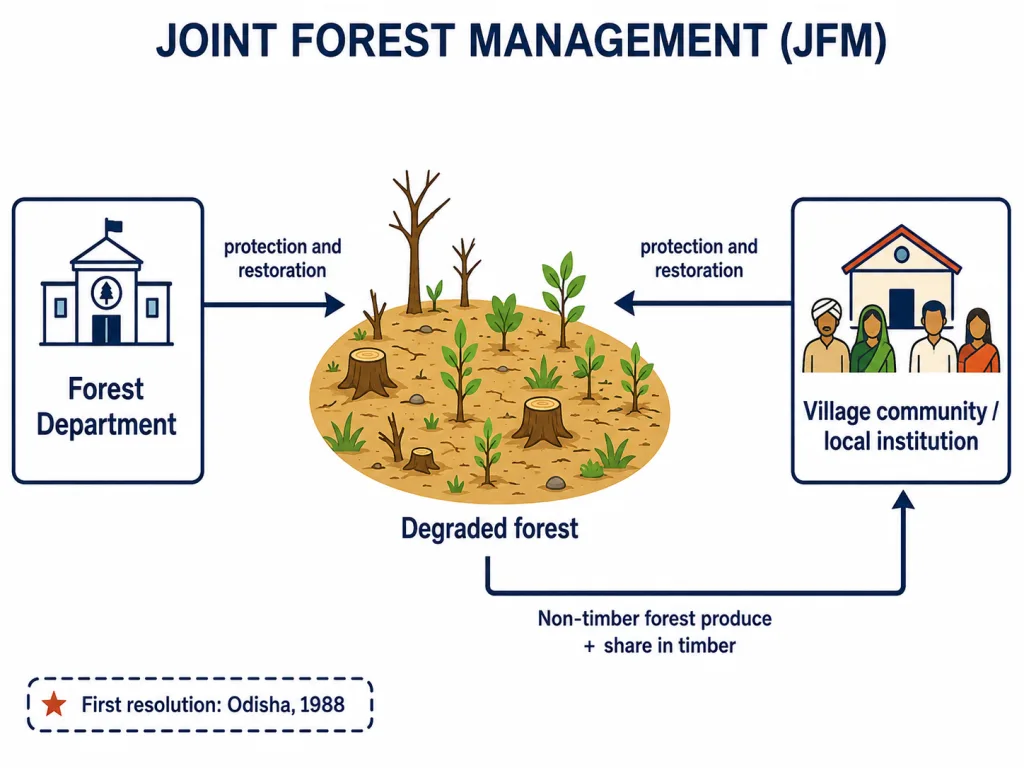
How JFM Works
JFM depends on the formation of local (village) institutions that undertake protection activities, mostly on degraded forest land managed by the Forest Department.
In return for protecting the forest, the members of these communities are entitled to benefits, such as:
- Intermediary benefits like non-timber forest produce (fruits, medicinal plants, fuel, fodder), and
- A share in the timber harvested through 'successful protection'.
This gives the community a direct stake in keeping the forest healthy.
The Broader Lesson
The experience of both environmental destruction and reconstruction in India teaches one clear lesson: local communities everywhere have to be involved in some kind of natural resource management. However, there is still a long way to go before local communities are truly at the centre of decision-making.
Guiding principle: We should accept only those economic or developmental activities that are people-centric, environment-friendly and economically rewarding. This is the path to conserving forests and wildlife while still allowing development.
Questions and Answers
Q1. What is Joint Forest Management (JFM)? When and where did it formally begin?
Answer: Joint Forest Management is a programme that involves local communities in the management and restoration of degraded forests, in partnership with the Forest Department. It has been in formal existence since 1988, when the state of Odisha passed the first resolution for joint forest management.
Q2. How does JFM work, and what do communities gain from it?
Answer: JFM depends on village institutions that carry out protection activities on degraded forest land managed by the Forest Department. In return, community members receive intermediary benefits such as non-timber forest produce and a share in the timber harvested through successful protection. This gives them a direct stake in conserving the forest.
Q3. What is the main lesson that JFM and India's conservation experience teach us?
Answer: The clear lesson is that local communities everywhere must be involved in natural resource management, because conservation succeeds when the people who depend on forests are made partners. We should accept only those developmental activities that are people-centric, environment-friendly and economically rewarding.
Q4. Write a note on good practices towards conserving forest and wildlife.
Answer: Good practices include involving local communities through Joint Forest Management, protecting sacred groves and community reserves, reviving ecological farming (as shown by the Beej Bachao Andolan and Navdanya), resisting destructive activities (as in the Chipko movement and Sariska), and choosing only developmental projects that are people-centric, environment-friendly and economically rewarding.