
Why Minerals Must Be Conserved
The total volume of workable mineral deposits is an insignificant fraction — just about one per cent — of the earth's crust. Yet we depend on them completely.
Minerals are:
- Non-renewable — the geological processes that form them are so slow that the rate of replenishment is far smaller than the rate at which we use them.
- Finite — continued extraction raises costs as deeper, lower-grade ores must be mined.
Therefore, minerals must be used in a planned and sustainable manner.
How to Conserve Minerals
We can conserve minerals in several ways:
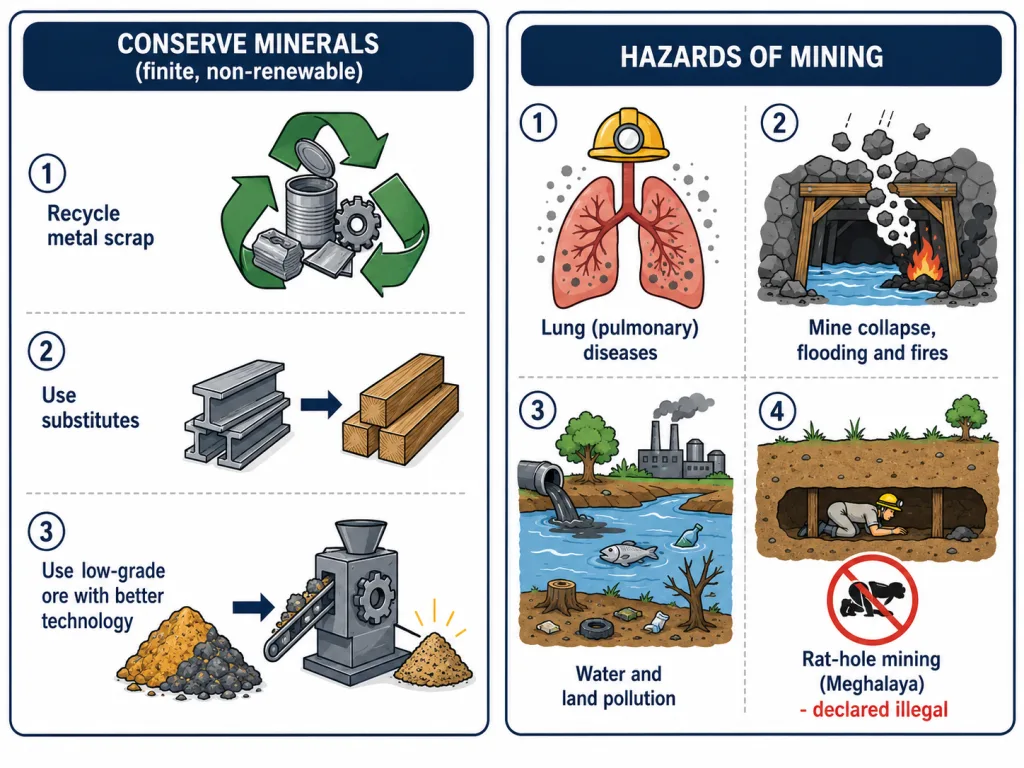
- Improved technologies to allow the use of low-grade ores at low cost.
- Recycling of metals — reusing metal scrap (like used aluminium, iron and copper) reduces the demand for fresh mining.
- Using substitutes for scarce metals wherever possible.
Key Point: Minerals took millions of years to form but can be used up in a few generations — so conservation is a shared responsibility.
The Hazards of Mining
Mining is essential but also dangerous and damaging:
- To health: miners work in conditions that harm the lungs (dust and fumes cause pulmonary diseases), and there is a constant risk of collapsing mine roofs, inundation (flooding) and fires in mines.
- To the environment: mining pollutes water sources, dumps waste and slurry, degrades land, and increases land, water, air and even sound pollution.
Rat-hole mining: In parts of the north-east, minerals are owned by individuals or communities. In Meghalaya, coal is mined at Jowai and Cherrapunji through long, narrow tunnels called 'rat-hole' mining — a hazardous practice that the National Green Tribunal has declared illegal.
Questions and Answers
Q1. Why is it necessary to conserve mineral resources?
Answer: Minerals are finite and non-renewable — they take millions of years to form, but are being consumed rapidly, and their replenishment is extremely slow. As richer ores are used up, deeper, lower-grade ores raise the cost of extraction. Hence minerals must be used in a planned and sustainable way.
Q2. Suggest ways to conserve minerals.
Answer: Minerals can be conserved by (1) using improved technologies to exploit low-grade ores cheaply, (2) recycling metals by reusing metal scrap, and (3) using substitutes for scarce metals wherever possible.
Q3. What are the health hazards of mining?
Answer: Mining harms miners' health — the dust and fumes cause pulmonary (lung) diseases — and exposes them to the risk of collapsing mine roofs, inundation (flooding) and fires in the mines. Water sources near mines also become polluted, affecting the health of local people.
Q4. What is rat-hole mining, and why has it been declared illegal?
Answer: Rat-hole mining is the mining of coal through long, narrow tunnels, practised in Meghalaya (at Jowai and Cherrapunji) where minerals are owned by individuals and communities. Because it is extremely hazardous and environmentally damaging, the National Green Tribunal has declared it illegal.