
Iron Ore — The Backbone of Industry
Iron ore is the basic mineral and the backbone of industrial development. India is endowed with fairly abundant and good-quality iron ore. There are two main types:
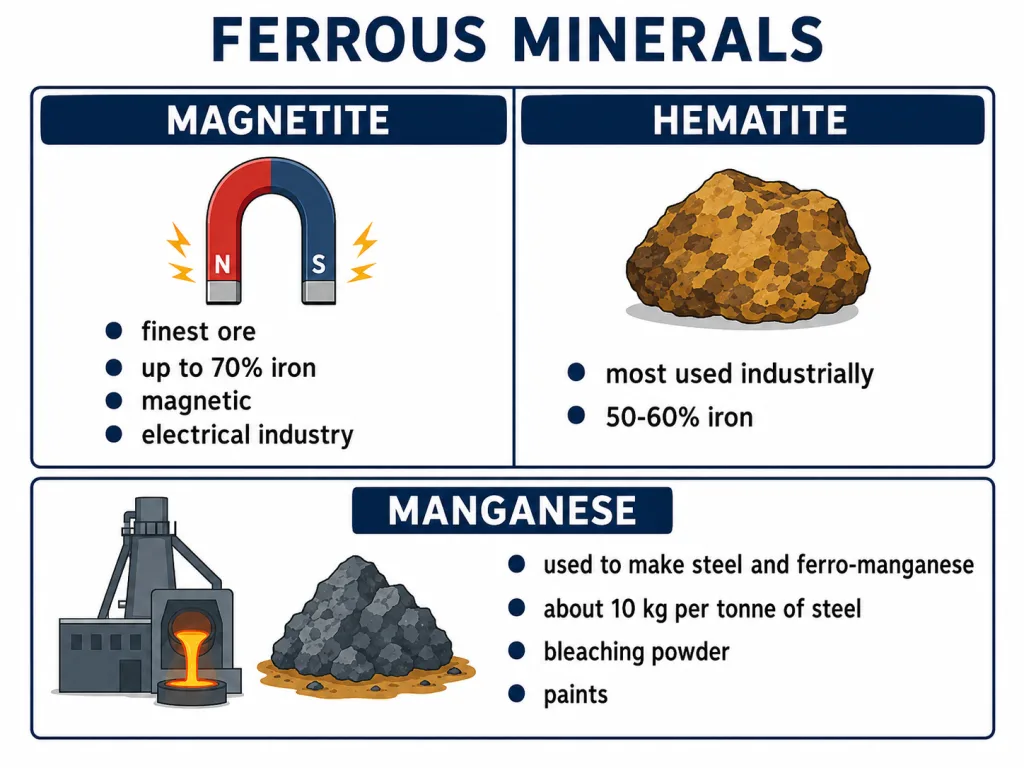
- Magnetite is the finest iron ore, with a very high iron content of up to 70 per cent. It has excellent magnetic qualities, valuable in the electrical industry.
- Hematite is the most important industrial iron ore in terms of the quantity used, but has a slightly lower iron content (50-60 per cent).
In 2018-19, almost the entire iron-ore production (about 97 per cent) came from Odisha, Chhattisgarh, Karnataka and Jharkhand.
The Major Iron-Ore Belts of India
- Odisha-Jharkhand belt: high-grade hematite in the Badampahar mines (Mayurbhanj, Kendujhar) of Odisha and at Gua and Noamundi in the Singhbhum district of Jharkhand.
- Durg-Bastar-Chandrapur belt (Chhattisgarh and Maharashtra): very high-grade hematite in the Bailadila range of Bastar (14 super-high-grade deposits), with the best properties for steel-making; exported to Japan and South Korea via Vishakhapatnam port.
- Ballari-Chitradurga-Chikkamagaluru-Tumakuru belt (Karnataka): the Kudremukh mines are a 100 per cent export unit, and the ore is carried as slurry through a pipeline to a port near Mangaluru.
- Maharashtra-Goa belt (Goa and Ratnagiri): the ores are not of very high quality but are efficiently exploited and exported through Marmagao port.
Manganese
Manganese is another important ferrous mineral. It is mainly used in the manufacturing of steel and ferro-manganese alloy — nearly 10 kg of manganese is required to make one tonne of steel. It is also used in making bleaching powder, insecticides and paints.
Major manganese-producing states include Madhya Pradesh, Maharashtra, Odisha, Karnataka and Andhra Pradesh.
Exam tip: Remember — magnetite = up to 70% iron (magnetic); hematite = 50-60% iron (most used); manganese → 10 kg per tonne of steel.
Questions and Answers
Q1. Distinguish between magnetite and hematite iron ores.
Answer: Magnetite is the finest iron ore with a very high iron content of up to 70 per cent and excellent magnetic qualities. Hematite is the most important industrial iron ore by quantity used, but has a slightly lower iron content of 50-60 per cent.
Q2. Name the major iron-ore belts of India.
Answer: The four major iron-ore belts are the Odisha-Jharkhand belt, the Durg-Bastar-Chandrapur belt (Chhattisgarh-Maharashtra), the Ballari-Chitradurga-Chikkamagaluru-Tumakuru belt (Karnataka), and the Maharashtra-Goa belt.
Q3. What is special about the Bailadila and Kudremukh mines?
Answer: The Bailadila range (Durg-Bastar-Chandrapur belt) has very high-grade hematite with the best properties for steel-making, exported to Japan and South Korea via Vishakhapatnam. The Kudremukh mines (Karnataka) are a 100 per cent export unit, and the ore is transported as slurry through a pipeline to a port near Mangaluru.
Q4. State the uses of manganese.
Answer: Manganese is mainly used in manufacturing steel and ferro-manganese alloy — about 10 kg is needed to make one tonne of steel. It is also used in making bleaching powder, insecticides and paints.