
Copper — A Non-Ferrous Mineral
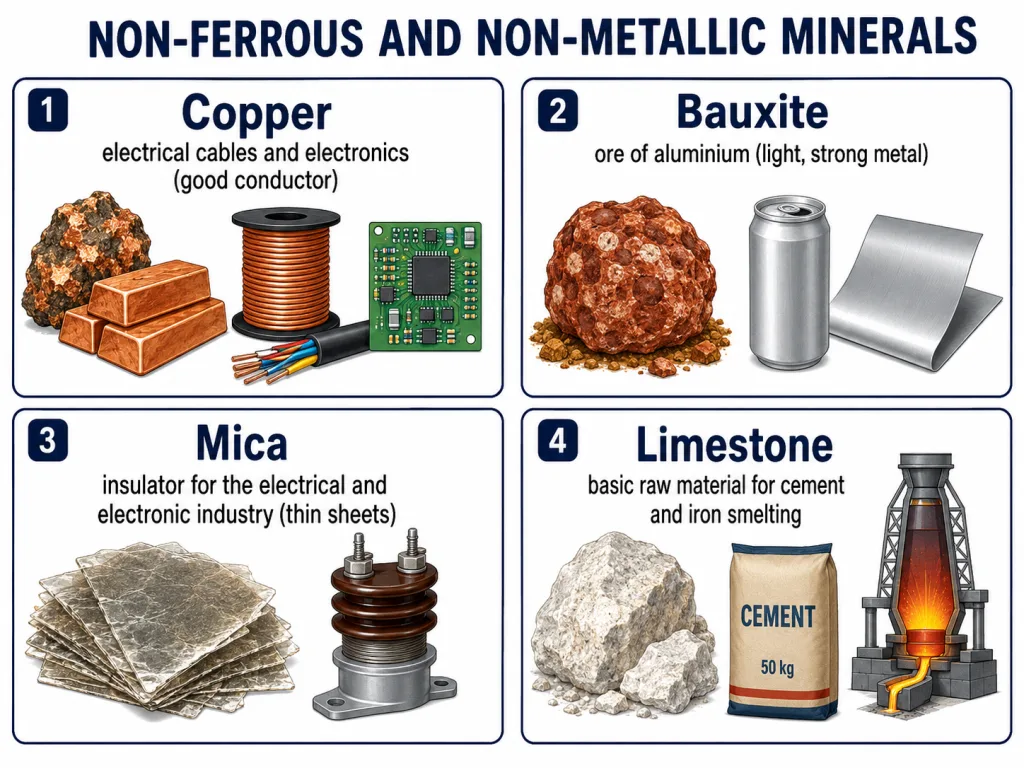
India is critically deficient in the reserves and production of copper. Being malleable, ductile and a good conductor, copper is mainly used in electrical cables, electronics and the chemical industries.
The leading copper producers are the Balaghat mines (Madhya Pradesh), the Khetri mines (Rajasthan) and the Singhbhum district (Jharkhand).
Bauxite — The Ore of Aluminium
Although several ores contain aluminium, it is from bauxite — a clay-like substance — that alumina and later aluminium are obtained. Bauxite deposits are formed by the decomposition of aluminium-rich rocks.
Aluminium is an important metal because it combines the strength of iron with extreme lightness, good conductivity and great malleability.
India's bauxite deposits are found mainly in the Amarkantak plateau, the Maikal hills and the plateau region of Bilaspur-Katni. Odisha is the largest bauxite-producing state, with the important Panchpatmali deposits in the Koraput district.
Mica — The Essential Insulator
Mica is a non-metallic mineral made up of a series of plates or leaves that split easily into very thin sheets. It can be clear, black, green, red, yellow or brown.
Because of its excellent dielectric strength, low power-loss factor, insulating properties and resistance to high voltage, mica is one of the most indispensable minerals in the electric and electronic industries.
Mica is found on the northern edge of the Chota Nagpur plateau — the Koderma-Gaya-Hazaribagh belt of Jharkhand is the leading producer — and around Ajmer (Rajasthan) and the Nellore belt (Andhra Pradesh).
Limestone — A Rock Mineral
Limestone is found in rocks composed of calcium carbonate (or calcium and magnesium carbonates), mostly in sedimentary rocks.
It is the basic raw material for the cement industry and is essential for smelting iron ore in the blast furnace.
Exam tip: Learn the uses — copper → electrical; bauxite → aluminium; mica → insulation; limestone → cement and iron smelting.
Questions and Answers
Q1. Why is copper important, and where is it produced in India?
Answer: Copper is malleable, ductile and a good conductor, so it is mainly used in electrical cables, electronics and chemical industries. India is critically deficient in copper. Its leading producers are the Balaghat mines (MP), Khetri mines (Rajasthan) and Singhbhum district (Jharkhand).
Q2. What is bauxite, and why is aluminium (obtained from it) an important metal?
Answer: Bauxite is a clay-like ore from which alumina and then aluminium are obtained; it forms by the decomposition of aluminium-rich rocks. Aluminium is important because it combines the strength of iron with extreme lightness, good conductivity and great malleability. Odisha is the largest producer (Panchpatmali, Koraput).
Q3. Why is mica so important for the electrical industry?
Answer: Mica has excellent dielectric strength, a low power-loss factor, good insulating properties and resistance to high voltage. These qualities make it one of the most indispensable minerals in the electric and electronic industries, where it is used as an insulator.
Q4. State the uses of limestone.
Answer: Limestone, composed of calcium carbonate, is the basic raw material for the cement industry and is also essential for smelting iron ore in the blast furnace.