
Conventional and Non-Conventional Sources
Energy resources can be classified into two broad groups:
- Conventional sources — those in long-standing traditional use: firewood, cattle-dung cake, coal, petroleum, natural gas and electricity (both hydel and thermal).
- Non-conventional sources — newer, renewable sources: solar, wind, tidal, geothermal, biogas and atomic (nuclear) energy.
Firewood and cattle-dung cake are still widely used in rural India, but they cannot be conserved and their overuse harms forests and soil fertility.
Coal — India's Most Abundant Conventional Energy
Coal is the most abundantly available conventional energy source in India, providing a large share of the country's energy needs and the power for many industries.
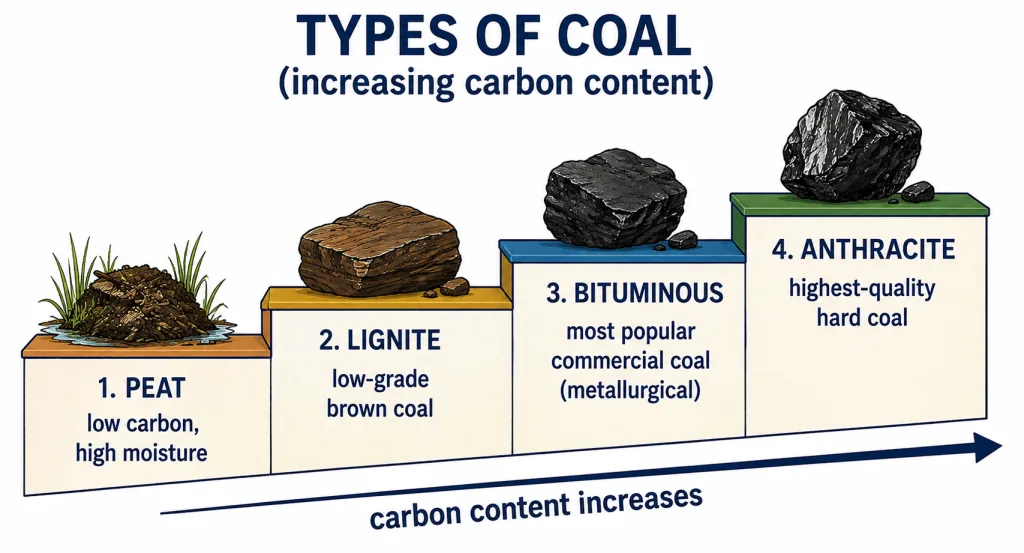
Coal forms from the compression of plant material over millions of years, so it passes through several stages, giving different types by carbon content:
- Peat — low carbon, high moisture, low heating capacity.
- Lignite — a low-grade brown coal, soft with high moisture.
- Bituminous — the most popular coal in commercial use; high-grade bituminous (metallurgical coal) is specially valued in the iron and steel industry.
- Anthracite — the highest-quality hard coal.
The Coalfields of India
In India, coal occurs in rock series of two main geological ages:
- Gondwana coal (older) — the metallurgical coal. The Damodar valley (West Bengal-Jharkhand) is the main region — Jharia, Raniganj and Bokaro are important coalfields. Coal also occurs in the Godavari, Mahanadi, Son and Wardha valleys.
- Tertiary coal (younger, about 55 million years old) — found in the north-eastern states: Meghalaya, Assam, Arunachal Pradesh and Nagaland.
Key Point: Coal is a bulky material that loses weight on use as it turns to ash — so heavy industries and thermal power stations are located on or near the coalfields.
Questions and Answers
Q1. Classify the sources of energy into conventional and non-conventional, with examples.
Answer: Conventional sources are traditional sources: firewood, cattle-dung cake, coal, petroleum, natural gas and electricity (hydel and thermal). Non-conventional sources are newer, renewable sources: solar, wind, tidal, geothermal, biogas and nuclear (atomic) energy.
Q2. Name the types of coal according to their carbon content.
Answer: According to carbon content, coal is of four types: peat (lowest carbon), lignite (low-grade brown coal), bituminous (the most popular commercial coal; high-grade bituminous is metallurgical coal) and anthracite (the highest-quality hard coal).
Q3. Distinguish between Gondwana and tertiary coal.
Answer: Gondwana coal is the older coal and is metallurgical coal, found mainly in the Damodar valley (Jharia, Raniganj, Bokaro) and the Godavari, Mahanadi, Son and Wardha valleys. Tertiary coal is younger (about 55 million years old) and is found in the north-eastern states (Meghalaya, Assam, Arunachal Pradesh, Nagaland).
Q4. Why are heavy industries and thermal power stations located near coalfields?
Answer: Coal is a bulky material that loses weight on use as it turns to ash, and it is costly to transport over long distances. Therefore, heavy industries and thermal power stations are located on or near the coalfields to minimise transport costs.