
Petroleum — Mineral Oil
Petroleum (mineral oil) is the next major energy source in India after coal. It provides fuel for heat and lighting, lubricants for machinery, and raw materials for many manufacturing industries. Petroleum refineries act as 'nodal industries' for synthetic textiles, fertilisers and the petrochemical industry.
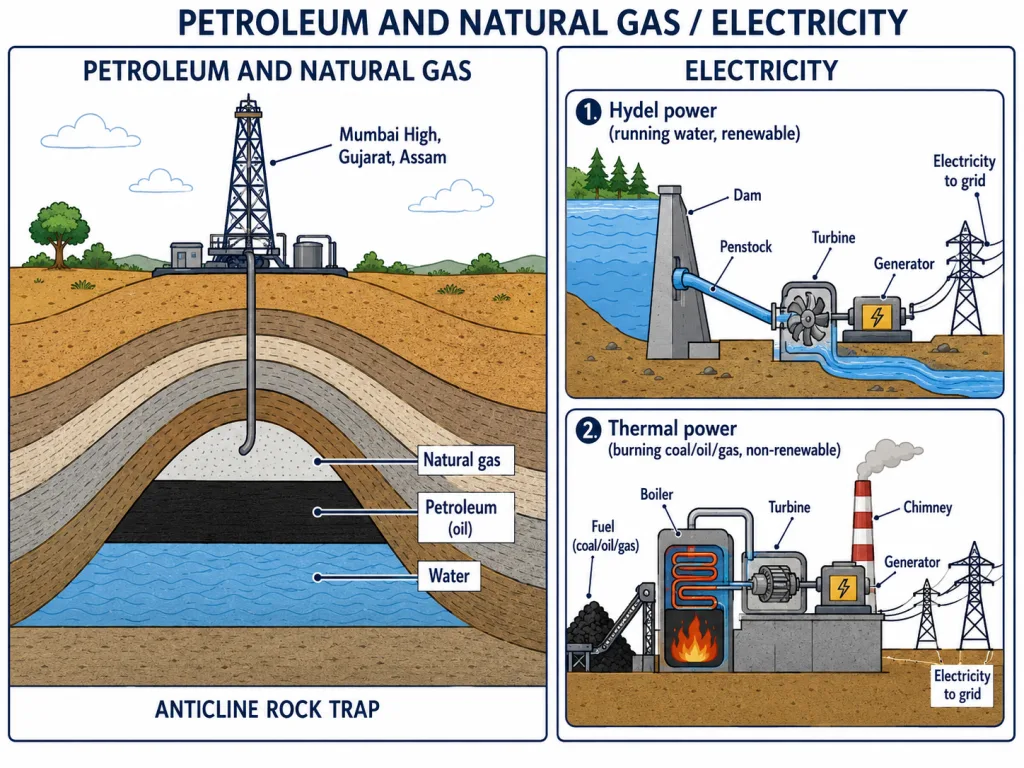
Most petroleum in India occurs in rock formations of the tertiary age, in anticlines and fault traps. The major producing regions are:
- Mumbai High (off the western coast — the largest producer),
- Gujarat (Ankleshwar), and
- Assam — the oldest oil-producing state, with fields at Digboi, Naharkatiya and Moran.
Natural Gas
Natural gas is an important clean energy resource found along with petroleum deposits and also independently.
- Large reserves of natural gas have been discovered in the Krishna-Godavari basin.
- Gas is carried across the country by pipelines, such as the Hazira-Vijaipur-Jagdishpur (HVJ) pipeline.
- Compressed Natural Gas (CNG) is increasingly used as a cleaner fuel for vehicles, reducing pollution.
Key Point: Petroleum and natural gas are found in tertiary sedimentary rocks on the flanks of the peninsula (Gujarat, Assam) and offshore (Mumbai High).
Electricity — Hydel and Thermal Power
Electricity is the most convenient and widely used form of energy. It is generated in two main ways:
- Hydroelectric power (hydel) — generated by fast-flowing (running) water, which turns turbines. It is a renewable source. Examples: the power from the Bhakra-Nangal and Damodar Valley projects.
- Thermal power — generated by burning fuels such as coal, petroleum and natural gas. There are many thermal power plants in India. Thermal power uses non-renewable fuels.
Exam tip: Hydel = running water (renewable); Thermal = burning coal/oil/gas (non-renewable). This distinction is frequently asked.
Questions and Answers
Q1. Why is petroleum important, and where is it mainly produced in India?
Answer: Petroleum provides fuel, lubricants and raw materials for many industries, and refineries are nodal industries for synthetic textiles, fertilisers and petrochemicals. It occurs in tertiary rocks in anticlines and fault traps. The major producing regions are Mumbai High, Gujarat and Assam (Digboi, the oldest field).
Q2. Where have large reserves of natural gas been discovered, and how is gas transported?
Answer: Large reserves of natural gas have been discovered in the Krishna-Godavari basin. Gas is transported across the country through pipelines such as the Hazira-Vijaipur-Jagdishpur (HVJ) pipeline. CNG (compressed natural gas) is used as a cleaner fuel for vehicles.
Q3. Distinguish between hydel power and thermal power.
Answer: Hydel (hydroelectric) power is generated from fast-flowing running water that turns turbines — it is renewable. Thermal power is generated by burning coal, petroleum or natural gas — it uses non-renewable fuels. Both are conventional sources of electricity.
Q4. Why is Assam significant for petroleum?
Answer: Assam is the oldest oil-producing state of India, with important oilfields at Digboi, Naharkatiya and Moran. Its petroleum occurs in tertiary rock formations, and Digboi is one of the earliest oilfields in the country.