
What is a Mineral?
Everything we use — from a tiny pin to a towering building or a ship — is made from materials obtained from the earth. Most of these come from minerals.
A mineral is a naturally occurring, homogeneous substance with a definable internal structure. Minerals are found in a great variety of forms — from the hardest diamond to the softest talc.
Geologists identify minerals by their physical and chemical properties (colour, hardness, form, chemical composition).
Minerals and Ores
Minerals are usually found in 'ores'. The term ore describes an accumulation of a mineral mixed with other elements.
For a mineral to be worth mining, its content in the ore must be in sufficient concentration to make extraction commercially viable. The type of formation or structure in which a mineral occurs decides how easily — and at what cost — it can be mined.
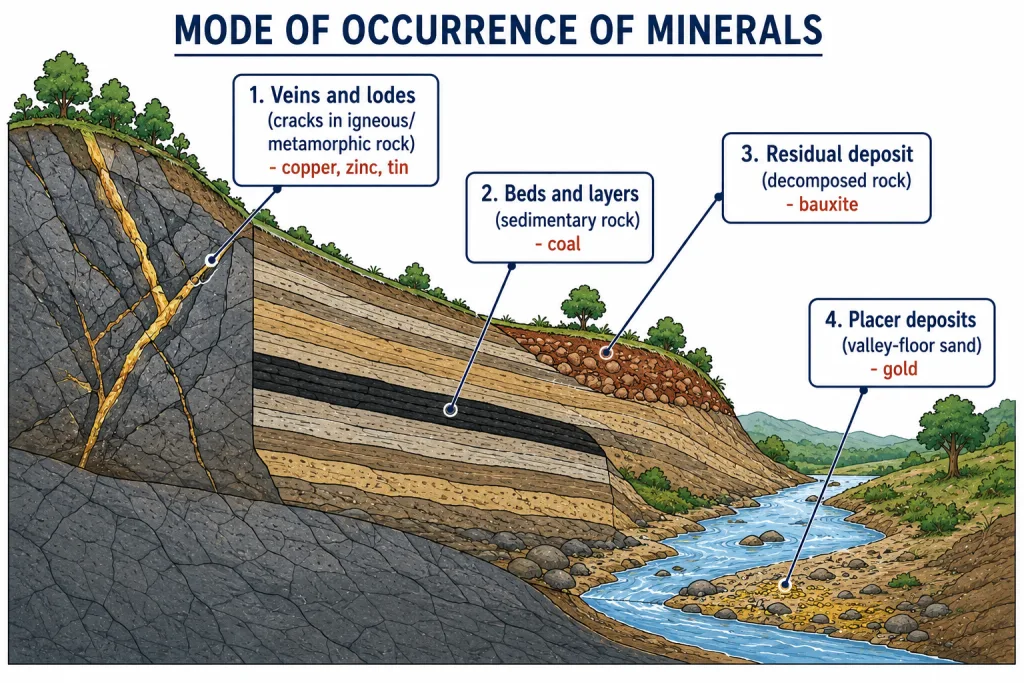
Mode of Occurrence of Minerals
Minerals occur in several forms:
- In igneous and metamorphic rocks — minerals fill the cracks, crevices, faults or joints. The smaller occurrences are called veins and the larger are called lodes. Metallic minerals like tin, copper, zinc and lead are obtained from veins and lodes.
- In sedimentary rocks — minerals occur in beds or layers formed by deposition and concentration. Coal and some iron ores formed this way; gypsum, potash and sodium salts formed by evaporation in arid regions.
- By decomposition of surface rocks — leaving a residual mass of weathered material containing ores. Bauxite is formed this way.
Placer Deposits and Ocean Waters
Two more modes of occurrence:
- Placer deposits — minerals occur as alluvial deposits in the sands of valley floors and the base of hills. These are usually not corroded by water, so they include gold, silver, tin and platinum.
- Ocean waters — the oceans contain vast quantities of minerals, though most are too widely diffused to be of economic use. Common salt, magnesium and bromine are largely derived from sea water, and the ocean beds are rich in manganese nodules.
Exam tip: Match the mode to the mineral — veins/lodes → copper, zinc; beds → coal; residual → bauxite; placer → gold; ocean → common salt.
Questions and Answers
Q1. What is a mineral?
Answer: A mineral is a naturally occurring, homogeneous substance with a definable internal structure. Minerals are identified by their physical and chemical properties such as colour, hardness, form and chemical composition, and range from the hardest (diamond) to the softest (talc).
Q2. What is an ore? Why must a mineral be present in sufficient concentration in an ore?
Answer: An ore is an accumulation of a mineral mixed with other elements. The mineral content must be in sufficient concentration so that its extraction is commercially viable — if the concentration is too low, the cost of mining and processing would be greater than the value of the mineral obtained.
Q3. Describe the main modes of occurrence of minerals.
Answer: Minerals occur (1) in veins and lodes in the cracks of igneous and metamorphic rocks (e.g. tin, copper, zinc); (2) in beds and layers of sedimentary rocks (e.g. coal, gypsum); (3) as residual deposits from the decomposition of rocks (e.g. bauxite); (4) as placer deposits in valley-floor sands (e.g. gold, platinum); and (5) in ocean waters (e.g. common salt, magnesium, manganese nodules).
Q4. What are placer deposits? Give two minerals found in them.
Answer: Placer deposits are minerals that occur as alluvial deposits in the sands of valley floors and at the base of hills. Because these minerals are not corroded by water, they include gold, silver, tin and platinum (any two).