
A Growing Population
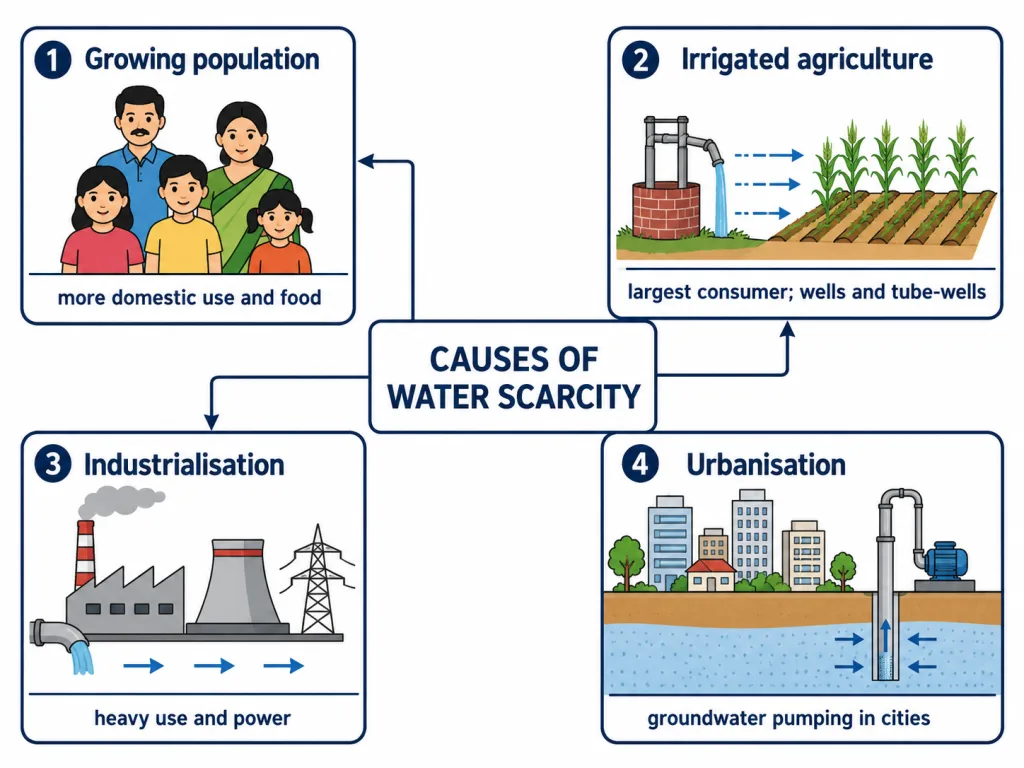
A large and growing population is a major cause of water scarcity. More people need more water — not only for domestic use (drinking, washing, cooking) but also to grow more food.
To produce more food grains, water resources are being over-exploited to expand irrigated areas for dry-season agriculture. This constant pressure to feed a rising population steadily increases the demand for water.
Irrigated Agriculture — The Largest Consumer
Irrigated agriculture is the largest consumer of water. To grow more crops, farmers dig their own wells and tube-wells to irrigate their fields.
But over-drawing water this way can cause falling groundwater levels, which in turn threatens both water availability and the food security of people. This is why experts stress the need to develop drought-resistant crops and dry-farming techniques to use water more wisely.
Key Point: Producing more food uses enormous amounts of water — so agriculture is at the heart of the water-scarcity problem.
Industrialisation and Urbanisation
After Independence, India saw intensive industrialisation and urbanisation, which created many opportunities but also increased the pressure on water:
- Industries are heavy users of water and also need power to run — much of it hydroelectric power, which itself needs water.
- Growing cities with large, dense populations and modern lifestyles have hugely increased both water and energy demands.
- Many housing societies and colonies run their own groundwater pumping devices, over-exploiting fragile water resources and causing their depletion in several cities.
Questions and Answers
Q1. How does a growing population cause water scarcity?
Answer: A large and growing population needs more water for domestic use and, above all, to grow more food. To raise food-grain production, water resources are over-exploited to expand irrigated areas for dry-season agriculture. This rising demand steadily strains the available water and causes scarcity.
Q2. Why is irrigated agriculture described as the largest consumer of water, and what problem does it create?
Answer: Growing crops requires enormous quantities of water, so irrigated agriculture is the largest consumer of water. To irrigate their fields, farmers sink their own wells and tube-wells; over-drawing water this way causes groundwater levels to fall, threatening future water availability and food security. Developing drought-resistant crops and dry-farming techniques can help.
Q3. How have industrialisation and urbanisation aggravated water scarcity?
Answer: Industries are heavy users of water and also need power (much of it hydroelectric, which needs water). Rapidly growing cities with dense populations and modern lifestyles have greatly increased water and energy demands, and many housing colonies run their own groundwater pumps. Together these have over-exploited and depleted fragile water resources in several cities.