
Water — Abundant Yet Scarce
About three-fourths of the earth's surface is covered with water, but only a very small proportion of it is freshwater that we can actually use. This usable freshwater comes mainly from surface run-off and groundwater, which are continually renewed and recharged.
Because water keeps moving and renewing itself, it is a renewable resource — yet, strangely, many regions of the world still face a shortage of it.
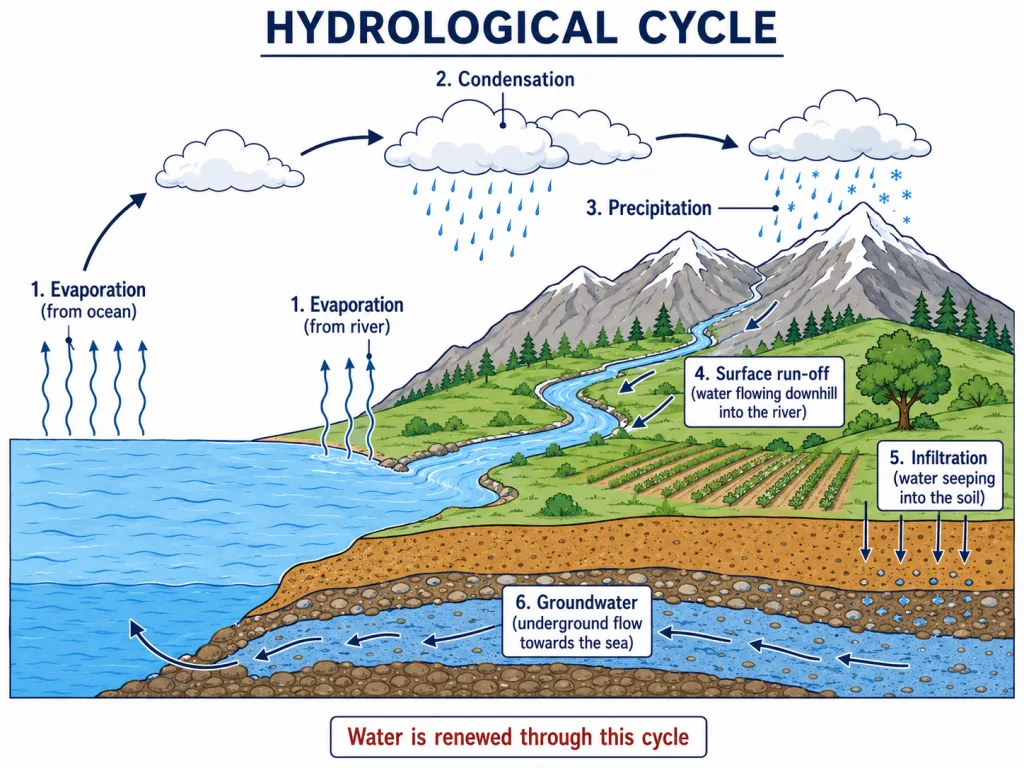
The Hydrological Cycle
All water moves within the hydrological cycle (water cycle). Water evaporates from oceans, rivers and lakes, forms clouds, falls back as precipitation (rain and snow), flows over the land as surface run-off or seeps down to become groundwater, and eventually returns to the sea — only to begin again.
Key Point: It is the hydrological cycle that constantly renews and recharges freshwater, which is why water is called a renewable resource.
The Paradox of Water Scarcity
Given that so much of the earth is covered with water, and that water renews itself, it seems hard to believe that we could ever run short. Yet it is predicted that by 2025, nearly two billion people will live in conditions of absolute water scarcity.
The availability of water does vary over space and time, mainly due to variations in seasonal and annual precipitation. But in most cases, water scarcity is not simply about low rainfall — it is caused by over-exploitation, excessive use, and unequal access to water among different social groups.
Exam tip: Remember — even a region with plenty of rainfall can suffer water scarcity. Scarcity is about how water is used and shared, not just how much falls.
Questions and Answers
Q1. Why is water considered a renewable resource?
Answer: Water is considered a renewable resource because it is continually renewed and recharged through the hydrological cycle. Water evaporates, forms clouds, falls as precipitation, flows as surface run-off and groundwater, and returns to the sea, repeating endlessly. This constant cycling ensures that freshwater keeps being replenished.
Q2. If three-fourths of the earth is covered with water, why do we still face water scarcity?
Answer: Although three-fourths of the earth is covered with water, only a small proportion is usable freshwater. Moreover, water scarcity is usually caused not by a lack of rainfall but by the over-exploitation and excessive use of water and by unequal access to it among different social groups. Hence scarcity persists despite the abundance of water.
Q3. What is the hydrological cycle, and why is it important?
Answer: The hydrological cycle is the continuous movement of water — evaporation from water bodies, condensation into clouds, precipitation as rain and snow, and flow as surface run-off and groundwater back to the sea. It is important because it renews and recharges freshwater, making water a renewable resource.