
What is a Dam?
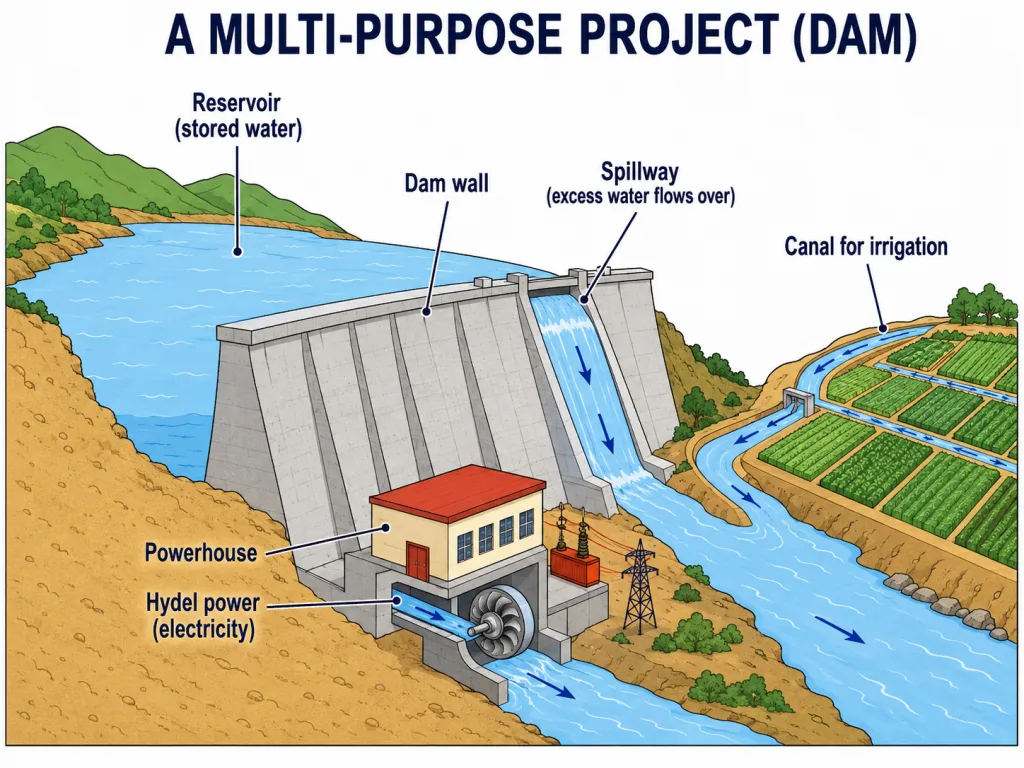
A dam is a barrier built across flowing water that obstructs, directs or slows the flow, usually creating a reservoir, lake or impoundment. In fact, the word "dam" often refers to the reservoir of stored water rather than just the wall.
Most dams have a section called a spillway or weir, over or through which water is allowed to flow. Dams are classified by structure (timber, embankment or masonry dams) and by height (low, medium and high dams).
Dams were traditionally built to impound rivers and rainwater so that the water could later be used to irrigate fields.
From Dams to Multi-Purpose Projects
Today, dams are built not just for irrigation but for many purposes at once — electricity generation, water supply for domestic and industrial use, flood control, recreation, inland navigation and fish breeding.
Because the many uses of the stored water are integrated with one another, such dams are called multi-purpose projects. Two well-known examples:
- Bhakra-Nangal Project (Sutlej-Beas basin) — its water is used for both hydel power and irrigation.
- Hirakud Project (Mahanadi basin) — it integrates the conservation of water with flood control.
"Temples of Modern India"
Multi-purpose projects were launched after Independence with an integrated water resources management approach. They were seen as the vehicle that would lead the nation to development and progress, overcoming the handicap of the colonial past.
Jawaharlal Nehru proudly proclaimed the dams as the "temples of modern India" — because they would integrate the development of agriculture and the village economy with rapid industrialisation and the growth of the urban economy.
Exam tip: Learn the two examples (Bhakra-Nangal, Hirakud) and Nehru's phrase — they are frequent Board questions.
Questions and Answers
Q1. What is a dam? What is a multi-purpose river project?
Answer: A dam is a barrier built across flowing water that obstructs, directs or slows the flow, usually creating a reservoir. A multi-purpose river project is a dam built to serve several integrated purposes at once — such as irrigation, electricity generation, water supply, flood control, navigation and fish breeding — where the many uses of the stored water are integrated with one another.
Q2. Give two examples of multi-purpose projects and the rivers on which they are built.
Answer: The Bhakra-Nangal Project is built in the Sutlej-Beas river basin and provides both hydel power and irrigation. The Hirakud Project is built in the Mahanadi basin and integrates the conservation of water with flood control.
Q3. Why did Jawaharlal Nehru call dams the 'temples of modern India'?
Answer: Nehru called dams the 'temples of modern India' because he saw them as the means to lead the newly independent nation to development and progress. Multi-purpose projects would integrate the development of agriculture and the village economy with rapid industrialisation and the growth of the urban economy, overcoming the handicap of the colonial past.