
Water Harvesting — A Viable Alternative
Given the disadvantages of and rising resistance to large multi-purpose projects, rainwater harvesting came to be seen as a viable alternative — both socio-economically and environmentally.
In ancient India, along with sophisticated hydraulic structures, there existed an extraordinary tradition of water harvesting. People had deep knowledge of rainfall patterns and soil types and developed a wide range of techniques to harvest rainwater, groundwater, river water and flood water, suited to their local conditions.
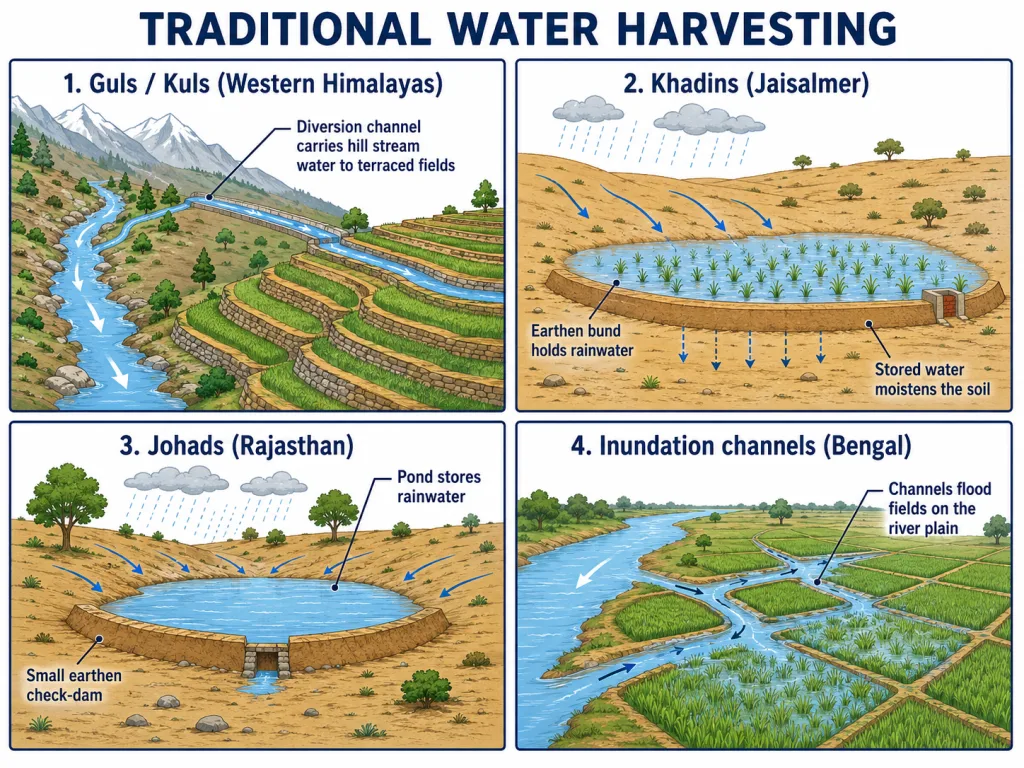
Traditional Harvesting Techniques Across India
Different regions developed their own methods:
- In hill and mountain regions, people built diversion channels called 'guls' or 'kuls' (Western Himalayas) to carry water to their fields.
- In the flood plains of Bengal, people made inundation channels to irrigate their fields.
- In arid and semi-arid regions, fields were converted into rain-fed storage structures that let water stand and moisten the soil — the 'khadins' of Jaisalmer and the 'johads' in other parts of Rajasthan.
- 'Rooftop rainwater harvesting' was commonly practised to store drinking water, particularly in Rajasthan.
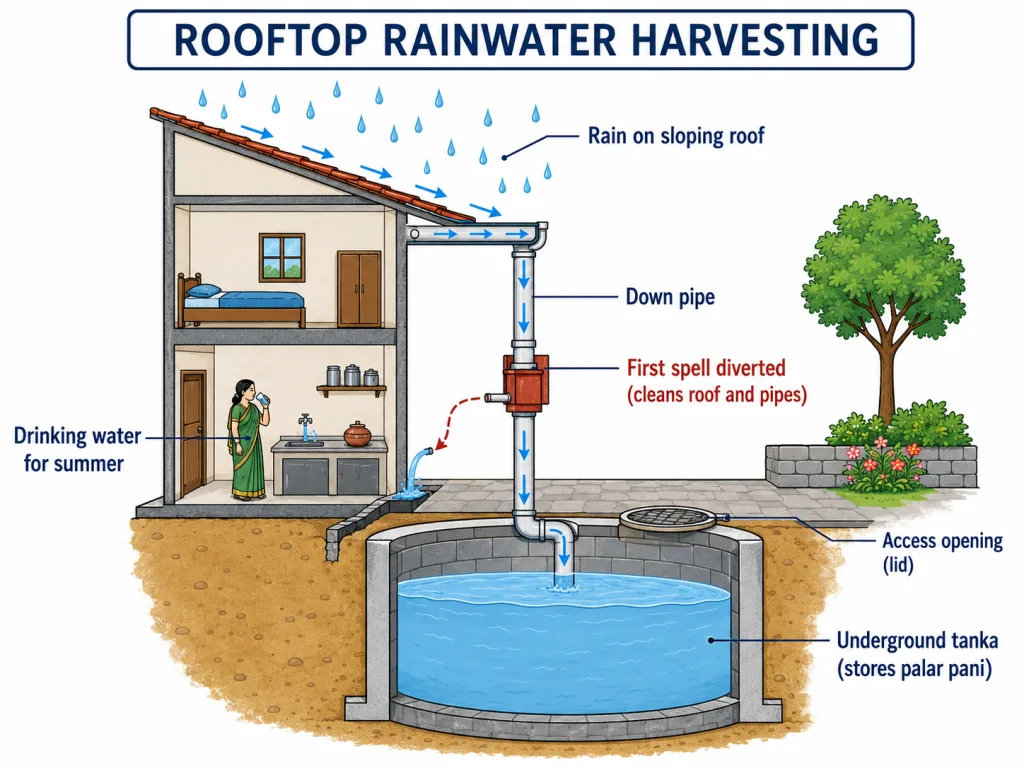
Tankas and 'Palar Pani' of Rajasthan
In the semi-arid and arid regions of Rajasthan — particularly in Bikaner, Phalodi and Barmer — almost all houses traditionally had underground tanks or 'tankas' for storing drinking water. A tanka could be as large as a big room, built inside the house or courtyard and connected by pipes to the sloping rooftops.
- Rain falling on the roof travelled down the pipe into the underground tanka.
- The first spell of rain was not collected — it was used to clean the roofs and pipes; water from later showers was then stored.
- This stored rainwater, called 'palar pani', was considered the purest form of natural water and a reliable source of drinking water in the dry summers.
Note: In western Rajasthan, this practice is sadly declining as canal water (from the Indira Gandhi Canal) becomes available — though some households still keep their tankas.
Questions and Answers
Q1. Why is rainwater harvesting seen as a viable alternative to large dams?
Answer: Because of the disadvantages of and rising resistance to large multi-purpose projects, rainwater harvesting is seen as a socio-economically and environmentally viable alternative. It is decentralised, locally managed, low-cost, and avoids the displacement and ecological damage caused by big dams, while making good use of local rainfall.
Q2. Describe any three traditional methods of rainwater harvesting in India.
Answer: (1) In hill regions, guls and kuls (Western Himalayas) are diversion channels that carry water to fields. (2) In arid Jaisalmer, khadins — and johads in other parts of Rajasthan — are structures that let rain-fed water stand and moisten the soil. (3) In Rajasthan, rooftop rainwater harvesting stored drinking water in underground tankas.
Q3. What are tankas, and what is 'palar pani'?
Answer: Tankas are underground tanks, traditionally built in the houses or courtyards of Bikaner, Phalodi and Barmer in Rajasthan, connected by pipes to sloping rooftops to store rooftop rainwater. The rainwater stored in them, called 'palar pani', was considered the purest form of natural water and a reliable source of drinking water in the summer.
Q4. Why was the first spell of rain not collected in rooftop rainwater harvesting?
Answer: The first spell of rain was not collected because it was used to clean the roofs and the pipes of dust and dirt. Only the rainwater from the subsequent showers, which was clean, was then collected and stored in the tanka.