
The Revival of Rooftop Rainwater Harvesting
Although the practice declined in some canal-irrigated areas, rooftop rainwater harvesting is being successfully revived in many rural and urban parts of India to store and conserve water.
A landmark step: Tamil Nadu is the first state in India to make rooftop rainwater harvesting structures compulsory for all houses across the state, with legal provisions to punish those who do not comply.
Case Study — Shillong and Gendathur
Shillong, Meghalaya: Rooftop rainwater harvesting is very common here. Interestingly, though Cherrapunji and Mawsynram (about 55 km away) receive the highest rainfall in the world, the state capital Shillong faces an acute water shortage. So nearly every household has a rooftop harvesting structure, meeting about 15-25 per cent of the household's water needs.
Gendathur, Karnataka: In this remote village near Mysuru, villagers installed rooftop rainwater harvesting systems and the village became 'rich in rainwater'. With about 1,000 mm annual rainfall and good collection efficiency, nearly 200 households harvest large amounts of water each year.
Bamboo Drip Irrigation of Meghalaya
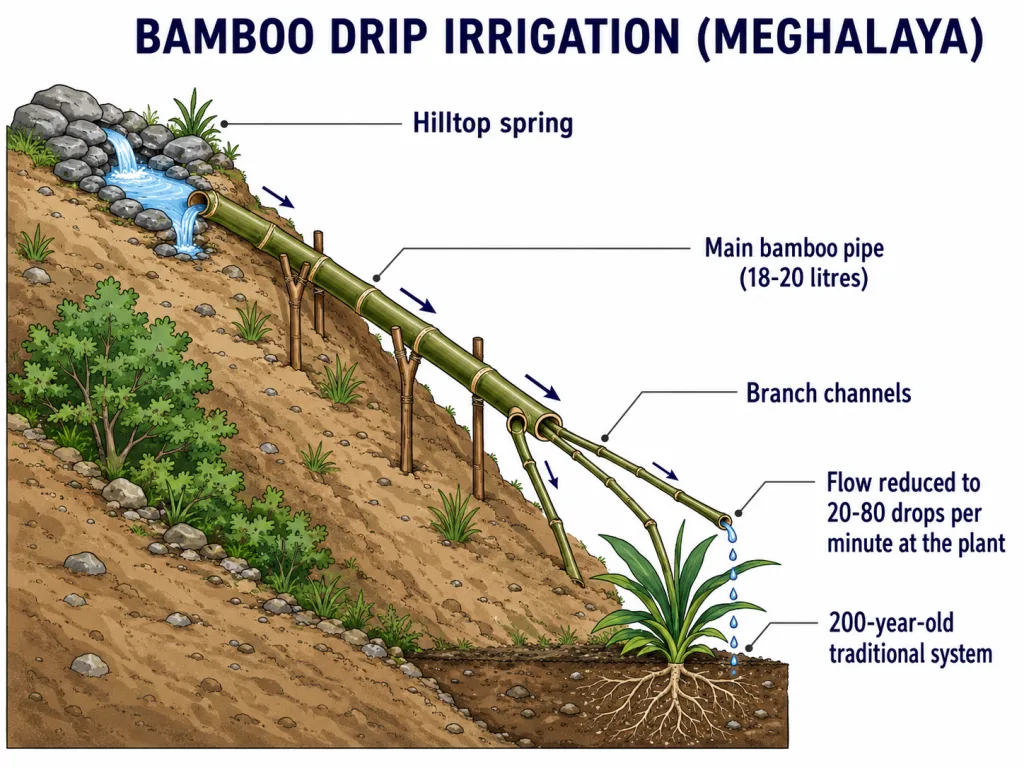
Meghalaya has a 200-year-old system of tapping stream and spring water using bamboo pipes, known as bamboo drip irrigation.
- Bamboo pipes divert perennial springs on the hilltops down to the lower fields by gravity.
- About 18-20 litres of water enters the bamboo pipe system and is transported over hundreds of metres.
- By the time it reaches the plant, the flow is reduced to just 20-80 drops per minute at the site of the plant — an efficient, traditional form of drip irrigation.
Key Point: From compulsory rooftop harvesting in Tamil Nadu to Meghalaya's bamboo drip system, India shows how traditional wisdom and modern policy together can conserve water.
Questions and Answers
Q1. Which is the first state in India to make rooftop rainwater harvesting compulsory?
Answer: Tamil Nadu is the first state in India to make rooftop rainwater harvesting structures compulsory for all houses across the state, with legal provisions to punish defaulters.
Q2. Why is rooftop rainwater harvesting common in Shillong despite the region's very high rainfall?
Answer: Although Cherrapunji and Mawsynram nearby receive the world's highest rainfall, the capital Shillong faces an acute water shortage. So nearly every household practises rooftop rainwater harvesting, which meets about 15-25 per cent of the household's total water needs.
Q3. Write a note on the village of Gendathur.
Answer: Gendathur, a remote village near Mysuru in Karnataka, is famous for rooftop rainwater harvesting. Nearly 200 households installed rooftop systems, and with about 1,000 mm of annual rainfall and good collection efficiency the village became known as 'rich in rainwater', meeting its water needs from harvested rain.
Q4. Describe the bamboo drip irrigation system of Meghalaya.
Answer: Bamboo drip irrigation is a 200-year-old system in Meghalaya that taps stream and spring water using bamboo pipes. Bamboo pipes divert perennial hilltop springs down to the fields by gravity. About 18-20 litres of water enters the system and, after travelling hundreds of metres, is reduced to 20-80 drops per minute at the plant — an efficient traditional drip method.