
Ecological Problems of Large Dams
In recent years, multi-purpose projects and large dams have come under great scrutiny and opposition. Regulating and damming rivers affects their natural flow:
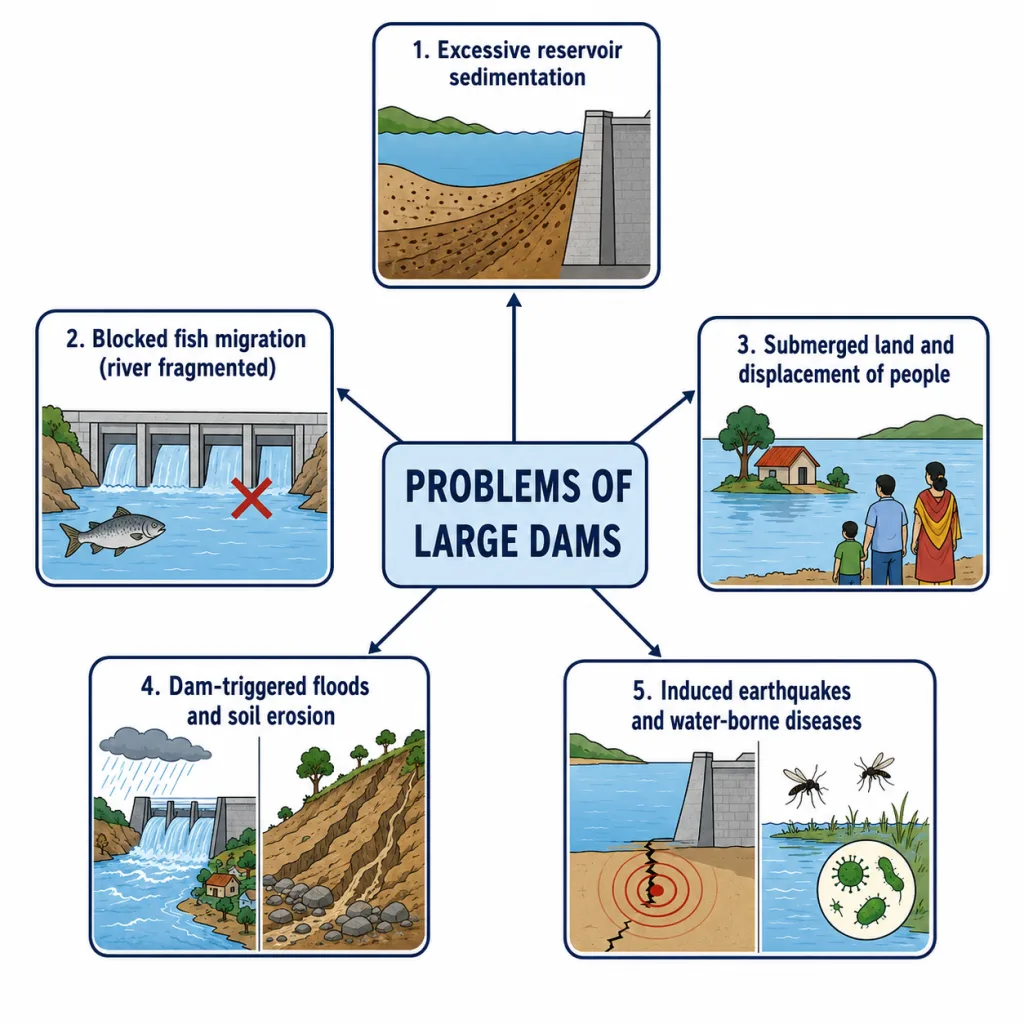
- It causes poor sediment flow and excessive sedimentation at the bottom of the reservoir, leaving rockier stream beds and poorer habitats for aquatic life.
- Dams fragment rivers, making it hard for aquatic animals to migrate, especially for spawning.
- Reservoirs built on floodplains submerge existing vegetation and soil, which decomposes over time.
The Irony of Floods and Land Degradation
Ironically, dams that were built to control floods have sometimes triggered floods — because sedimentation in the reservoir reduces its capacity. During times of excessive rainfall, big dams have mostly been unsuccessful in controlling floods.
These floods devastate life and property and cause severe soil erosion. Sedimentation also means the floodplains are deprived of silt (a natural fertiliser), adding to land degradation. Multi-purpose projects have also been observed to induce earthquakes, cause water-borne diseases and pests, and lead to pollution and salinisation of the soil from excessive irrigation.
Displacement, Movements and Water Disputes
Large dams displace huge numbers of people and submerge their land and livelihoods, sparking strong resistance movements:
- The Narmada Bachao Andolan opposed the large dams (such as the Sardar Sarovar) on the Narmada River, highlighting the displacement of local people and the loss of livelihood and environment. (Similar concerns surround the Tehri Dam.)
- Multi-purpose projects also cause inter-state water disputes. For example, the Krishna-Godavari dispute arose from objections by Karnataka and Andhra Pradesh to Maharashtra diverting more water at Koyna, which would reduce the downstream flow to their states.
Exam tip: Link the Narmada Bachao Andolan to displacement, and the Krishna-Godavari dispute to inter-state water sharing.
Questions and Answers
Q1. How do large dams affect the natural flow and ecology of a river?
Answer: Damming a river affects its natural flow: it causes poor sediment flow and excessive sedimentation in the reservoir, leaving rockier beds and poorer aquatic habitats. Dams fragment rivers, making it hard for aquatic fauna to migrate and spawn, and reservoirs submerge vegetation and soil on the floodplains, which then decomposes.
Q2. Explain the irony that dams built for flood control can cause floods.
Answer: Dams are built to control floods, but sedimentation gradually reduces the reservoir's storage capacity. During heavy rainfall the reservoir cannot hold the excess water, so the dams have often been unsuccessful in controlling floods and have even triggered floods, devastating life and property and causing soil erosion.
Q3. Why did movements like the Narmada Bachao Andolan oppose large dams?
Answer: Large dams displace large numbers of people and submerge their land, homes and livelihoods, and cause serious ecological damage. The Narmada Bachao Andolan opposed the large dams on the Narmada River (such as the Sardar Sarovar) mainly because of this displacement and loss of livelihood and environment of local communities.
Q4. What is the Krishna-Godavari dispute an example of?
Answer: It is an example of an inter-state water dispute. The dispute arose because Karnataka and Andhra Pradesh objected to Maharashtra diverting more water at Koyna for a multi-purpose project, which would reduce the downstream flow to their states and harm their agriculture and industry.