
Scarcity Even Where Water Is Plentiful
So far we have looked at the quantity of water. But there is another kind of scarcity — one that occurs even when water is available in sufficient amounts.
An area may have plenty of water and still suffer scarcity if that water is of bad quality — polluted and unfit for use. In such cases, the problem is not how much water there is, but how usable it is.
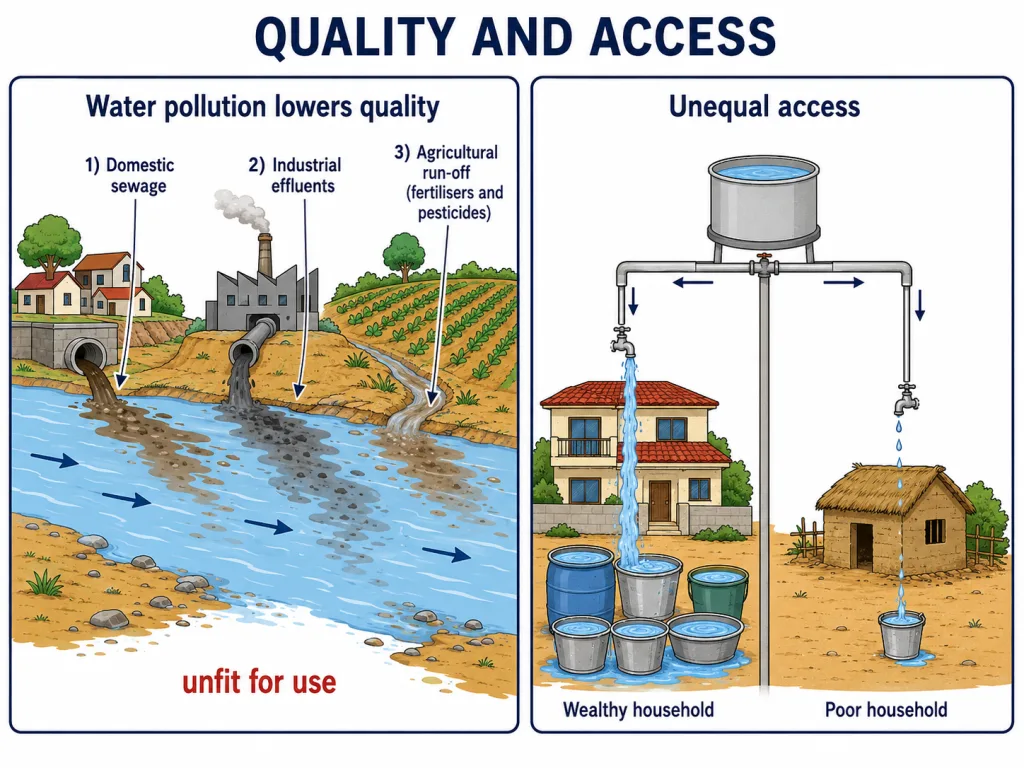
Deterioration of Water Quality
Water quality is being spoiled by pollution from many sources:
- Domestic waste and sewage from homes and cities.
- Industrial effluents and chemicals released by factories.
- Agricultural run-off carrying fertilisers and pesticides.
When freshwater is polluted in these ways, it becomes hazardous and unfit for drinking or other uses — so a region can be rich in water yet poor in usable water.
Unequal Access to Water
Water scarcity is also linked to unequal access. Even where water exists, it is often not shared equally among different social groups. Wealthier and more powerful groups may secure more than their share, while poorer communities struggle to obtain safe water.
Key Point: Because scarcity can come from poor quality and unequal sharing — not only from shortage — the conservation and careful management of water is essential everywhere, even in well-watered regions.
Questions and Answers
Q1. How can a region suffer water scarcity even when it has enough water?
Answer: A region can have sufficient water in quantity and still face scarcity if the water is of bad quality — polluted by domestic waste, industrial effluents or agricultural chemicals — making it unfit for use. Here the problem is not the amount of water but its usability.
Q2. What are the main sources of water pollution that lower water quality?
Answer: Water quality is lowered by pollution from domestic waste and sewage, industrial effluents and chemicals from factories, and agricultural run-off carrying fertilisers and pesticides. Such pollution makes freshwater hazardous and unfit for drinking and other uses.
Q3. Explain how unequal access contributes to water scarcity.
Answer: Water is often not shared equally among different social groups. Wealthier and more powerful groups may take more than their fair share, while poorer communities struggle to get safe water. Thus even where water exists, unequal access creates scarcity for some — which is why careful management is needed everywhere.