
A Method for Solving Genetics Problems
Genetics questions look hard but follow a fixed recipe. Use these steps every time:
- Assign letters: capital for dominant, small for recessive (e.g. T tall, t short).
- Write the parents' genotypes from the information given.
- Find the gametes each parent can make (split the letters).
- Draw a Punnett square and fill in the offspring.
- Count the genotype and phenotype ratios.
The Punnett square is just an organised way of combining every possible egg with every possible sperm.
Deducing Dominance from Data
Sometimes you are given data and asked which trait is dominant. The rule:
- If two parents showing a trait produce some offspring without it, the parents were hybrids and the disappeared trait is recessive (so the shown trait is dominant).
- A single observation may not be enough. For example: a light-eyed child mostly has light-eyed parents. This alone does not tell you whether light is dominant or recessive — you need to see whether the trait can skip and reappear, or use crosses with known genotypes.
Key Point: A trait that can be hidden and reappear later is recessive; the one that masks it is dominant. One family's data is often not enough — you need ratios or test crosses.
ABO Blood Groups — an Application
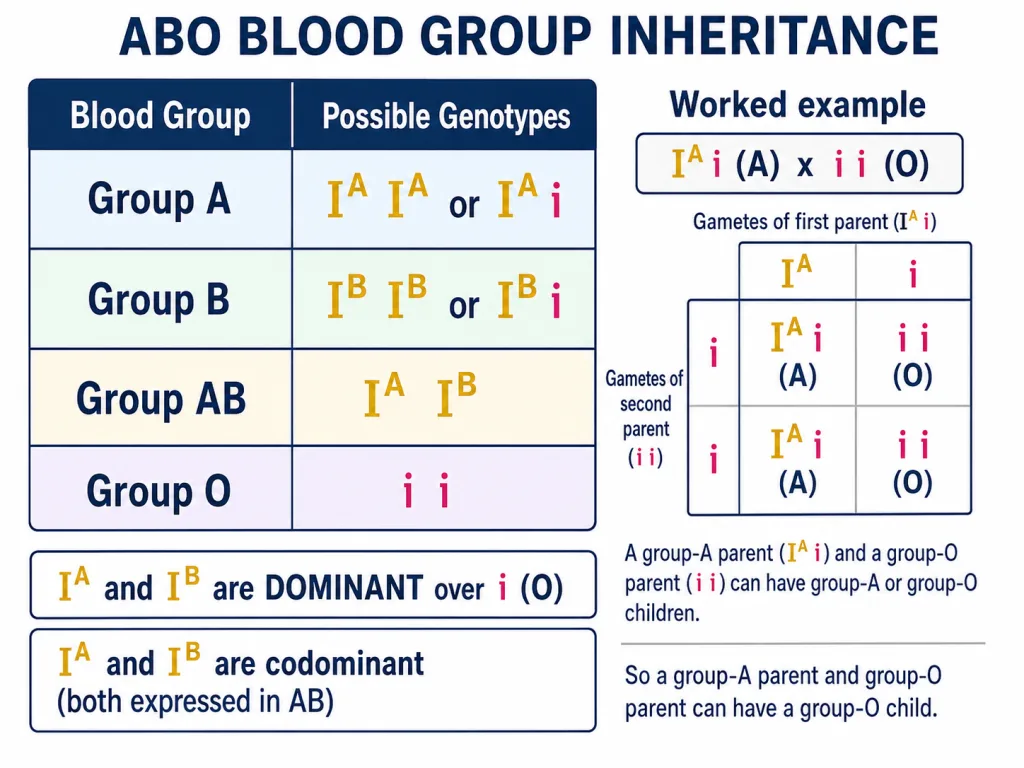
Human ABO blood group is a neat real-life example of inheritance. It is controlled by three alleles: I^A, I^B and i.
- I^A and I^B are dominant over i (the O allele).
- I^A and I^B are codominant — if both are present, both are expressed (AB group).
| Blood group | Possible genotypes |
|---|---|
| A | I^A I^A or I^A i |
| B | I^B I^B or I^B i |
| AB | I^A I^B |
| O | i i |
Worked idea (NCERT-style): a father with blood group A (I^A i) and a mother with group O (i i) can have a child with group O (i i). This is possible because the group-A father can carry a hidden i. But this single family cannot by itself prove that A is dominant over O — you would need to know the exact genotypes or see more data.
[NEET Important] O (ii) is the "hidden" group — two group-A or group-B parents can have an O child if both carry i.
Memory Capsule — Section 8
Quick revision: solving genetics problems.
1. Steps: assign letters → parent genotypes → gametes → Punnett square → count ratios. 2. Ratios to know: monohybrid F2 = 3:1 (genotype 1:2:1); dihybrid F2 = 9:3:3:1; test cross = 1:1. 3. Recessive = can be hidden and reappear; dominant = masks the other. 4. One family's data may not prove dominance — need ratios/test crosses. 5. Blood groups: I^A, I^B dominant over i; I^A & I^B codominant (AB). O = ii.
Solved Examples
Example 1: NCERT — Blood Group Dominance
A man with blood group A marries a woman with blood group O and their daughter has blood group O. Is this information enough to tell which of the traits — A or O — is dominant? Why or why not?
Solution: No, it is not enough. The father with group A could be I^A i (carrying a hidden i). With the mother i i (group O), a cross I^A i × i i gives children that are I^A i (group A) or i i (group O) — so an O daughter is possible whether or not A is dominant. A single such family cannot establish dominance; we would need to know the exact genotypes or more offspring data.
Takeaway: One child's blood group cannot, by itself, prove which allele is dominant.
Example 2: NCERT — Genetic Make-up of the Tall Parent
A Mendelian experiment crossed tall pea plants with violet flowers × short pea plants with white flowers. The progeny all bore violet flowers, but almost half were short. What is the genotype of the tall, violet parent? (a) TTWW (b) TTww (c) TtWW (d) TtWw
Solution:
- Flowers: all F1 were violet → violet is dominant; since none were white, the violet parent is homozygous WW.
- Height: almost half the F1 were short → this is a 1:1 (test-cross) ratio, which happens only if the tall parent is heterozygous Tt crossed with short tt.
So the tall, violet parent is Tt WW → option (c) TtWW.
Takeaway: "Half short" signals a Tt × tt (1:1) cross; "all violet" signals a homozygous WW parent.
Example 3: NCERT — Light Eye Colour
Children with light-coloured eyes tend to have parents with light-coloured eyes. Can we say whether light eye colour is dominant or recessive? Why or why not?
Solution: No, not from this alone. The observation only shows that light-eyed parents tend to have light-eyed children — it does not reveal whether the light allele masks or is masked by the dark allele. To decide dominance we would need to see, for example, whether two dark-eyed parents can have a light-eyed child (which would show light is recessive), or use crosses with known genotypes.
Takeaway: Similarity between parents and children does not by itself reveal dominance.
Example 4: NCERT — A Project on Coat Colour in Dogs
Outline a project to find the dominant coat colour in dogs.
Solution:
- Choose two contrasting coat colours (e.g. black and brown).
- Cross pure-breeding black dogs with pure-breeding brown dogs and record the F1 coat colour.
- The colour that appears in all the F1 puppies is the dominant colour.
- Confirm by breeding the F1 together and checking that the recessive colour reappears in about 1/4 of the F2 (a 3:1 ratio).
Takeaway: The colour that shows in F1 is dominant; the recessive one reappears in F2 at 3:1.
Example 5: A Dihybrid Practice Cross
In a RrYy × RrYy cross, what fraction of offspring are round and yellow (both dominant)?
Solution: In the 9:3:3:1 ratio, the double-dominant (round, yellow) class is 9 out of 16. So 9/16 of the offspring are round and yellow.
Takeaway: 9/16 double dominant, 3/16 + 3/16 single dominant, 1/16 double recessive.