
How is Sex Decided?
How is the sex of a newborn decided — boy or girl? Different species use very different strategies:
- In some reptiles, the temperature at which the fertilised eggs are kept decides the sex — an environmental cue.
- In some animals like snails, an individual can change sex, showing sex is not always genetically fixed.
- In human beings, sex is largely genetically determined — the genes inherited from our parents decide whether we are boys or girls.
But if similar gene sets come from both parents, how can genetics decide sex? The answer lies in a special pair of chromosomes.
Autosomes and Sex Chromosomes
Not all human chromosomes are perfectly paired. Humans have 23 pairs of chromosomes in all:
- 22 pairs have a matching maternal and paternal copy — these are the autosomes.
- 1 pair is the sex chromosomes, and this pair is odd — it is not always a perfect match.
The sex chromosomes come in two types — a normal-sized X and a shorter Y:
- Females have a perfect pair: XX.
- Males have a mismatched pair: XY (one X and one Y).
Key Point: Female = XX; Male = XY. The 22 non-sex pairs are autosomes.
The Father Decides the Child's Sex
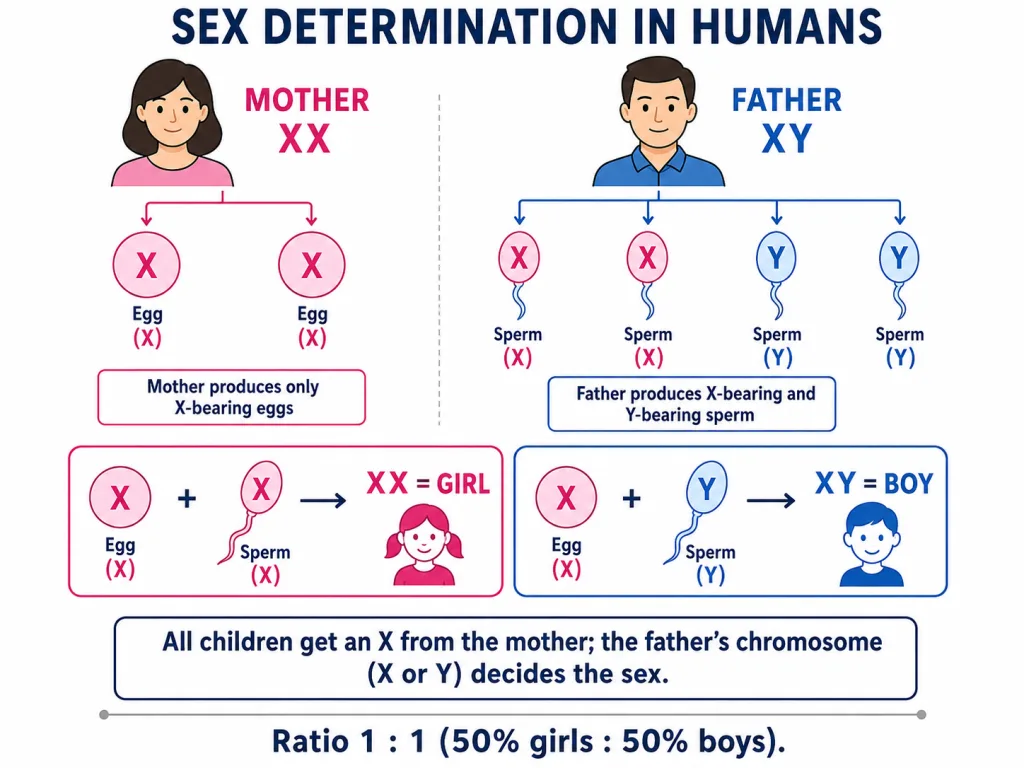
Now trace the inheritance of X and Y:
- The mother is XX, so every egg carries an X.
- The father is XY, so half his sperms carry X and half carry Y.
At fertilisation:
- An X-sperm + X-egg → XX = girl.
- A Y-sperm + X-egg → XY = boy.
So all children receive an X from the mother regardless of sex. The child's sex is therefore decided by what it inherits from the father — an X gives a girl, a Y gives a boy. On average, half the children are boys and half are girls (a 1:1 ratio).
[Board Trap] A common value-based point: since the father's chromosome (X or Y) determines the child's sex, it is scientifically wrong to blame the mother for the sex of a child.
Memory Capsule — Section 7
Quick revision: sex determination.
1. Sex is decided differently in different species — temperature (some reptiles), sex change (snails), genes (humans). 2. Humans: 23 pairs = 22 autosome pairs + 1 sex-chromosome pair. *3. Female = XX; Male = XY. *4. Mother's eggs → all X; father's sperms → half X, half Y.* 5. X-sperm → girl (XX); Y-sperm → boy (XY). The father decides the sex. 6. Ratio ≈ 1 : 1 (50% boys : 50% girls).
Solved Examples
Example 1: NCERT — How is Sex Determined?
How is the sex of the child determined in human beings?
Solution: Humans have a pair of sex chromosomes: females are XX and males are XY.
- The mother (XX) gives an X to every child.
- The father (XY) gives either an X or a Y.
- If the child gets the father's X, it is a girl (XX); if it gets the father's Y, it is a boy (XY).
Thus the father's chromosome determines the child's sex.
Takeaway: Mother always gives X; the father's X or Y decides girl or boy.
Example 2: Autosomes vs Sex Chromosomes
What is the difference between autosomes and sex chromosomes in humans?
Solution:
- Autosomes: the 22 pairs of chromosomes that are the same in both sexes and carry most body-trait genes.
- Sex chromosomes: the 1 pair that determines sex — XX in females, XY in males.
Takeaway: 22 autosome pairs + 1 sex-chromosome pair = 23 pairs in humans.
Example 3: The 1:1 Ratio
Why are boys and girls born in roughly equal numbers?
Solution: The father (XY) produces half X-sperms and half Y-sperms. Since an X-sperm gives a girl and a Y-sperm gives a boy, and both are made in equal numbers, the chances of a boy and a girl are equal — giving an approximately 1:1 (50:50) ratio.
Takeaway: Equal X and Y sperms ⇒ equal chance of boy or girl.
Example 4: Who Determines the Sex?
A couple is blamed for having only daughters. Explain scientifically who determines the sex of a child.
Solution: The mother always contributes an X chromosome. The father contributes either an X (→ girl) or a Y (→ boy). Therefore the sex of the child is determined by the father's chromosome, not the mother's. Blaming the mother is scientifically incorrect.
Takeaway: A frequent value-based/board question — the father's sperm (X or Y) decides the sex.