
Genes Control Traits through Proteins
How does a gene actually cause a trait? The answer connects DNA to proteins.
Cellular DNA is the information source for making proteins. A section of DNA that carries the information for one protein is called the gene for that protein.
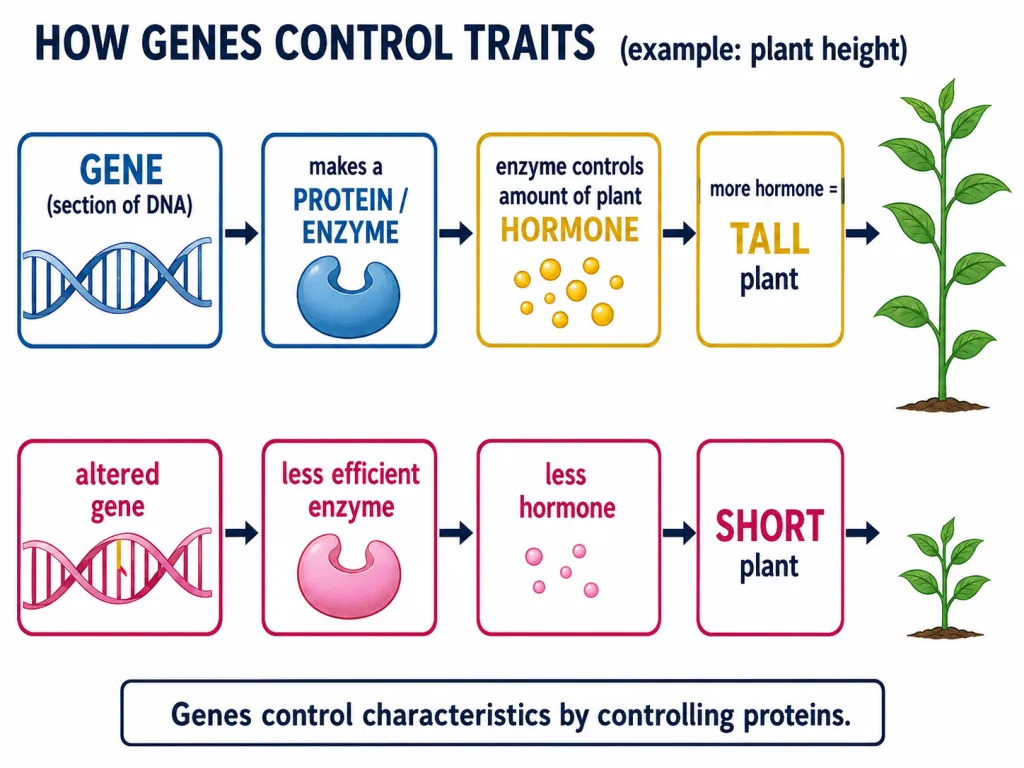
Take plant height as an example:
- Plants have hormones that trigger growth; height depends on the amount of a particular hormone.
- The amount of hormone made depends on an enzyme (a protein) that helps make it.
- If the gene for that enzyme works efficiently → lots of hormone → tall plant.
- If the gene is altered so the enzyme is less efficient → less hormone → short plant.
So genes control characteristics (traits) by controlling proteins.
Two Copies of Every Gene
Mendel's results only make sense if both parents contribute equally to the offspring's DNA. If both parents help decide a trait, then each must contribute a copy of the same gene.
This means every organism (like a pea plant) must have two sets of all genes — one inherited from each parent. And for this to work across generations, each germ cell (gamete) must carry only one set of genes; otherwise the number of gene sets would double every generation.
Key Point: Body cells = two copies of each gene; germ cells (gametes) = one copy. Fertilisation restores the pair.
Chromosomes — Why Traits Assort Independently
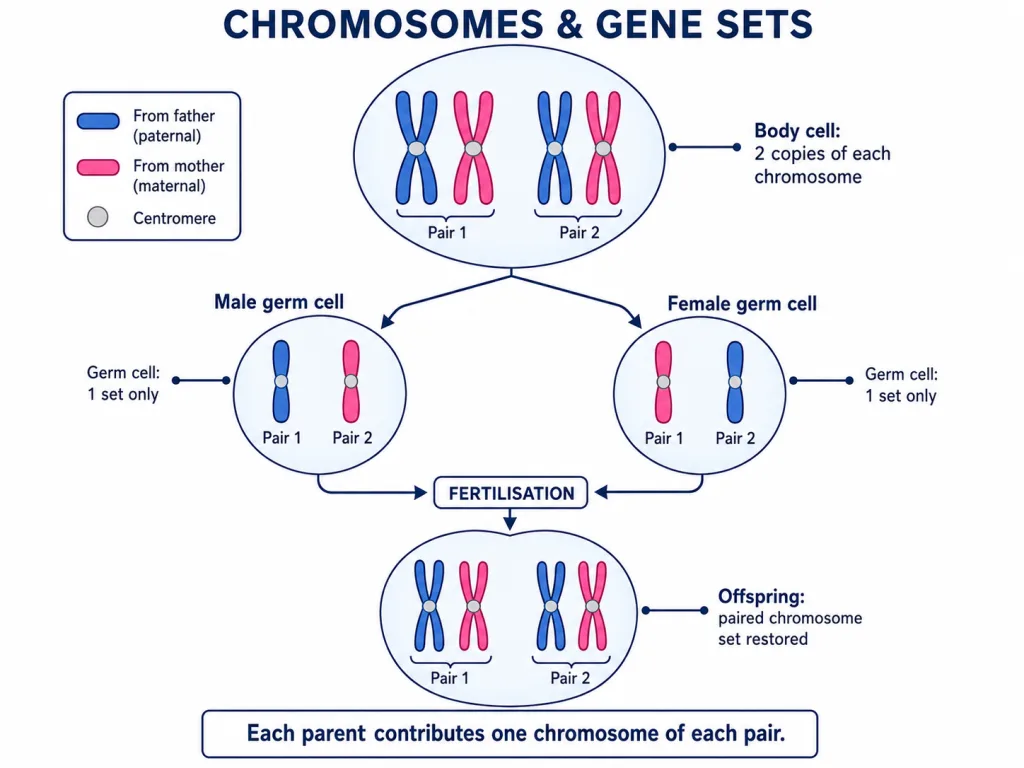
Here's a puzzle: if a whole gene set were inherited as one long thread, then two traits (like seed shape 'R' and colour 'y') would always stay linked — and could not be inherited independently. But Mendel showed they are independent. How?
Because a gene set is not a single thread — it is carried as separate independent pieces, each called a chromosome.
- Each cell has two copies of each chromosome — one from the father, one from the mother.
- Every germ cell takes one chromosome from each pair (which may be maternal or paternal in origin).
- When two germ cells combine at fertilisation, the normal (paired) chromosome number is restored, keeping the DNA of the species stable.
Because different chromosomes are sorted independently into gametes, genes on different chromosomes are inherited independently — exactly what the dihybrid cross showed.
[NEET Important] This chromosome mechanism explains Mendel's results and is used by all sexually reproducing organisms.
Memory Capsule — Section 6
Quick revision: how traits are expressed.
1. Gene = section of DNA that codes for one protein. 2. Pathway: gene → protein/enzyme → hormone amount → trait (efficient enzyme → tall; altered → short). *3. Genes control traits by controlling proteins. *4. Body cells have two copies of each gene/chromosome (one per parent); germ cells have one.* 5. Gene sets are carried as separate chromosomes, not one thread → genes on different chromosomes assort independently. 6. Fertilisation restores the paired chromosome number → species DNA stays stable.
Solved Examples
Example 1: Gene → Protein → Trait
Explain, using plant height, how a gene controls a trait.
Solution: A gene carries the information to make a protein (enzyme). For height, this enzyme controls how much growth hormone is made:
- Efficient enzyme → more hormone → tall plant.
- An altered gene making a less-efficient enzyme → less hormone → short plant.
Thus genes control traits by controlling the proteins (enzymes) that run the body's processes.
Takeaway: Gene → enzyme → hormone → height. Change the gene, change the trait.
Example 2: NCERT — Equal Genetic Contribution
How is the equal genetic contribution of male and female parents ensured in the progeny?
Solution: Each parent's genes are carried on chromosomes, present as pairs in body cells. During gamete formation, each germ cell receives one chromosome of each pair, so a gamete has a single set of genes. At fertilisation, the male and female gametes fuse, and the offspring receives one set of chromosomes from the father and one from the mother — ensuring an equal genetic contribution from both.
Takeaway: One set from each gamete → equal contribution → paired number restored.
Example 3: Why Germ Cells Have One Set
Why must a germ cell carry only one set of genes?
Solution: If each germ cell carried a full (double) set, then when two germ cells combined the offspring would have four sets, and this would double every generation. To keep the number of gene sets constant, each germ cell carries only one set, so that fertilisation restores exactly two sets in the offspring.
Takeaway: Halving in gametes + doubling at fertilisation keeps the chromosome number stable.
Example 4: Chromosomes and Independent Inheritance
How do chromosomes explain the independent inheritance of two traits?
Solution: Genes are carried on separate chromosomes, not on one continuous thread. During gamete formation, each chromosome pair is sorted independently, so a gamete may get the maternal copy of one chromosome and the paternal copy of another. Genes on different chromosomes therefore end up in new combinations — which is why traits like seed shape and colour are inherited independently.
Takeaway: Independent sorting of chromosomes ⇒ independent inheritance of their genes.