
Following Two Traits at Once
What happens when pea plants differing in two traits are crossed? This is a dihybrid cross. Mendel crossed a plant with round, yellow seeds and a plant with wrinkled, green seeds.
Two things must be tracked here: seed shape (round R / wrinkled r) and seed colour (yellow Y / green y). Round and yellow turn out to be dominant.
F1 generation: all seeds were round and yellow (RrYy) — the two dominant traits appeared together.
The F2 Generation — 9:3:3:1
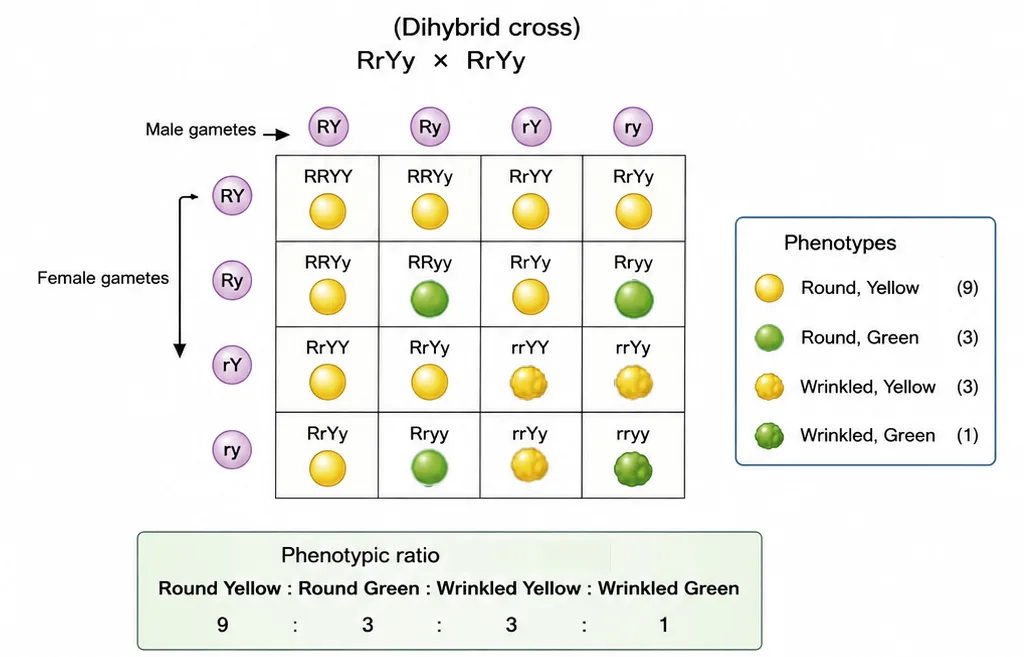
When the F1 plants (RrYy) were self-pollinated, the F2 seeds appeared in four types:
- Round, yellow (both dominant)
- Round, green (new combination)
- Wrinkled, yellow (new combination)
- Wrinkled, green (both recessive)
The ratio was 9 : 3 : 3 : 1. Mendel's actual counts were about 315 round-yellow : 108 round-green : 101 wrinkled-yellow : 32 wrinkled-green (out of 556 seeds) — very close to 9:3:3:1.
The key point: new combinations appeared — round with green, and wrinkled with yellow — that were not in the parents.
Independent Inheritance
The appearance of these new combinations proves something important: the seed-shape trait and the seed-colour trait are inherited independently of each other.
If shape and colour were linked (always inherited together), you would only ever get round-yellow and wrinkled-green — the parental combinations. But because round can pair with green, and wrinkled with yellow, the two traits must assort independently.
This is Mendel's Law of Independent Inheritance (Independent Assortment): during gamete formation, the alleles of one gene separate independently of the alleles of another gene.
[NEET Important] Monohybrid F2 = 3:1; Dihybrid F2 = 9:3:3:1. The 9:3:3:1 is essentially (3:1) × (3:1) for two independent traits.
Memory Capsule — Section 5
Quick revision: the dihybrid cross.
1. Dihybrid cross = two traits at once (seed shape R/r + colour Y/y). 2. Round (R) and Yellow (Y) are dominant. *3. F1 = all round, yellow (RrYy). *4. F2 = 9 : 3 : 3 : 1 (round-yellow : round-green : wrinkled-yellow : wrinkled-green).* 5. New combinations (round-green, wrinkled-yellow) appear → two traits inherited independently (Law of Independent Assortment). 6. 9:3:3:1 = (3:1) × (3:1).
Solved Examples
Example 1: NCERT — Independent Inheritance
How do Mendel's experiments show that traits are inherited independently?
Solution: In the dihybrid cross (round-yellow × wrinkled-green), the F2 offspring included new combinations — tall/round-green and wrinkled-yellow — that were not present in the parents. If seed shape and colour were always inherited together, only the parental combinations (round-yellow, wrinkled-green) would appear. The appearance of new combinations shows the two traits are inherited independently.
Takeaway: New combinations in F2 = proof of independent inheritance.
Example 2: The F2 Ratio
In a dihybrid cross RrYy × RrYy, state the F2 phenotype ratio and name the four phenotypes.
Solution: The F2 phenotype ratio is 9 : 3 : 3 : 1:
- 9 round, yellow
- 3 round, green
- 3 wrinkled, yellow
- 1 wrinkled, green
Takeaway: Learn the 9:3:3:1 with its four phenotype classes in order.
Example 3: Gametes of a Dihybrid
What types of gametes can a RrYy plant produce?
Solution: Each gamete gets one allele of each gene, and the two genes assort independently. So RrYy produces four kinds of gametes in equal numbers: RY, Ry, rY, ry.
Takeaway: A dihybrid (two heterozygous genes) makes 4 gamete types — the basis of the 4×4 Punnett square.
Example 4: Counting a Phenotype
In the F2 of a dihybrid cross of 16 offspring, how many are expected to show both recessive traits (wrinkled, green)?
Solution: In the 9:3:3:1 ratio, the both-recessive class (wrinkled, green) is 1 out of 16. So out of 16 offspring, about 1 is expected to be wrinkled and green (genotype rryy).
Takeaway: The rarest class (1/16) is the double recessive; the commonest (9/16) is the double dominant.