
What is Heredity?
The most obvious result of reproduction is the creation of individuals of similar design — a human baby always has the basic features of a human being, not a cat or a plant. Heredity is the transfer of characters (traits) from parents to their offspring, and the rules of heredity decide how these traits are reliably inherited.
Yet a child does not look exactly like its parents, and human populations show a great deal of variation. So heredity explains both the similarity (why offspring resemble parents) and, together with variation, the differences.
Inherited Traits — an Example
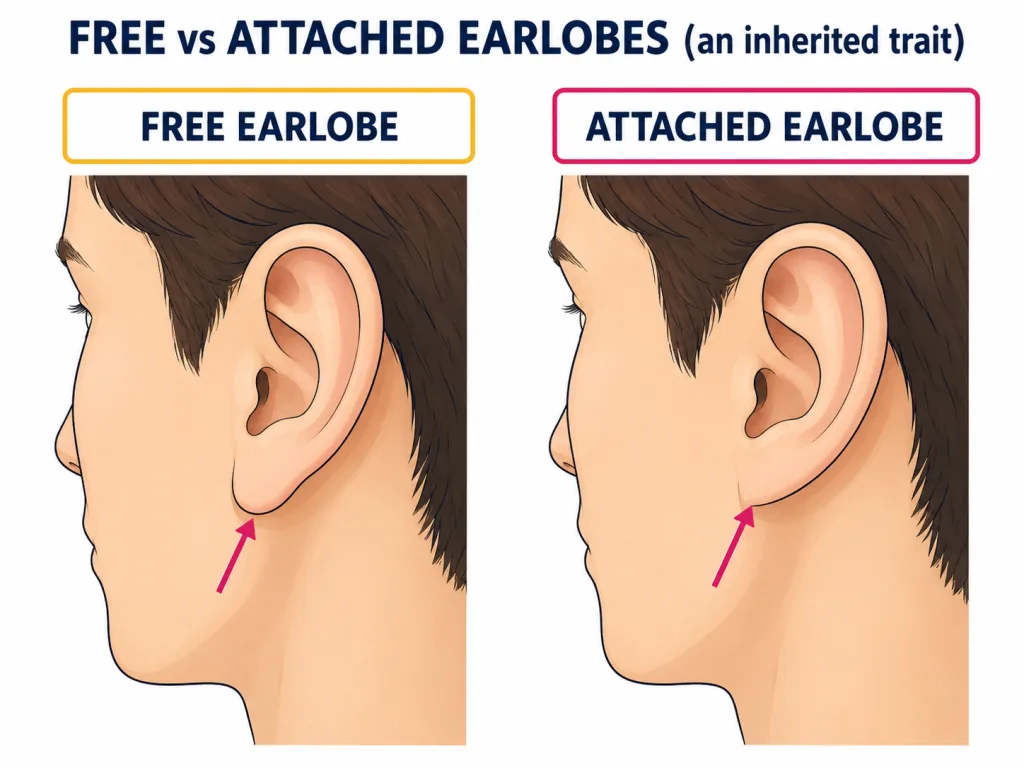
A trait is a characteristic feature — like height, seed shape, or the type of earlobe. Some traits are inherited (passed from parents through DNA).
Take earlobes: in some people the lowest part of the ear hangs free (free earlobe); in others it is attached directly to the side of the head (attached earlobe). These are two inherited variants found in human populations. If you compare students' earlobes with those of their parents, you can work out a rule for how earlobe type is inherited — exactly the kind of study that reveals the rules of heredity.
[Board Tip] Free vs attached earlobes is the standard NCERT example of a simple inherited human trait — remember it.
Two Versions of Every Trait
Here is the central idea that makes inheritance work: both the father and the mother contribute practically equal amounts of genetic material (DNA) to the child.
This means each trait can be influenced by both paternal and maternal DNA — so for every trait, a child carries two versions (one from each parent). These two versions may be identical or different, depending on the parents.
Which of the two versions actually shows up in the child? That question is exactly what Mendel answered with his famous pea-plant experiments (next section).
Key Point: Each trait in a sexually reproducing organism has two copies of a "factor" (gene) — one from each parent.
Memory Capsule — Section 2
Quick revision: heredity and inherited traits.
1. Heredity = transfer of traits from parents to offspring. 2. Offspring are similar to parents (basic design) yet not identical (variation). 3. A trait = a characteristic feature (height, seed shape, earlobe type). 4. Free vs attached earlobes = NCERT example of an inherited human trait. 5. Father and mother contribute equal DNA → each trait has two versions (one per parent), which may be same or different.
Solved Examples
Example 1: Define Heredity and Trait
What is heredity? What is a trait? Give one example of an inherited human trait.
Solution:
- Heredity is the transfer of characters (traits) from parents to their offspring through DNA.
- A trait is a distinct characteristic feature of an organism.
- Example: free or attached earlobes (also eye colour, height, etc.).
Takeaway: Learn a crisp definition of heredity plus one NCERT example.
Example 2: Why Two Versions of a Trait?
Why does each child carry two versions of every trait?
Solution: Because both parents contribute practically equal amounts of genetic material (DNA) to the child. The child therefore receives one copy of the factor (gene) for each trait from the father and one from the mother — giving two versions per trait. These may be identical or different.
Takeaway: Two parents → two gene copies per trait. This is the basis of Mendel's rules.
Example 3: Similar Yet Different
A child has all the basic features of a human being but does not look exactly like either parent. Explain.
Solution: Heredity ensures the child inherits the basic human body design (making it clearly human and similar to its parents). At the same time, the child receives a new combination of gene versions from the two parents, plus small variations — so it is similar but not identical to either parent.
Takeaway: Similarity comes from inheritance; the differences come from new gene combinations and variation.