
Why Do Offspring Vary?
In the last chapter we saw that reproduction produces new individuals that are similar, but subtly different. Even asexual reproduction produces a little variation (because DNA copying is never perfectly accurate), and sexual reproduction maximises the number of successful variations.
Look at a field of sugarcane — the plants (produced asexually, by vegetative propagation) show very little variation. But among human beings, or other sexually reproducing animals, you can see many distinct variations between individuals. In this chapter we study how these variations are created and inherited — the subject of heredity.
Key Point: Little variation → asexual reproduction. More variation → sexual reproduction.
Accumulation of Variation over Generations
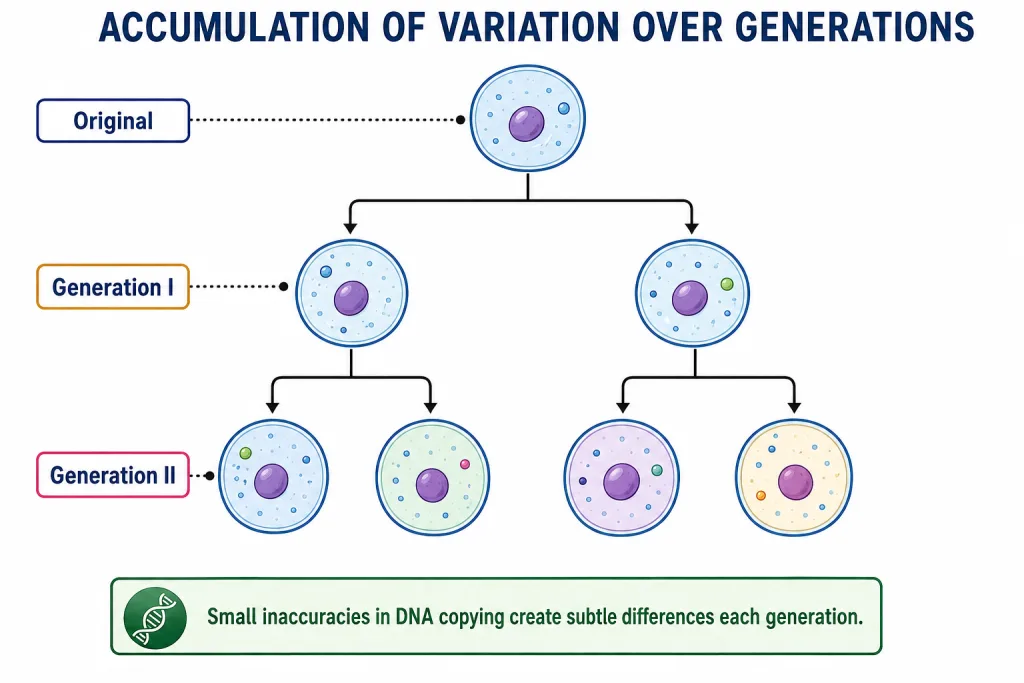
Inheritance from the previous generation gives the next generation both a common basic body design and small changes in it. Now think what happens as generations pass:
- One organism gives rise to two individuals — similar, but with subtle differences.
- Each of those gives rise to two more.
- By the bottom row, the four individuals are all different from one another — some differences are newly created, others are inherited from their (already different) parents.
So variation accumulates generation after generation. In asexual reproduction (e.g. a dividing bacterium), the differences are only the minor ones from DNA-copying errors. In sexual reproduction, much greater diversity is generated (as the rules of inheritance will show).
Selection of Variants by the Environment
Do all variations in a species have an equal chance of surviving? No. Depending on the nature of the variation, different individuals have different advantages.
For example, bacteria that can withstand heat survive better in a heat wave. The environment thus "selects" some variants over others. This selection of variants by environmental factors is the basis of evolution.
[NEET Important] Two linked ideas: (1) reproduction creates variation; (2) the environment selects among those variations. Together they drive evolutionary change.
Memory Capsule — Section 1
Quick revision: variation and its accumulation.
1. Reproduction makes offspring similar but subtly different. 2. Asexual → little variation (only DNA-copying errors); Sexual → more variation. 3. Variation accumulates over generations — bottom row all differ. 4. Variations do not have equal survival chances; the environment selects variants (e.g. heat-resistant bacteria). 5. Creation of variation + selection = basis of evolution.
Solved Examples
Example 1: NCERT — Which Trait Arose Earlier?
If a trait A exists in 10% of a population of an asexually reproducing species and a trait B exists in 60% of the same population, which trait is likely to have arisen earlier?
Solution: Trait B is likely to have arisen earlier. In asexual reproduction, variations are passed on to offspring over generations. A trait present for a longer time has had more generations to spread, so it is found in a larger fraction of the population. Since B (60%) is far more common than A (10%), B most likely appeared earlier.
Takeaway: More widespread trait (in an asexual population) ⇒ generally the older trait.
Example 2: NCERT — How Variation Promotes Survival
How does the creation of variations in a species promote survival?
Solution: Variations give different individuals different advantages. If the environment changes (temperature rise, new disease, scarcity of food), some variants will happen to be suited to the new conditions and will survive and reproduce, while others may not. Thus variation improves the chance that at least some members of the species survive a change — ensuring the survival of the species over time.
Takeaway: Variation is the species' insurance against a changing environment.
Example 3: Asexual vs Sexual Variation
Why does sexual reproduction produce more variation than asexual reproduction?
Solution:
- In asexual reproduction, offspring come from a single parent, so the only differences are the minor errors in DNA copying.
- In sexual reproduction, offspring receive DNA from two different parents, each already carrying its own accumulated variations. Combining these creates new combinations, greatly increasing diversity.
Takeaway: Two parents + recombination ⇒ far more variation than copying errors alone.