
Dominant and Recessive Traits
From the monohybrid cross we learned that each trait is controlled by two copies of a factor (gene). Let's name the two versions of the height gene: T (tall) and t (short).
- A single T is enough to make the plant tall — so TT and Tt are both tall.
- The plant is short only if both copies are t — so only tt is short.
A trait like T, which shows up even when only one copy is present, is called a dominant trait. A trait like t, which is hidden unless both copies are present, is called a recessive trait.
Key Point: Dominant needs one copy to show; recessive needs both copies to show.
The Monohybrid Punnett Square
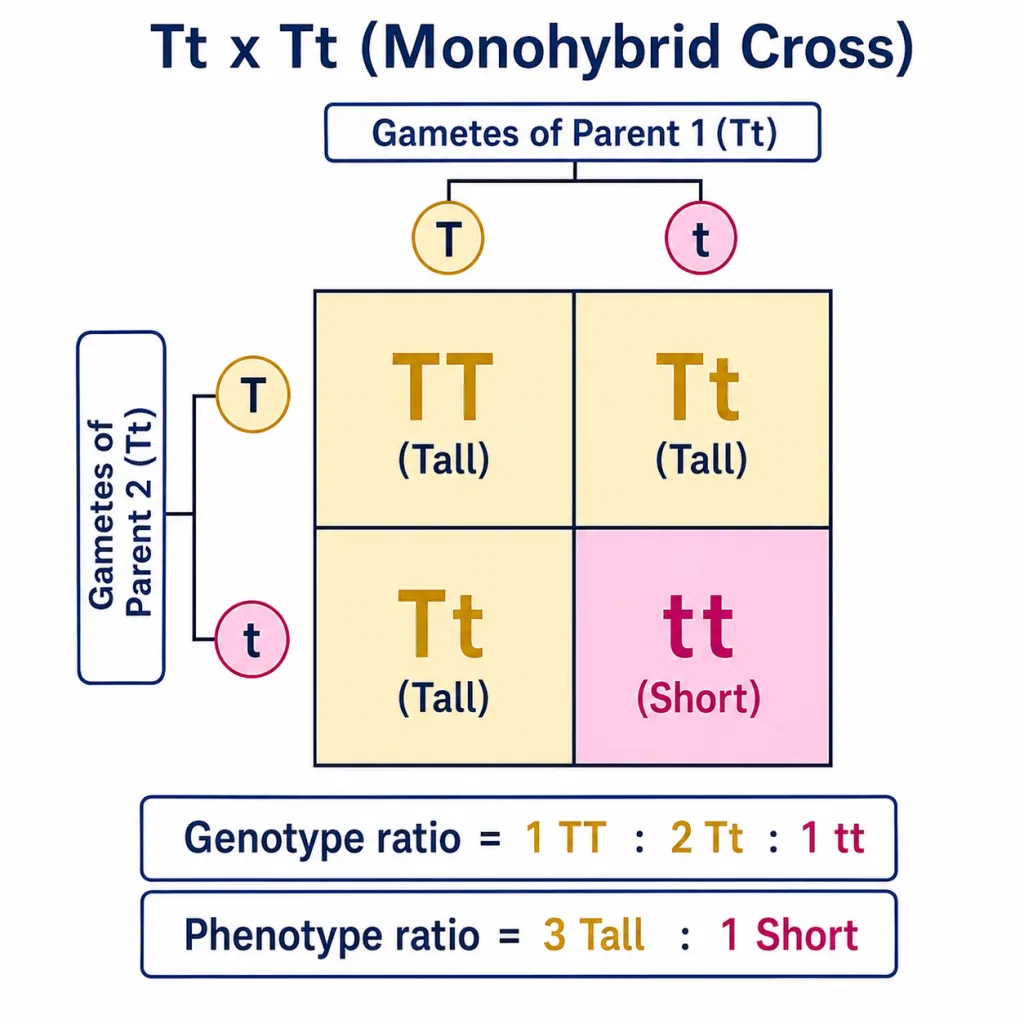
To work out the F2, cross two F1 plants: Tt × Tt. Each parent makes two kinds of gametes — T and t. A Punnett square combines them:
| T | t | |
|---|---|---|
| T | TT | Tt |
| t | Tt | tt |
The four results are TT, Tt, Tt, tt.
- Genotype ratio = 1 TT : 2 Tt : 1 tt (i.e. 1:2:1).
- Phenotype ratio = 3 tall : 1 short (because TT and Tt are both tall).
This is exactly the 3:1 ratio Mendel observed. To confirm the underlying 1:2:1, one would self-pollinate each F2 plant and see which ones breed true.
Key Genetics Terms
Let's fix the vocabulary you'll use throughout genetics:
- Gene: a unit of inheritance; a section of DNA that controls a trait.
- Alleles: the different versions of a gene (e.g. T and t).
- Genotype: the genetic make-up (the letters), e.g. Tт, tt.
- Phenotype: the visible characteristic (the appearance), e.g. tall, short.
- Homozygous (pure): both alleles the same — TT or tt.
- Heterozygous (hybrid): the two alleles different — Tt.
- Dominant allele: expressed even in a single copy (T).
- Recessive allele: expressed only when present in both copies (t).
[NEET Important] Genotype vs phenotype is a favourite trap: TT and Tt have the same phenotype (tall) but different genotypes.
Memory Capsule — Section 4
Quick revision: rules of inheritance and key terms.
1. Dominant (T) shows with one copy; recessive (t) needs both copies. 2. TT & Tt = tall; tt = short. 3. Tt × Tt → genotype 1 TT : 2 Tt : 1 tt; phenotype 3 tall : 1 short. 4. Terms: gene, alleles, genotype (letters), phenotype (looks), homozygous (TT/tt), heterozygous (Tt). *5. Same phenotype, different genotype: TT and Tt both look tall. *6. Punnett square = tool to combine gametes and predict offspring.*
Solved Examples
Example 1: Genotype vs Phenotype
In pea plants, T (tall) is dominant over t (short). Give the phenotype of TT, Tt and tt.
Solution:
- TT → tall (homozygous dominant)
- Tt → tall (heterozygous; T is expressed)
- tt → short (homozygous recessive)
Takeaway: Both TT and Tt are tall — same phenotype, different genotype.
Example 2: The Tt × Tt Cross
Cross two heterozygous tall plants (Tt × Tt). Give the genotype and phenotype ratios.
Solution: Gametes: each parent gives T and t. Punnett square:
| T | t | |
|---|---|---|
| T | TT | Tt |
| t | Tt | tt |
- Genotype ratio = 1 TT : 2 Tt : 1 tt
- Phenotype ratio = 3 tall : 1 short
Takeaway: This is the classic monohybrid F2 result.
Example 3: A Test-Type Cross (Tt × tt)
Cross a heterozygous tall plant (Tt) with a short plant (tt). What are the offspring?
Solution: Gametes: Tt gives T and t; tt gives t and t. Punnett square:
| t | t | |
|---|---|---|
| T | Tt | Tt |
| t | tt | tt |
- Genotype: 2 Tt : 2 tt = 1 Tt : 1 tt
- Phenotype: 1 tall : 1 short (50% tall, 50% short)
Takeaway: Crossing with the recessive (tt) reveals the hidden allele — a "test cross\".
Example 4: Reasoning from a Ratio
A cross gives offspring in a 3:1 ratio for a trait. What were the likely genotypes of the two parents?
Solution: A 3:1 phenotype ratio is the signature of a cross between two heterozygotes: Tt × Tt. Both parents show the dominant phenotype, yet one quarter of the offspring show the recessive phenotype.
Takeaway: 3:1 in the offspring ⇒ both parents were hybrids (Tt × Tt).