
Gregor Mendel — the Father of Genetics
Gregor Johann Mendel (1822–1884) was educated in a monastery and studied science and mathematics at the University of Vienna. He grew pea plants in his monastery garden. Many people had studied inheritance before, but Mendel was the first to keep an exact count of how many individuals showed each trait in every generation. By blending biology with mathematics, he arrived at the laws of inheritance.
Why the garden pea?
The pea plant was a clever choice: it has several easily visible contrasting characters — for example round/wrinkled seeds, tall/short plants, white/violet flowers — and it can be self-pollinated or cross-pollinated as needed.
The Monohybrid Cross (One Trait)
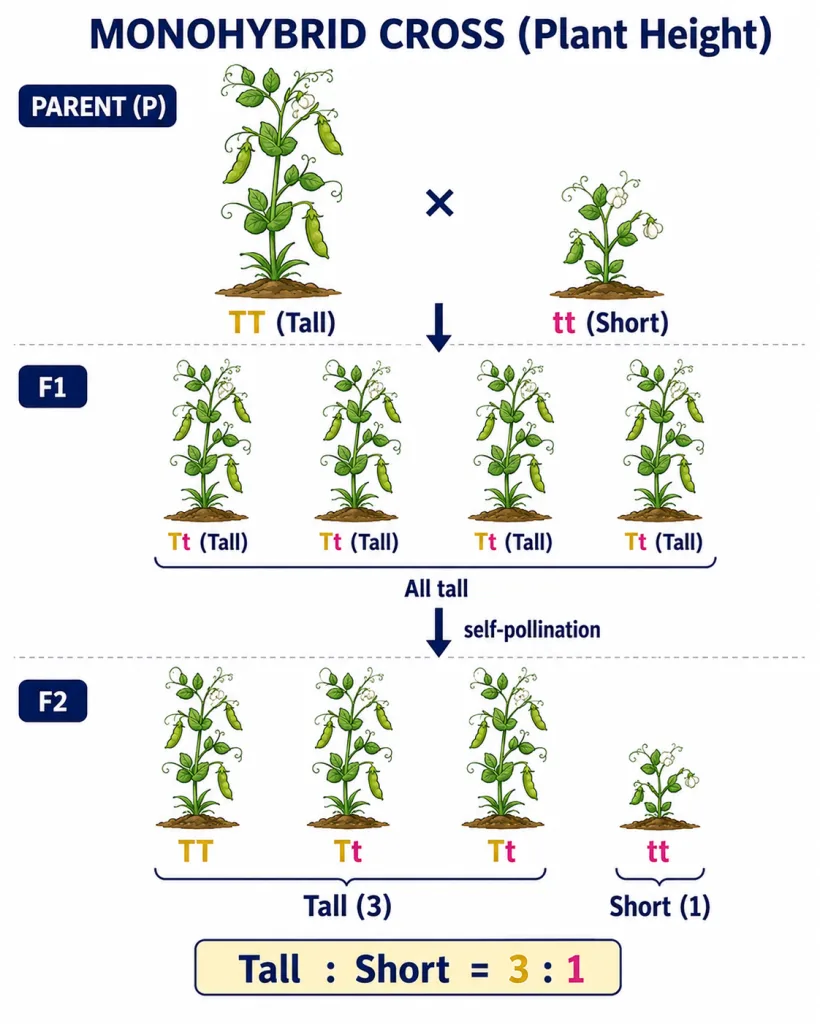
A cross that follows one trait is called a monohybrid cross. Mendel crossed a tall pea plant with a short pea plant and counted the offspring.
First generation (F1): All the offspring were tall — there were no medium-height plants. So only one parental trait appeared, not a mixture of the two.
This raised a question: are these F1 tall plants exactly the same as the tall parent? To find out, Mendel let the F1 tall plants self-pollinate.
The F2 Generation — a 3:1 Ratio
When the F1 tall plants were self-pollinated, the second generation (F2) was not all tall. Instead, about one quarter were short — the shortness had reappeared!
So the F2 showed tall and short plants in a ratio of 3 : 1.
What does this tell us?
- The shortness trait was present (hidden) in the F1 plants but was not expressed — only tallness showed.
- This led Mendel to propose that two copies of a factor (gene) control each trait in a sexually reproducing organism. These two copies may be identical or different.
Using T for the tall factor and t for the short factor: the tall parent is TT, the short parent is tt, and the F1 plants are Tt (tall, because T is expressed). We will work out the F2 in the next section.
[Board Trap] The classic monohybrid result is F1 = all tall; F2 = 3 tall : 1 short. Memorise both.
Memory Capsule — Section 3
Quick revision: Mendel and the monohybrid cross.
1. Mendel — used pea plants; first to count individuals per trait per generation. 2. Pea chosen for contrasting characters (round/wrinkled, tall/short, violet/white) + easy self/cross-pollination. 3. Monohybrid cross = one trait. Tall (TT) × Short (tt). 4. F1 = all tall (Tt) — only one trait shows; no medium plants. 5. F2 = 3 tall : 1 short — shortness reappears → each trait has two factors (genes).
Solved Examples
Example 1: Why the Pea Plant?
Why did Mendel choose the garden pea for his experiments?
Solution: Because the garden pea has several clearly visible contrasting characters (round/wrinkled seeds, tall/short plants, violet/white flowers) that are easy to score, and it can be self-pollinated or cross-pollinated as needed — making controlled breeding experiments possible.
Takeaway: Clear contrasting traits + controllable pollination = ideal experimental plant.
Example 2: The F1 Result
Mendel crossed a tall pea plant with a short one. What did the F1 generation look like, and what did this show?
Solution: All the F1 plants were tall — there were no medium-height plants. This showed that only one of the two parental traits (tallness) was expressed, not a blend of the two. Tallness is therefore the dominant trait and shortness is recessive.
Takeaway: F1 all tall ⇒ tallness is dominant; blending does not happen.
Example 3: The F2 Result and Its Meaning
What was the F2 ratio when Mendel self-pollinated the F1 tall plants, and what did it prove?
Solution: The F2 showed tall and short plants in a 3 : 1 ratio (about one quarter were short). This proved that the shortness trait had not disappeared — it was present but hidden (unexpressed) in the F1 plants. Hence each organism carries two factors (genes) for a trait, and a hidden recessive factor can reappear.
Takeaway: Reappearance of the short trait in F2 (3:1) proves two gene copies per trait.
Example 4: Writing the Genotypes
Using T for tall and t for short, write the genotypes of the tall parent, the short parent and the F1 plants.
Solution:
- Tall parent = TT
- Short parent = tt
- F1 plants = Tt (tall, because T is dominant and is expressed)
Takeaway: The F1 (Tt) is tall in appearance but secretly carries the recessive t.