
Asexual Reproduction Overview
'Asexual reproduction' = reproduction involving only ONE parent, with no fusion of gametes.
Offspring are genetically identical to the parent (clones).
Key Features
1. Single parent — no mate needed. 2. No gametes — no sperm/egg formation. 3. Clones produced — genetic identical copies. 4. Mitosis only — type of cell division. 5. Fast — rapid population growth. 6. Energy-efficient — less effort.
Methods of Asexual Reproduction
Six main methods:
1. Fission — single cell splits into two/many. 2. Budding — outgrowth develops into new individual. 3. Fragmentation — body breaks into pieces. 4. Regeneration — broken parts grow into new individuals. 5. Spore Formation — special cells (spores) develop into new organisms. 6. Vegetative Propagation — plants grow from non-reproductive parts.
Different organisms use different methods.
Why Asexual?
Useful when: 1. Environment is stable (no need for variation). 2. Quick population growth needed. 3. Mate not available. 4. Simple body structure.
Common in: bacteria, fungi, simple plants, some invertebrates.
[NCERT — important]
1. Fission
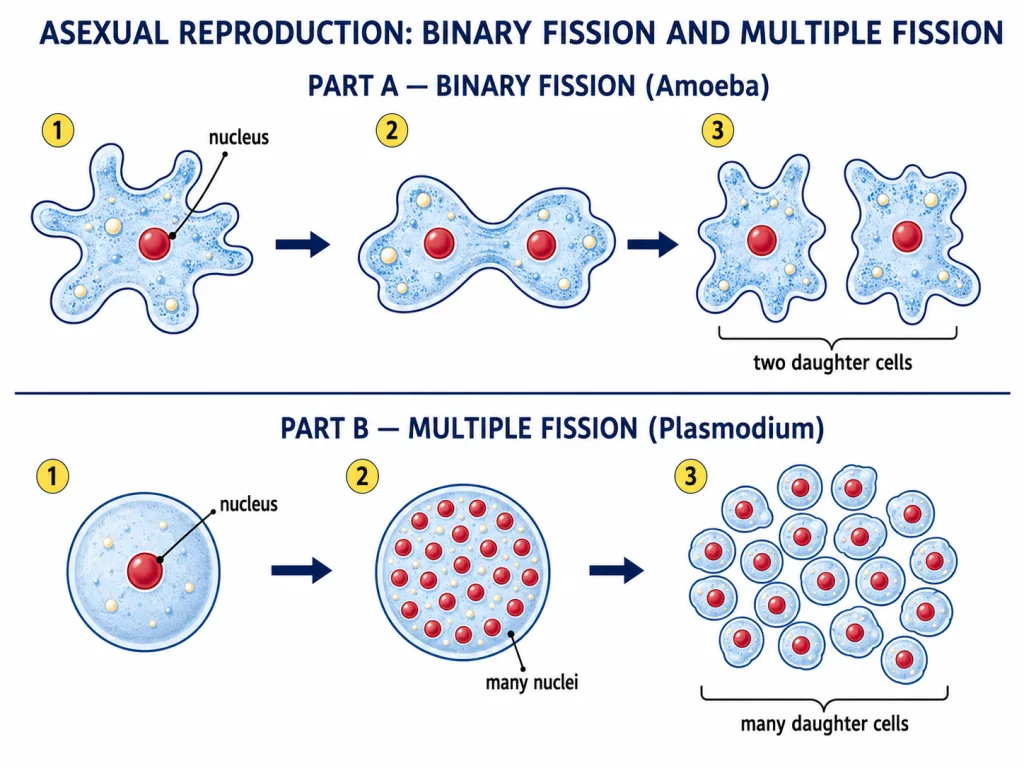
'Fission' = parent organism splits into two or more daughter organisms.
Types of Fission
A. Binary Fission
Single parent divides into TWO daughter cells.
Examples: 1. Bacteria — fastest reproduction (~20 min). 2. Amoeba — divides in any plane. 3. Paramecium — divides transversely. 4. Euglena — divides longitudinally.
Process in Amoeba: 1. DNA replicates. 2. Nucleus divides (karyokinesis). 3. Cytoplasm divides (cytokinesis). 4. Two daughter Amoebas form. 5. Each is genetically identical.
Cell division can occur in any plane in Amoeba.
Process in Paramecium: Divides transversely (across the body). One daughter inherits front, other inherits back.
Process in Leishmania: Has whip-like flagellum at one end. Divides longitudinally (along long axis). Specific orientation due to body structure.
Hence: organism's body structure determines fission plane.
B. Multiple Fission
Single parent divides into MANY daughter cells.
Examples: 1. Plasmodium (malaria parasite) — divides into many merozoites. 2. Some algae — produce multiple spores.
Process in Plasmodium: 1. Inside human RBC. 2. Nucleus divides multiple times (8-24 nuclei). 3. Each nucleus surrounds itself with cytoplasm. 4. Many small Plasmodium cells form. 5. Cell ruptures, releases new parasites.
Hence: multiple fission helps in rapid population growth.
Diagram: Binary Fission in Amoeba
Parent Amoeba
    |
    | (DNA replicates)
    |
Nucleus divides
    |
Cytoplasm divides
    |
Two Daughter Amoebas
Why Fission is Effective
1. Very fast (minutes). 2. No partner needed. 3. Continuous reproduction in favourable conditions. 4. Population can double every cycle.
This is why bacteria can multiply explosively in food, infections.
[NCERT — important]
2. Budding
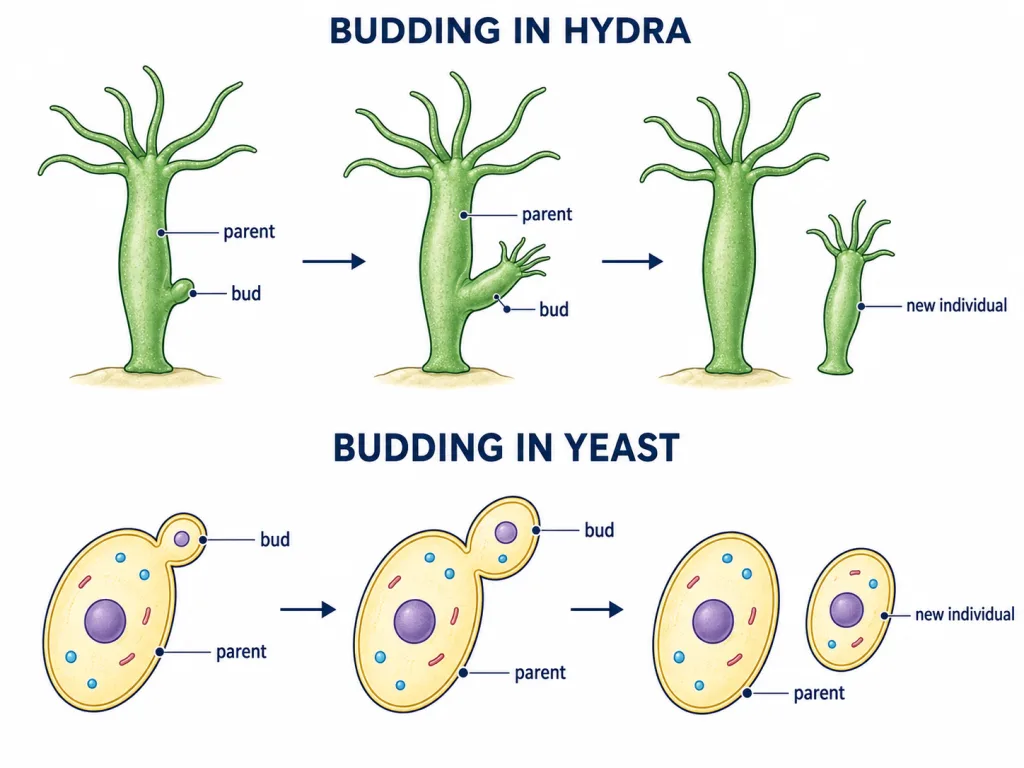
'Budding' = a small outgrowth (bud) forms on parent body, grows, and becomes a new individual.
Examples
A. Yeast (Unicellular fungus)
Process: 1. Bulge forms on parent yeast cell. 2. Nucleus divides; one part moves into bulge. 3. Bulge grows into bud. 4. Bud separates from parent. 5. Becomes new yeast cell.
Sometimes bud doesn't separate immediately → forms chain of buds.
Yeast budding is rapid in warm, moist conditions with sugar (used in baking, brewing).
B. Hydra (Multicellular animal)
Hydra = small freshwater animal (resembles sea anemone).
Process: 1. Outgrowth develops on Hydra's body wall. 2. Bud has all body parts (mouth, tentacles). 3. Bud grows in size. 4. Mature bud detaches from parent. 5. Lives independently.
Hydra can have multiple buds simultaneously.
Time: a few days to a week.
Comparison: Yeast vs Hydra Budding
| Feature | Yeast | Hydra |
|---|---|---|
| Type | Unicellular | Multicellular |
| Bud size | Small | Larger (mini Hydra) |
| Body parts | Only cell | Mouth, tentacles |
| Time | Hours | Days |
| Independence | Quick | After mature |
Why Budding Works
1. Mitotic division produces identical cells. 2. Energy-efficient. 3. New individual already partly developed when separated. 4. Suitable for stable environments.
Diagram: Budding in Hydra
Parent Hydra
   |
[Bud 1 forms on body wall]
   |
[Bud grows, develops mouth + tentacles]
   |
[Bud detaches]
   |
[New independent Hydra]
Sometimes bud separates only after fully developed → mini-Hydra.
Real-life Connection
Yeast budding is used in: 1. Baking — yeast makes bread rise. 2. Brewing — alcohol production. 3. Biotechnology — protein production.
[NCERT — important]
3. Fragmentation, 4. Regeneration, 5. Spore Formation
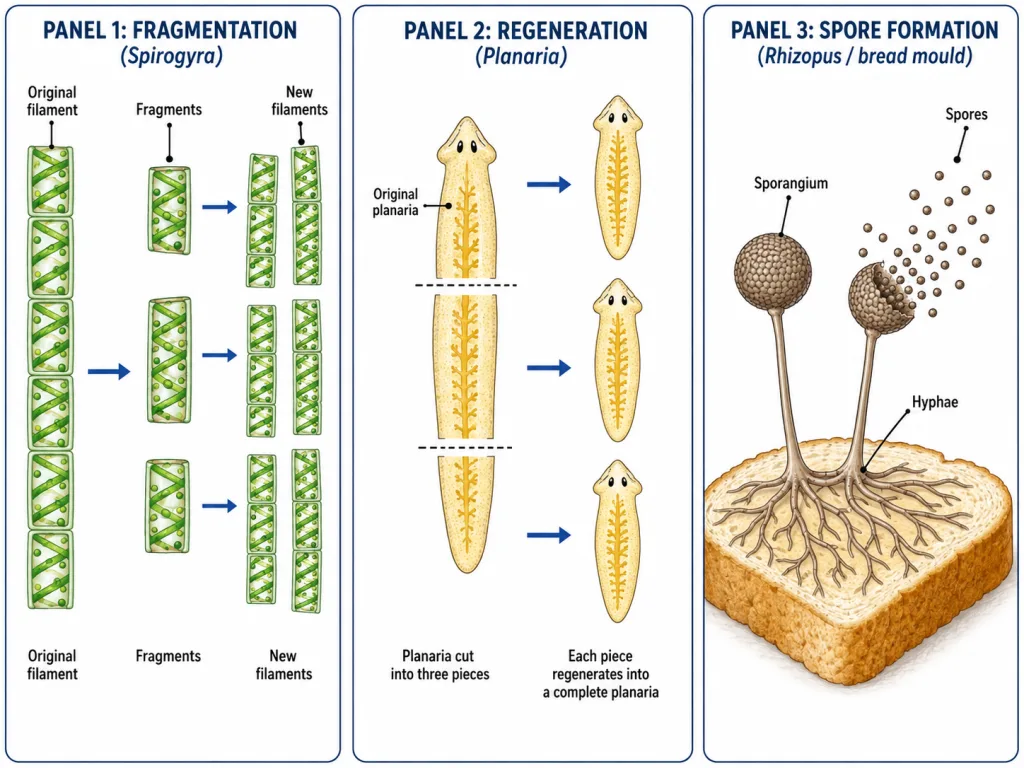
3. Fragmentation
'Fragmentation' = body breaks into pieces (fragments), each fragment grows into a new organism.
Example: Spirogyra (filamentous green alga)
Process: 1. Spirogyra grows as long thin filament. 2. Filament breaks into small fragments (due to current, disturbance). 3. Each fragment continues growing. 4. Each becomes new Spirogyra filament.
Common in algae, some plants.
Rapid spread possible in water bodies.
4. Regeneration
'Regeneration' = ability to grow back lost parts; in some organisms, broken parts can grow into complete individuals.
Example: Planaria (flatworm)
Process: 1. Planaria's body cut into pieces. 2. Each piece can regenerate into a complete worm! 3. Special cells called specialised regenerative cells divide rapidly. 4. They form different organs. 5. Complete worm forms from each piece.
Planaria is a 'reproductive marvel' — can be cut in 100 pieces and each becomes complete worm!
Other examples of regeneration: 1. Hydra — can regenerate from small piece. 2. Starfish — lost arms can regrow; sometimes severed arm becomes new starfish. 3. Lizard — tail regrows (but no full body regeneration).
Note: All organisms have some regenerative ability (wound healing), but only some can regenerate complete bodies.
Regeneration ≠ reproduction always — it's reproduction only when broken parts develop into complete organisms.
5. Spore Formation
'Spores' = special asexual reproductive cells with thick walls; can germinate into new organisms in favourable conditions.
Example: Rhizopus (bread mould)
Structure: 1. Hyphae (thread-like fungal body) on bread. 2. Some hyphae stand erect → sporangiophores. 3. Tips swell into round structures → sporangia (singular: sporangium). 4. Inside sporangium, many tiny spores form.
Process: 1. Sporangium ripens. 2. Wall ruptures. 3. Spores released into air. 4. Spores land on suitable surface (warm, moist, food). 5. Spore germinates → new mould forms.
Each spore can grow into new Rhizopus.
Why Spores are Successful
1. Many spores produced — high reproductive potential. 2. Light — easily dispersed by wind/water. 3. Thick walls — survive harsh conditions. 4. Resistant to drying, heat. 5. Long-lived — can wait for right conditions.
Hence: spores are nature's 'survival kit'.
Other Spore-forming Organisms
1. Mushrooms — produce spores in gills. 2. Ferns — produce spores in sori. 3. Mosses — produce spores in capsules. 4. Bacteria — produce endospores in stress.
Many fungi, lower plants, bacteria use spores.
Diagram: Sporangium of Rhizopus
Sporangium (round)
    | (releases spores)
  Spores (tiny, light)
    |
[Air dispersal]
    |
[Land on bread]
    |
New Rhizopus mould
[NCERT — important]
6. Vegetative Propagation
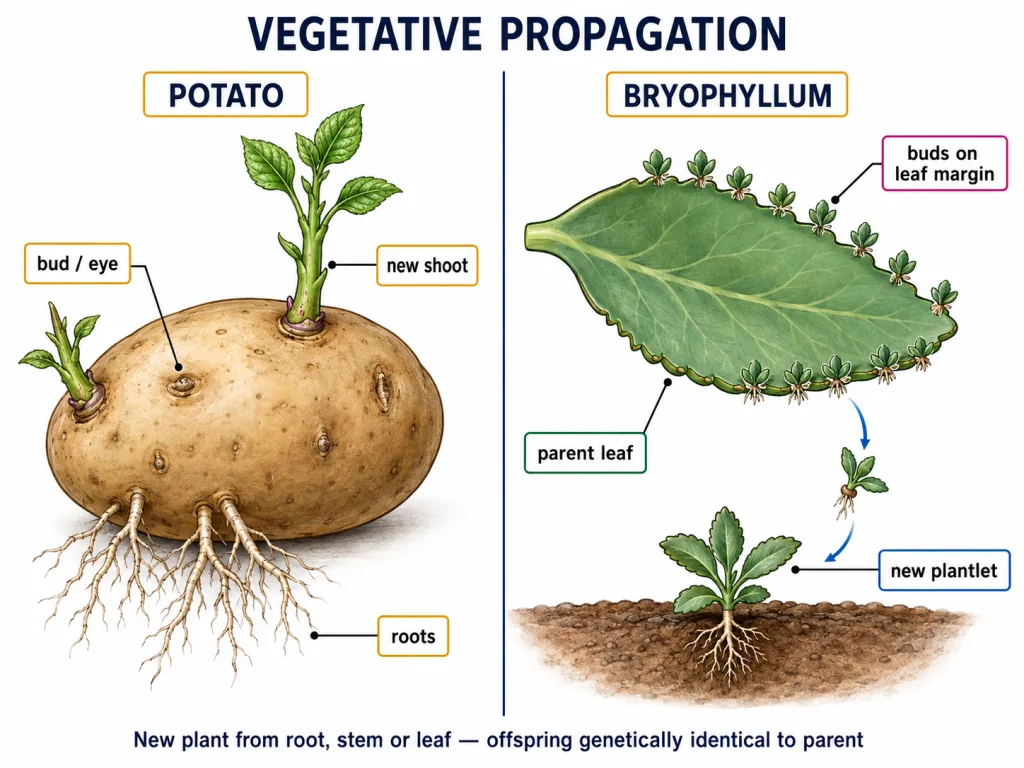
'Vegetative propagation' = plants reproduce from non-reproductive parts (roots, stems, leaves) without involving seeds.
Why Plants Use This
1. Faster than seeds — quick population. 2. Genetic uniformity — desired traits preserved. 3. Used in agriculture for crop multiplication. 4. Useful for sterile plants (banana, sugarcane). 5. One-step propagation — no seed dormancy.
Types of Vegetative Propagation
A. Through Roots
Some plants reproduce through modified roots: 1. Sweet potato — tuberous roots have buds; each bud grows into new plant. 2. Dahlia — same mechanism. 3. Carrot — taproot can sprout new shoots.
B. Through Stems
1. Underground Stems (Tubers, Rhizomes, Bulbs):
1. Potato — tuber has 'eyes' (axillary buds); each eye = new plant. 2. Ginger — rhizome (underground stem) sprouts. 3. Onion, Garlic — bulbs (modified stems with leaves). 4. Turmeric — rhizome.
2. Stem Cuttings:
Pieces of stem placed in soil grow new plant. 1. Rose — stem cutting in soil → new rose plant. 2. Sugarcane — set (piece) planted in field. 3. Hibiscus — stem cutting roots easily. 4. Bougainvillea, Money Plant — stem cuttings.
3. Runners:
Horizontal stems above ground. 1. Strawberry — runners produce new plants at nodes. 2. Grass — runners spread laterally.
C. Through Leaves
Some plants grow new individuals from leaf margins. 1. Bryophyllum — leaf margins have tiny notches with adventitious buds; each bud falls off, grows into new plant. 2. Begonia — leaf cuttings sprout new plants.
Bryophyllum is called 'mother of thousands' for this reason!
Artificial Methods of Vegetative Propagation
Used in agriculture/horticulture for desired plants:
1. Cutting: Stem/root cutting placed in soil → roots and shoots develop. Examples: rose, sugarcane.
2. Layering: Branch is bent down, partly buried in soil. Roots develop from buried part. Once rooted, separated from parent. Examples: jasmine, lemon, raspberry.
3. Grafting: Stem of one plant (scion) joined to root of another (stock). Both fuse and grow as one plant. Used for fruit trees: mango, apple, citrus. Combines best traits of two plants.
4. Tissue Culture: Modern technique. Small piece of plant tissue placed in nutrient medium. Cells multiply, form callus. Callus develops into new plantlet. Used for: orchids, banana, potato (large-scale). Advantage: many identical plants from one parent.
Advantages of Vegetative Propagation
1. Faster than seeds. 2. Desired traits preserved — same as parent. 3. Useful for seedless plants (banana, sugarcane). 4. Uniformity in commercial production. 5. Economic value — cheap mass production. 6. Successful in non-flowering season.
Disadvantages
1. No genetic variation — all plants susceptible to same diseases. 2. Disease can spread rapidly. 3. Cannot adapt to changing conditions. 4. Limited to certain plants — not all can propagate vegetatively.
Examples Summary Table
| Plant | Method | Part Used |
|---|---|---|
| Potato | Tuber | Underground stem |
| Ginger | Rhizome | Underground stem |
| Onion | Bulb | Modified stem |
| Sweet potato | Tuberous root | Modified root |
| Bryophyllum | Adventitious buds | Leaf margins |
| Strawberry | Runner | Above-ground stem |
| Rose | Cutting | Stem |
| Grass | Runner/rhizome | Stem |
| Mango | Grafting | Stem (artificial) |
| Banana | Tissue culture | Cells (artificial) |
Vegetative propagation = nature's photocopying method!
[NCERT + agricultural relevance]
Memory Capsule — Section 2
Quick revision: All asexual reproduction methods.
Six Methods
1. Fission — one parent splits. 2. Budding — bud forms, separates. 3. Fragmentation — body breaks into pieces. 4. Regeneration — broken parts grow into new. 5. Spore formation — spores germinate. 6. Vegetative propagation — plants from non-reproductive parts.
Examples Cheat Sheet
| Method | Example | Notes |
|---|---|---|
| Binary fission | Bacteria, Amoeba | Splits in 2 |
| Multiple fission | Plasmodium | Splits in many |
| Budding | Yeast, Hydra | Outgrowth |
| Fragmentation | Spirogyra | Body breaks |
| Regeneration | Planaria | Cut piece grows |
| Spore formation | Rhizopus | Spores in sporangium |
| Vegetative | Potato, Ginger | Stem/root parts |
Key Differences
Binary vs Multiple Fission: Binary: 2 daughter cells. Multiple: Many daughter cells.
Budding vs Fragmentation: Budding: small bud forms. Fragmentation: body breaks.
Regeneration vs Fragmentation: Both produce new from pieces. Regeneration: pieces accidentally cut. Fragmentation: pieces naturally break.
Important Plane of Fission
1. Amoeba — any plane. 2. Paramecium — transverse. 3. Leishmania — longitudinal.
Determined by body structure!
Plant Vegetative Propagation
Through: 1. Roots — sweet potato. 2. Stems — potato (tuber), ginger (rhizome), onion (bulb), sugarcane (cutting), strawberry (runner). 3. Leaves — Bryophyllum.
Artificial methods: 1. Cutting — rose, sugarcane. 2. Layering — jasmine. 3. Grafting — mango. 4. Tissue culture — orchids, banana.
One-Liner Insights
1. Asexual = clones (same DNA). 2. Fast and energy-efficient. 3. No mate needed. 4. Common in simple organisms. 5. Fungi prefer spores. 6. Plants love vegetative propagation.
Real-life Applications
1. Yeast for bread, beer. 2. Tissue culture for orchids, banana. 3. Grafting for fruit trees. 4. Cuttings for ornamental plants. 5. Bryophyllum in gardens.
[Quick reference for asexual!]
Example 1: NCERT — Binary vs Multiple Fission
Differentiate between binary fission and multiple fission. Give examples.
Solution:
Comparison
| Feature | Binary Fission | Multiple Fission |
|---|---|---|
| Number of daughter cells | 2 | Many (8-24+) |
| Time | Quick | Longer |
| Conditions | Favourable | Unfavourable too |
| Cell wall | Around mother cell | Around each daughter |
| Examples | Bacteria, Amoeba, Paramecium | Plasmodium, some algae |
Binary Fission
Single parent → 2 daughters.
Process in Amoeba: 1. DNA replicates. 2. Nucleus divides (karyokinesis). 3. Cytoplasm divides (cytokinesis). 4. Two genetically identical daughters.
Time: ~30 min (Amoeba), 20 min (bacteria).
Multiple Fission
Single parent → MANY daughters.
Process in Plasmodium: 1. Plasmodium enters human RBC. 2. Inside, nucleus divides multiple times (8-24 times). 3. Each nucleus surrounds itself with cytoplasm. 4. Cell wall forms around each nucleus. 5. Many daughter Plasmodium form in one cell. 6. RBC ruptures; releases parasites. 7. Each parasite enters new RBC.
This causes malaria fever cycles!
Why Multiple?
1. Quick population growth in single host. 2. Survival in adverse conditions (parasitic life). 3. High reproductive efficiency.
Examples
Binary:
- Bacteria (every species).
- Amoeba.
- Paramecium.
- Euglena.
- Yeast (sometimes).
Multiple:
- Plasmodium (malaria).
- Some algae (Chlamydomonas).
- Some protozoans.
[NCERT — Important]
Example 2: NCERT — Vegetative Propagation Advantages
What are the advantages of vegetative propagation? Give examples.
Solution:
Advantages
1. Faster than seeds: 1. New plants ready in weeks-months. 2. Seeds may take years (e.g., apple takes 5-10 years). 3. Quick crop turnover.
2. Genetic uniformity (clones): 1. All offspring identical to parent. 2. Desired traits preserved. 3. Predictable yield, taste, appearance.
3. Useful for seedless plants: 1. Banana — sterile, no seeds → vegetative propagation. 2. Sugarcane — rarely produces seeds. 3. Pineapple — propagated through suckers. 4. Grapes (seedless varieties).
4. Suitable for plants that don't grow from seeds easily: 1. Orchid — slow seed germination. 2. Bamboo — flowers rarely. 3. Rose — many varieties propagated through cuttings.
5. Mass production at low cost: 1. Tissue culture produces thousands from one plant. 2. Grafting combines two desirable plants. 3. Layering, cuttings — simple, cheap.
6. Off-season propagation: 1. Doesn't depend on flowering season. 2. Plants produced when needed. 3. Year-round agriculture.
Examples
Through Stems:
- Potato (tuber).
- Ginger (rhizome).
- Onion, garlic (bulbs).
- Sugarcane (stem cutting).
- Strawberry (runners).
Through Roots:
- Sweet potato.
- Dahlia.
Through Leaves:
- Bryophyllum (leaf margins).
- Begonia.
Through Artificial Methods:
- Mango (grafting).
- Rose (cutting).
- Lemon (layering).
- Orchid (tissue culture).
- Banana (tissue culture).
Disadvantages (For Balance)
1. No genetic variation — all susceptible to same diseases. 2. Disease can spread rapidly in commercial crops. 3. No adaptation to changing environments. 4. Reduced biodiversity.
In Agriculture
Vegetative propagation is widely used: 1. Cash crops — sugarcane, banana. 2. Ornamentals — roses, orchids. 3. Fruit trees — mango, apple, citrus (grafted). 4. Vegetables — potato, garlic. 5. Spices — ginger, turmeric.
Modern Application: Tissue Culture
Process: 1. Small tissue piece taken from desired plant. 2. Placed in nutrient medium with hormones. 3. Cells multiply, form callus. 4. Hormones direct callus to grow shoots, roots. 5. Plantlet transferred to soil.
Advantages: 1. Hundreds of plants from one parent. 2. Year-round production. 3. Disease-free plants. 4. Used for endangered species, commercial crops.
Conclusion
Vegetative propagation is nature's photocopying method — used by humans extensively in agriculture.
Combines speed (asexual) + selection (chosen plants) for benefits.
[NCERT — Application]
Example 3: Synthesis Question on Asexual Methods
For each method of asexual reproduction, give: (a) Definition (b) An organism example (c) One real-world significance
Solution:
1. Fission
Definition: Single parent splits into 2 (binary) or many (multiple) daughter cells.
Example: Amoeba (binary fission), Plasmodium (multiple fission).
Significance: Bacteria multiply explosively in food → spoilage; Plasmodium causes malaria fever cycles.
2. Budding
Definition: Outgrowth (bud) develops on parent body, becomes new individual.
Example: Yeast (unicellular), Hydra (multicellular).
Significance: Yeast used in baking (bread rising), brewing (alcohol fermentation).
3. Fragmentation
Definition: Body breaks into pieces; each piece grows into new organism.
Example: Spirogyra (filamentous green alga).
Significance: Algae spread rapidly in water bodies; can cause water pollution.
4. Regeneration
Definition: Broken/cut parts grow into complete individuals (specialised regenerative cells).
Example: Planaria (flatworm) — cut into pieces, each becomes whole worm.
Significance: Studied for tissue regeneration in medical research; possible future applications for human tissue repair.
5. Spore Formation
Definition: Special reproductive cells (spores) with thick walls produced; germinate in suitable conditions.
Example: Rhizopus (bread mould) — spores produced in sporangia.
Significance: Fungi spoil food (bread mould); also used in brewing, antibiotic production (Penicillium).
6. Vegetative Propagation
Definition: Plants reproduce from non-reproductive parts (root, stem, leaf) without seeds.
Example: Potato (tuber/eyes), Bryophyllum (leaf margins), Mango (grafting).
Significance: Used in agriculture for mass propagation; preserves desired traits; faster than seed-based growth.
Comparison Table
| Method | Parent Body Action | Daughter Form |
|---|---|---|
| Fission | Splits | 2 or many |
| Budding | Bud forms | Detaches |
| Fragmentation | Breaks | Pieces grow |
| Regeneration | Cut piece | Each becomes whole |
| Spore | Spores released | Each germinates |
| Vegetative | Plant part | Becomes new plant |
Why So Many Methods?
Different organisms evolved different strategies: 1. Speed vs investment trade-off. 2. Energy availability. 3. Body structure constraints. 4. Environmental adaptations.
All achieve same goal — produce offspring without mating.
Diversity of asexual methods reflects diversity of life on Earth.
Common Theme
All asexual methods: 1. Single parent. 2. Mitotic division. 3. Genetically identical offspring. 4. No genetic variation (within same individual). 5. Fast multiplication.
Hence: asexual = mass production with quality control (clones).
But limited adaptability — that's why complex life evolved sexual reproduction.
[Synthesis — Board: 5 marks]
Example 4: NCERT — How does Hydra reproduce?
How does Hydra reproduce by budding? Draw a labelled diagram.
Solution:
Hydra
Hydra = small (~1 cm) freshwater animal. Looks like miniature sea anemone. Lives attached to objects in ponds. Has tube-like body with mouth + tentacles.
Reproduction by Budding
Step-by-step process:
Step 1: Bud Formation 1. Cells on one side of Hydra's body wall divide rapidly. 2. Small bulge appears on body. 3. This is the bud (young Hydra).
Step 2: Bud Growth 1. Bud grows in size. 2. Develops mouth at top. 3. Tentacles grow around mouth. 4. Forms internal cavity (gastric cavity). 5. Looks like miniature Hydra attached to parent.
Step 3: Detachment 1. Mature bud separates from parent. 2. Becomes independent Hydra. 3. Attaches to surface, starts feeding.
Multiple Buds
Hydra can have several buds at once. Each at different developmental stage. One Hydra → multiple offspring rapidly.
Diagram
      Tentacles
         |
      [Mouth]
     /     |     \
   /       |       \
  |   Body Cavity   |
  |                  |
   \                /
    \______________/
       |
     [Bud 1]  ← New small Hydra
       |
     Tentacles forming
Time and Conditions
1. Time: 4-7 days for full bud development. 2. Conditions: warm water, abundant food (small invertebrates). 3. In good conditions, Hydra reproduces continuously.
Why Hydra Uses Budding
1. Fast reproduction: Suitable for short-lived, simple animals. Quick population growth.
2. Energy-efficient: No need to find mate. No gamete formation. Simple cell division.
3. Stable environment: Pond conditions usually stable. No need for genetic variation.
4. Body structure favours it: Hydra has many cells. Cells can dedifferentiate, redivide. Easy to form new individual.
Comparison with Sexual Reproduction in Hydra
Note: Hydra also reproduces sexually!
When Sexual? 1. Cold weather or food scarcity. 2. Hydra produces sperm (testes) and eggs (ovary) on body. 3. Self-fertilises or with other Hydra. 4. Zygote develops thick wall, survives winter. 5. New Hydra in spring.
Asexual (budding) when conditions good. Sexual when conditions bad → variations help survive.
Best of both worlds!
Real-world Significance
1. Hydra used in biology labs. 2. Studied for regeneration ability. 3. Model for development biology. 4. Lives in aquariums.
[NCERT — important]