
What Are Sexually Transmitted Diseases?
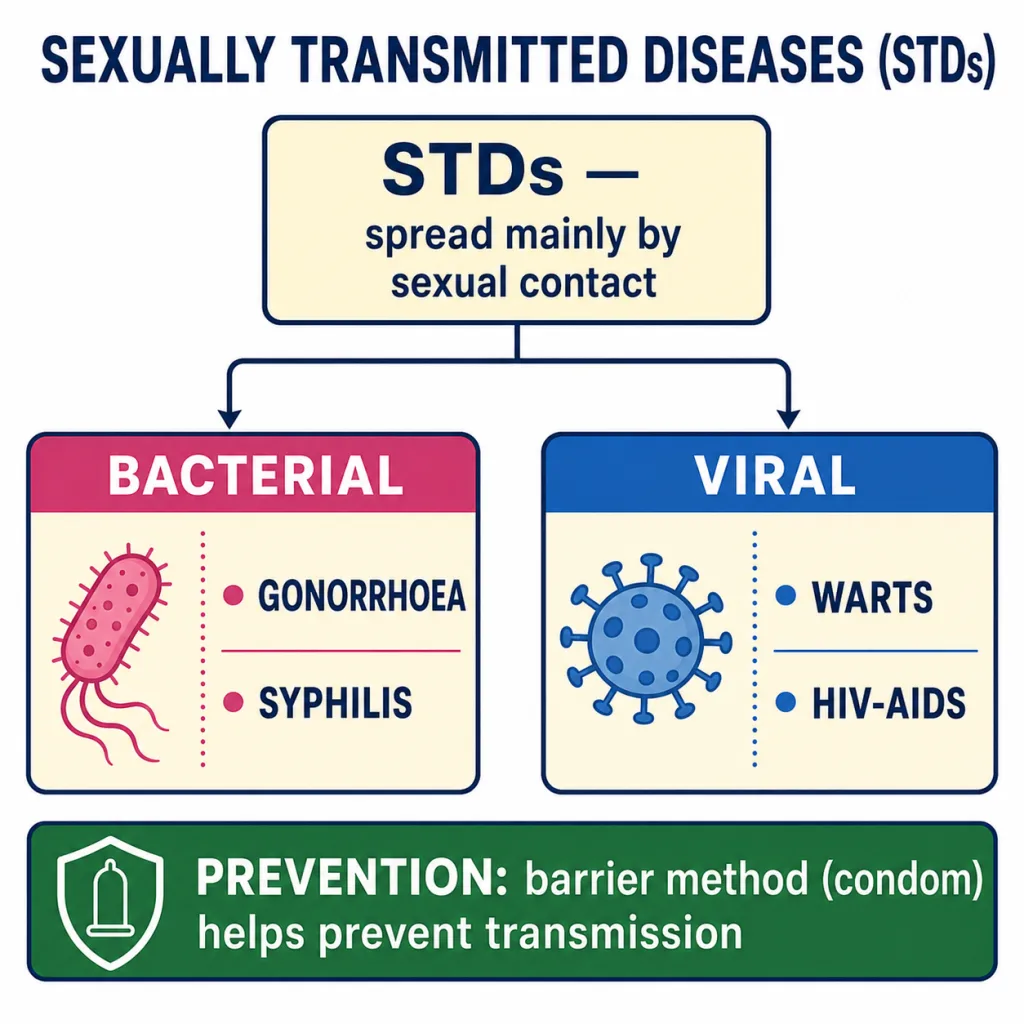
You learnt in Class IX that diseases can be passed from one person to another in many ways. Since the sexual act is a very intimate connection of two bodies, it is not surprising that certain diseases can spread through it. These are called sexually transmitted diseases (STDs) — infections that are transmitted mainly through sexual contact.
The NCERT sorts the examples into two groups by the type of germ that causes them — bacteria and viruses. Learning them by cause is the easiest way to remember them for the exam.
Key Point: An STD is spread mainly by sexual contact. The two categories to remember are bacterial and viral.
Bacterial STDs
Some STDs are caused by bacteria. The two examples given in the NCERT are:
- Gonorrhoea
- Syphilis
Because they are caused by bacteria, this group is, in principle, treatable with appropriate medicines — but prevention is always better, and untreated infections can cause serious harm.
[Memory Tip] Bacterial STDs = "G and S" → Gonorrhoea and Syphilis.
Viral STDs
Other STDs are caused by viruses. The two examples in the NCERT are:
- Warts (viral warts)
- HIV–AIDS
HIV–AIDS is the most serious of these. HIV (the virus) attacks the body's immune system, and there is no complete cure — which makes prevention absolutely essential.
[Memory Tip] Viral STDs = "W and H" → Warts and HIV-AIDS.
So the full NCERT list is: Bacterial → gonorrhoea, syphilis; Viral → warts, HIV-AIDS.
Prevention — and the Link to Reproductive Health
Is it possible to prevent the transmission of these diseases during the sexual act? Yes, to a large extent. Using a covering called a condom on the penis during sex helps to prevent the transmission of many of these infections.
This is why, of all the contraceptive methods, barrier methods (condoms) are special: they prevent unwanted pregnancy and reduce the spread of STDs. Methods like oral pills, the copper-T, or surgical blocks prevent pregnancy but do nothing to stop disease transmission.
Protecting oneself from STDs is therefore an essential part of reproductive health — being physically and mentally well in all matters relating to reproduction.
[Board Trap] If a question asks "how can STDs be prevented?" or "which contraceptive protects against STDs?", the answer centres on the condom (a barrier method).
Memory Capsule — Section 8
Quick revision: sexually transmitted diseases.
Definition
STD = disease spread mainly through sexual contact.
The NCERT list (learn by cause!)
1. Bacterial → Gonorrhoea, Syphilis ("G & S"). 2. Viral → Warts, HIV–AIDS ("W & H").
Prevention
• Use a condom (barrier method) → prevents transmission of many STDs. • Only barrier methods protect against STDs — pills, copper-T, surgery do not.
Link
Avoiding STDs is part of reproductive health.
Solved Examples
Example 1: Classify the STDs
Name two bacterial and two viral sexually transmitted diseases.
Solution:
- Bacterial STDs: Gonorrhoea and Syphilis.
- Viral STDs: Warts and HIV–AIDS.
Takeaway: Remember them by cause — "G & S" are bacterial, "W & H" are viral.
Example 2: Preventing STDs
How can the transmission of sexually transmitted diseases be prevented during the sexual act?
Solution: Using a condom (a covering worn on the penis) during sex helps prevent the transmission of many STDs to a large extent. Condoms are barrier methods, so they physically stop the exchange of infection-carrying fluids.
Takeaway: The key preventive device named in the NCERT is the condom.
Example 3: Why the Condom is "Dual-Purpose"
Why is a condom considered better than an oral pill or a copper-T for someone concerned about both pregnancy and disease?
Solution: A condom is a barrier method — it stops sperm from reaching the egg (preventing pregnancy) and also blocks the exchange of fluids that carry infection (preventing many STDs).
Oral pills (hormonal) and the copper-T (IUCD) prevent pregnancy only; they provide no protection against STDs.
Takeaway: Only barrier methods do "double duty" — pregnancy prevention and disease prevention.
Example 4: Identify the Cause
A doctor tells a patient that their STD is caused by a virus, not a bacterium. Which of the NCERT-listed diseases could the patient have?
Solution: The viral STDs listed in the NCERT are warts and HIV–AIDS. So the patient's disease could be either of these.
(If it had been bacterial, the options would be gonorrhoea or syphilis.)
Takeaway: Sorting STDs into bacterial vs viral is a common one-mark discrimination question.
Example 5: STDs and Reproductive Health
Explain how avoiding STDs is connected to reproductive health.
Solution: Reproductive health means being physically and mentally well in all matters relating to reproduction. Sexually transmitted diseases (like gonorrhoea, syphilis, warts and HIV–AIDS) directly harm this well-being.
By preventing STDs — mainly through the use of condoms (barrier method) and informed, responsible choices — a person safeguards their reproductive health.
Takeaway: Connect the two ideas explicitly: preventing STDs = protecting reproductive health.