
What is Reproduction?
Look around — every living thing came from another living thing. A mango tree from a mango seed. A puppy from its parent dogs. A bacterium from another bacterium dividing.
This is reproduction — one of the most fundamental life processes.
Definition
'Reproduction' = the biological process by which living organisms produce offspring (new individuals) of their own kind.
Is Reproduction Essential for Individual Survival?
Surprisingly — NO!
Unlike nutrition, respiration, or excretion, reproduction is NOT essential for an individual organism to stay alive.
An individual can live a full life without reproducing.
Then why do organisms reproduce?
Why Reproduction Matters
1. Continuation of Species: Without reproduction, species would go extinct. Each individual eventually dies → species needs new members.
2. Maintaining Population: Replaces individuals lost to death. Keeps population stable or growing.
3. Evolution: Reproduction enables evolution through:
- Variation (differences among offspring).
- Natural selection (fittest survive).
- Adaptation over generations.
4. Survival in Changing Environments: Variations help species adapt to new conditions. If environment changes, some variants survive.
The Big Picture
Reproduction is essential for the species, not the individual. It ensures life continues across generations. It enables life to evolve and adapt. It's the engine of biological diversity.
[NCERT — fundamental]
DNA and Reproduction
Reproduction at its core is about passing genetic information to offspring. This information is stored in DNA.
What is DNA?
'DNA' (Deoxyribonucleic Acid) = the molecule that carries genetic instructions in all living organisms.
Found in the nucleus of cells (in eukaryotes).
Often called the 'blueprint of life.'
Function of DNA
1. Stores genetic information — like a code. 2. Controls characteristics — eye colour, height, etc. 3. Passed to offspring during reproduction. 4. Replicates during cell division.
DNA Replication
Before any cell divides: 1. DNA replicates (copies itself). 2. Each new cell gets identical DNA. 3. New cells are like the parent.
This is how organisms maintain similarity across generations.
Importance of Accurate DNA Copying
Why accuracy matters: 1. Offspring should be similar to parents. 2. Each species has specific DNA. 3. Errors can be harmful.
But… errors do occur! Small errors during DNA copying = variations.
These variations are crucial for evolution.
Variations in Reproduction
'Variations' = differences in features among individuals of a species.
Sources: 1. Errors in DNA copying (small mistakes). 2. Sexual reproduction (mixing of two parents' DNA). 3. Mutations (changes in DNA). 4. Environmental factors.
Why Variation is Important
1. Survival of Species: Different individuals have slightly different traits. If environment changes, some can survive.
2. Evolution: Variations are the raw material for evolution. Natural selection acts on variations. Better-adapted variants survive and reproduce.
3. Adaptation to Different Environments: Species can spread to new habitats. Different variations suit different conditions.
4. Disease Resistance: Some variants resistant to diseases. Helps species survive epidemics.
Example: Bacteria and Antibiotics
A population of bacteria has slight variations. Some are naturally resistant to a specific antibiotic. When antibiotic used, sensitive ones die. Resistant variants survive and multiply. Result: drug-resistant bacteria emerge.
This is why we have antibiotic resistance crisis today!
Variations make this possible.
[NCERT — important]
Two Modes of Reproduction
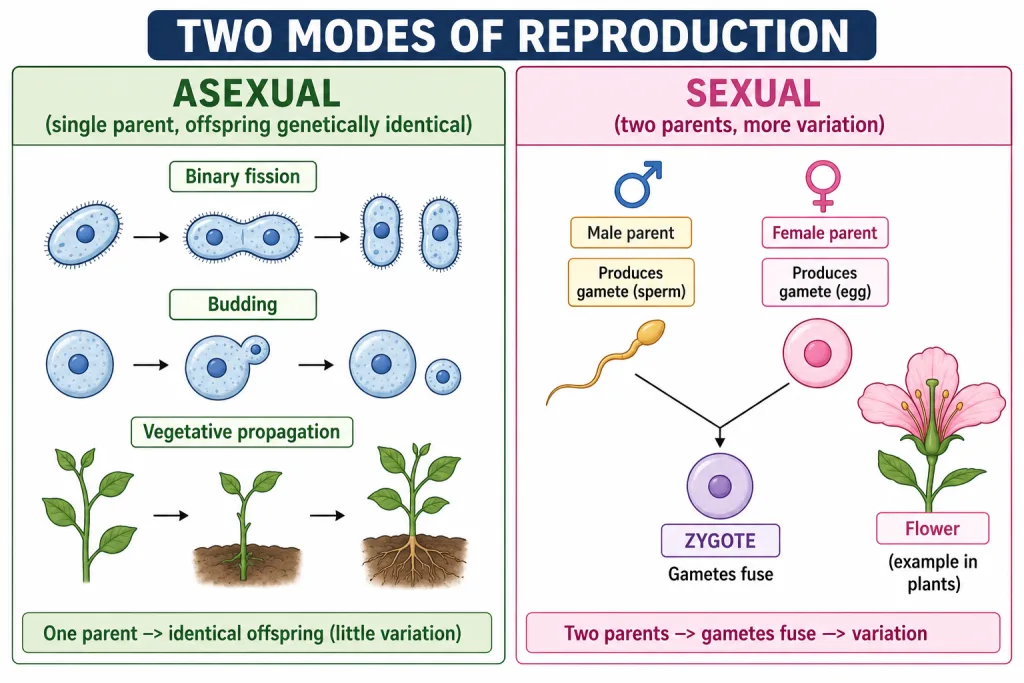
Two main ways organisms reproduce:
1. Asexual Reproduction
Definition: Reproduction involving only one parent, with no fusion of gametes.
Offspring are genetically identical to the parent (clones). No mixing of DNA.
Examples of asexual reproduction: 1. Fission — bacteria, Amoeba. 2. Budding — yeast, Hydra. 3. Fragmentation — Spirogyra (algae). 4. Regeneration — Planaria (flatworm). 5. Spore formation — bread mould (Rhizopus). 6. Vegetative propagation — many plants (potato, ginger).
All produce genetically identical copies. Called 'clones'.
2. Sexual Reproduction
Definition: Reproduction involving two parents (male and female), with fusion of gametes (sperm + egg = zygote).
Offspring have mixed DNA from both parents. Hence varied — not identical to parents.
Examples: 1. Most plants (flowering plants). 2. All vertebrates (fish, frogs, mammals, humans). 3. Most invertebrates (insects, worms).
Most complex organisms reproduce sexually.
Comparison Table
| Feature | Asexual | Sexual |
|---|---|---|
| Parents | One | Two |
| Gametes | None | Yes (sperm + egg) |
| Offspring | Identical (clones) | Variable |
| Variation | Low | High |
| Speed | Fast | Slow |
| Energy needed | Less | More |
| Examples | Bacteria, Amoeba | Humans, plants |
Advantages and Disadvantages
Asexual: Pros: 1. Fast (no need to find mate). 2. Energy-efficient. 3. One organism can populate a region.
Cons: 1. No variation — vulnerable to changes. 2. Disease can wipe out entire population.
Sexual: Pros: 1. Variation — better adaptation to changes. 2. Disease resistance varies. 3. Engine of evolution.
Cons: 1. Slow. 2. Energy-intensive. 3. Need to find mate.
Why Most Complex Organisms Use Sexual
Sexual reproduction enables: 1. Genetic variation — adaptation, evolution. 2. Survival in changing environments. 3. Disease resistance in population. 4. Long-term species success.
Hence: complex life forms (humans, animals, plants) chose sexual reproduction over millions of years.
Asexual still useful for simple, fast-reproducing organisms.
[NCERT — important]
Importance of Reproduction in Nature
Reproduction is more than just making babies — it's the engine of life on Earth.
Reproduction and Evolution
Charles Darwin's theory: 1. Organisms produce more offspring than can survive. 2. Variations exist among offspring. 3. Some variants are better suited (fitter). 4. Fitter variants survive and reproduce more. 5. Over generations, species evolves.
Without variations from reproduction → no evolution. Without reproduction → no future generations.
Without Reproduction
Imagine if reproduction stopped: 1. No new individuals. 2. Existing organisms die naturally. 3. Species go extinct one by one. 4. Life on Earth ends within a few generations.
Hence reproduction = lifeline of biodiversity.
Genetic Variation Quotient
Sexual reproduction creates a unique 'mix' for each offspring: 1. Half DNA from mother. 2. Half DNA from father. 3. Random combinations. 4. Each child slightly different.
Even siblings (except identical twins) are different — this is sexual reproduction's magic!
Reproductive Strategies
Different organisms use different strategies:
1. Many offspring, low investment: Examples: fish (millions of eggs), insects. Few offspring survive, but enough for species.
2. Few offspring, high investment: Examples: humans, elephants, whales. Each offspring receives lots of care. Higher survival rate per individual.
Both strategies work for different lifestyles.
Reproduction in Different Organisms
| Organism | Method | Speciality |
|---|---|---|
| Bacteria | Binary fission | Every 20 min! |
| Yeast | Budding | New buds grow on parent |
| Hydra | Budding | Like yeast but bigger |
| Spirogyra | Fragmentation | Breaks into pieces |
| Planaria | Regeneration | Can regrow whole body |
| Mushroom | Spores | Wind-dispersed |
| Potato | Vegetative | Eyes grow new plants |
| Plants | Sexual via flowers | Pollination + fertilization |
| Fish | Sexual (external fertilization) | Eggs released in water |
| Humans | Sexual (internal fertilization) | Pregnancy ~9 months |
Different organisms = different strategies, all serving same purpose.
[NCERT — comprehensive]
Memory Capsule — Section 1
Quick revision card for reproduction basics.
Definition
Reproduction = producing offspring of own kind. Essential for species survival, NOT individual survival.
Why Reproduce?
1. Continuation of species. 2. Maintain population. 3. Evolution through variation. 4. Adaptation to changing environments.
DNA and Genetics
1. DNA = molecule with genetic information. 2. Replicates during cell division. 3. Errors in copying = variations. 4. Variations enable evolution.
Why Variation is Important
1. Helps species survive environmental changes. 2. Raw material for natural selection. 3. Enables adaptation to new conditions. 4. Disease resistance varies.
Example: Antibiotic Resistance
Some bacteria have natural variation → resistant to antibiotics. Antibiotic kills sensitive ones, resistant survive. Result: drug-resistant bacteria emerge. Why we have antibiotic resistance crisis!
Two Modes of Reproduction
| Asexual | Sexual | |
|---|---|---|
| Parents | One | Two |
| Gametes | None | Sperm + Egg |
| Offspring | Identical (clones) | Variable |
| Variation | Low | High |
| Speed | Fast | Slow |
| Examples | Bacteria, Amoeba | Humans, plants |
Methods of Asexual Reproduction
1. Fission — bacteria, Amoeba. 2. Budding — yeast, Hydra. 3. Fragmentation — Spirogyra. 4. Regeneration — Planaria. 5. Spore formation — Rhizopus. 6. Vegetative propagation — potato, ginger.
One-Liner Insights
1. Reproduction = essential for species, not individual. 2. DNA = blueprint of life. 3. Variation = engine of evolution. 4. Asexual = clones (no variation). 5. Sexual = mixed DNA (variation).
Real-World Connections
1. Antibiotic resistance — example of evolution. 2. Variation in siblings — sexual reproduction's gift. 3. Identical twins — exception (same DNA). 4. Cloning — artificial asexual reproduction. 5. Hybrid plants — bred for desired variation.
[Quick reference for whole chapter!]
Example 1: NCERT — Why Organisms Reproduce
Why do organisms reproduce? Is reproduction essential for individual survival?
Solution:
Why Organisms Reproduce
Reproduction is essential for:
1. Continuation of species: Without reproduction, species would go extinct. Each individual eventually dies. Species needs new members to continue.
2. Maintaining population: Replaces individuals lost to death. Keeps population stable or growing.
3. Evolution: Reproduction enables variation. Variation enables natural selection. Species evolve and adapt over generations.
4. Survival in changing environments: Variations among offspring allow some to survive when environment changes. Without variations, species can't adapt.
Is Reproduction Essential for Individual?
NO — reproduction is NOT essential for individual survival.
Other life processes (nutrition, respiration, excretion) keep individuals alive.
An individual can live full life without reproducing.
Examples:
- Worker bees never reproduce.
- People who choose not to have children.
- Animals past reproductive age.
All survive normally.
So Why Reproduce?
Reproduction serves the species, not the individual. Drives: 1. Genetic continuity. 2. Population stability. 3. Evolution. 4. Biodiversity.
Without reproduction → life on Earth would end within a few generations.
Hence reproduction = essential for life as a whole, not for any single organism.
[NCERT — fundamental]
Example 2: NCERT — Importance of Variation
Why is variation important in reproduction?
Solution:
Variation
'Variation' = differences in features among individuals of a species.
Sources: 1. Errors in DNA copying. 2. Sexual reproduction (mixing parental DNA). 3. Mutations. 4. Environmental influences.
Why Variation is Important
1. Survival in Changing Environments:
Imagine: species lives in cold climate. Suddenly, temperature rises. Without variation: all individuals adapted to cold → all die. With variation: some can tolerate higher temperatures → survive. Population continues with these variants.
2. Evolution:
Charles Darwin's theory: 1. Organisms produce more offspring than environment can support. 2. Among offspring, variations exist. 3. Some variants better suited to environment (fitter). 4. Fitter variants survive and reproduce more. 5. Their traits become common in next generation. 6. Over many generations, species evolves.
Variation = raw material for evolution.
3. Adaptation to Different Habitats:
Within a species, different variants can thrive in different conditions. Example: humans of different climates have different skin colours, body types. All same species, but adapted variants.
4. Disease Resistance:
Diseases can wipe out populations. If all individuals identical → all susceptible → all die. If varied → some have natural resistance → survive. Population recovers.
Famous Example: Antibiotic Resistance
Bacteria reproduce rapidly. Among them, some have natural genetic variation. A few are accidentally resistant to a particular antibiotic.
When antibiotic is used: 1. Sensitive bacteria killed. 2. Resistant bacteria survive. 3. Resistant bacteria reproduce. 4. Now most bacteria are resistant.
Result: antibiotic doesn't work anymore!
This is antibiotic resistance — major medical crisis today.
Caused by:
- Overuse of antibiotics.
- Variation in bacteria.
- Natural selection.
Lesson: variation has both positive (adaptation) and negative (resistance) consequences.
What Sexual Reproduction Adds
Sexual reproduction creates even more variation: 1. Each offspring gets random mix of two parents' genes. 2. New combinations every generation. 3. Faster evolution.
That's why most complex organisms reproduce sexually.
Negative Variations
Not all variations are good: 1. Some are harmful (disease, deformity). 2. Some are neutral. 3. Some are beneficial.
Natural selection favours beneficial ones.
Conclusion
Variation is the engine of evolution: 1. Without variation, species can't adapt. 2. Climate change, diseases, competitors — all threats need variation to survive. 3. Reproduction without variation = vulnerability.
That's why nature evolved sexual reproduction — to maximise variation.
Diversity of life = result of variation across millions of years.
[NCERT — important]
Example 3: NCERT — Asexual vs Sexual Reproduction
Differentiate between asexual and sexual reproduction. Give 3 examples of each.
Solution:
Comparison Table
| Feature | Asexual | Sexual |
|---|---|---|
| Number of parents | One | Two (male + female) |
| Gametes involved | None | Sperm + Egg |
| Type of cell division | Mitosis only | Meiosis (gamete formation) + Mitosis |
| Offspring | Genetically identical (clones) | Genetically variable |
| Variation | Low | High |
| Speed | Fast | Slow |
| Energy required | Less | More |
| Common in | Simple organisms | Complex organisms |
| Adaptation | Limited | Better |
3 Examples of Asexual Reproduction
1. Bacteria — Binary Fission: Single bacterium divides into two identical bacteria. Time: ~20 minutes (some species). Each new bacterium = exact copy. Population grows exponentially.
2. Yeast — Budding: Small bud forms on parent yeast. Bud grows, separates from parent. Becomes new yeast cell.
3. Potato — Vegetative Propagation: Potato has 'eyes' (small buds on tuber). Each eye can grow into new potato plant. Farmers use this for cultivation.
3 Examples of Sexual Reproduction
1. Humans: Male produces sperm. Female produces eggs. Sperm + egg = zygote. Zygote develops in uterus → baby. Pregnancy lasts ~9 months.
2. Flowering Plants (e.g., Rose): Flower has male (stamen) and female (pistil) parts. Pollination: pollen from stamen → stigma. Pollen tube grows down → fertilises ovule. Ovule becomes seed; ovary becomes fruit.
3. Fish: Female releases eggs in water. Male releases sperm over eggs. External fertilisation. Eggs hatch into baby fish.
Why Different Methods Exist
Asexual works well for: 1. Fast reproduction. 2. Stable environments. 3. Simple organisms. 4. When mate is hard to find.
Sexual works well for: 1. Producing variation. 2. Adapting to change. 3. Complex organisms. 4. Long-term species success.
Many simple organisms use both methods at different times.
Summary
1. Both methods serve same goal — produce offspring. 2. Different strategies for different life situations. 3. Sexual = more variation, slower. 4. Asexual = faster, less variation.
Nature uses what works!
[NCERT — important]
Example 4: Application — Antibiotic Resistance
Explain how antibiotic resistance develops in bacteria. Why is it a global concern?
Solution:
Background: Bacteria and Variation
Bacteria reproduce by binary fission (asexual). Yet they have genetic variation due to: 1. Random mutations in DNA (during fast replication). 2. Horizontal gene transfer (sharing DNA between bacteria).
This makes some bacteria resistant to antibiotics.
How Resistance Develops
Step 1: Initial Population Bacterial population has slight genetic variation. A few bacteria are randomly resistant to antibiotic. Most are not (sensitive).
Step 2: Antibiotic Use Person takes antibiotic for infection. Antibiotic kills sensitive bacteria. Resistant ones survive (not affected).
Step 3: Resistant Bacteria Multiply Surviving resistant bacteria reproduce rapidly. They pass resistance to offspring. Population becomes mostly resistant.
Step 4: Antibiotic Stops Working Same antibiotic given again. Most bacteria already resistant. Antibiotic ineffective. Need stronger antibiotic.
This is Natural Selection in Action
1. Variation existed (resistant bacteria). 2. Pressure (antibiotic) selected fittest (resistant ones). 3. Resistance spread through reproduction. 4. Population evolved to be resistant.
Why It's a Global Concern
1. Treatment Failure: Common infections become hard to treat. Pneumonia, urinary infections, etc.
2. Longer Hospital Stays: Patients need stronger drugs, more time. Healthcare costs rise.
3. Death Rate Increases: Some infections become untreatable. People die from previously treatable diseases.
4. Last-Resort Antibiotics Needed: Reserved drugs being used routinely. Eventually even those will become resistant.
5. Future Generations at Risk: Loss of antibiotics could send us back to pre-antibiotic era. Surgery, chemotherapy, transplants — all rely on antibiotics.
Causes of Antibiotic Resistance
1. Overuse of antibiotics: taking when not needed (e.g., for viral infections). 2. Incomplete courses: stopping medication early. 3. Self-medication: without doctor's prescription. 4. Use in livestock: farm animals given antibiotics routinely. 5. Poor infection control in hospitals. 6. Over-the-counter sales in some countries.
How to Prevent
Personal Level: 1. Take antibiotics only when prescribed. 2. Complete full course (don't stop early). 3. Don't share or reuse antibiotics. 4. Follow hand hygiene. 5. Get vaccinated (prevents infections).
Society Level: 1. Strict prescription rules. 2. Reduce use in livestock. 3. Develop new antibiotics. 4. Public awareness. 5. Better diagnostics.
Connection to Reproduction
This is reproduction + variation in action: 1. Bacteria reproduce rapidly. 2. Variations exist. 3. Selection pressure (antibiotic) chooses fittest. 4. Population evolves.
Same process that drives all evolution!
Lesson: variation is powerful — can be lifesaving (adaptation) or dangerous (drug resistance).
Modern medicine depends on understanding and managing this.
[Application — Real life, JEE/NEET]
Example 5: Synthesis Question
(a) What is reproduction? Why is it important? (b) Compare asexual and sexual reproduction. (c) How does variation help species survive?
Solution:
(a) Reproduction Definition and Importance
Reproduction = biological process by which organisms produce offspring (new individuals) of their own kind.
Importance: 1. Continuation of species — without it, extinction. 2. Maintaining population — replaces those that die. 3. Evolution — through variation, species adapt. 4. Biodiversity — different species result from reproduction over millions of years. 5. Survival of life on Earth — without reproduction, life ends.
Note: Reproduction is essential for species, not for individual survival.
(b) Asexual vs Sexual Reproduction
| Feature | Asexual | Sexual |
|---|---|---|
| Parents | 1 | 2 |
| Gametes | None | Sperm + Egg |
| Offspring | Clones (identical) | Variable |
| Variation | Low | High |
| Speed | Fast | Slow |
| Energy | Less | More |
| Examples | Bacteria, Amoeba, yeast | Humans, plants, animals |
Asexual: Methods: 1. Fission (bacteria). 2. Budding (yeast). 3. Fragmentation (algae). 4. Regeneration (Planaria). 5. Spore formation (mushroom). 6. Vegetative propagation (potato).
Key feature: only ONE parent. Offspring = exact clones.
Sexual: Steps: 1. Gamete formation (meiosis). 2. Fusion of male and female gametes. 3. Zygote formation. 4. Development → offspring.
Key feature: TWO parents. Offspring = mixed DNA.
Trade-offs
Asexual advantages: 1. Fast reproduction. 2. No need to find mate. 3. Energy-efficient. 4. One organism can populate area.
Asexual disadvantages: 1. No variation. 2. Vulnerable to environmental changes. 3. Disease can wipe out entire population.
Sexual advantages: 1. Variation enables adaptation. 2. Better disease resistance (varied population). 3. Drives evolution.
Sexual disadvantages: 1. Slow. 2. Need to find mate. 3. Energy-intensive.
Most complex organisms chose sexual for long-term survival.
(c) How Variation Helps Species Survive
1. Environmental Changes:
Imagine: species in cold habitat. Climate gets warmer. Without variation: all adapted to cold → all suffer. With variation: some can tolerate warmth → survive. Species continues with these variants.
2. Disease Outbreaks:
Disease can kill. If all individuals identical → all susceptible → wiped out. If varied → some have natural resistance → survive. Population recovers.
3. Competition:
Species compete for resources. Varied individuals exploit different niches. Reduces competition within species.
4. Long-term Evolution:
Variations are raw material for natural selection. Beneficial variants survive and pass on traits. Over generations, species evolves. New species can emerge.
Real-world Examples
1. Antibiotic-resistant bacteria — variation helps survive antibiotics. 2. Pesticide-resistant insects — variation helps survive pesticides. 3. Drug-resistant viruses — variation helps escape drugs. 4. Adaptation to new climates — humans spread to all continents. 5. New species formation — Darwin's finches in Galapagos.
Without Variation
Imagine all individuals of a species were identical: 1. Susceptible to same diseases. 2. Adapted to same conditions. 3. One environmental change → all suffer. 4. One disease → all die. 5. Species extinct quickly.
This is why biodiversity (variation across species) AND genetic variation (within species) are critical.
Variation = nature's insurance policy against changes.
Final Insight
Reproduction with variation = engine of evolution.
Single-parent reproduction (asexual) gives speed. Two-parent reproduction (sexual) gives variation. Both methods coexist because both are useful.
Life on Earth has flourished for 3.8 billion years thanks to: 1. Reproduction (continuity). 2. Variation (adaptation). 3. Natural selection (survival of fittest). 4. Evolution (long-term change).
All starting from the simple act of organisms making more of their own kind.
[Board: 5-mark synthesis]