
Fertilisation — The Zygote is Formed
We ended the last section at the moment a sperm meets an egg. Let's follow the story forward.
During sexual intercourse, sperms are released into the vagina. They swim upwards through the uterus and into the oviduct (Fallopian tube). There, one sperm fuses with the egg. This fusion of the male and female germ-cells is fertilisation, and the single cell it produces is the zygote.
The zygote is the very first cell of the new individual. It contains DNA from both parents — which is the whole point of sexual reproduction: combining variations from two individuals.
Key Point: Fertilisation = fusion of sperm and egg → zygote. It happens in the oviduct.
From Zygote to Embryo to Foetus
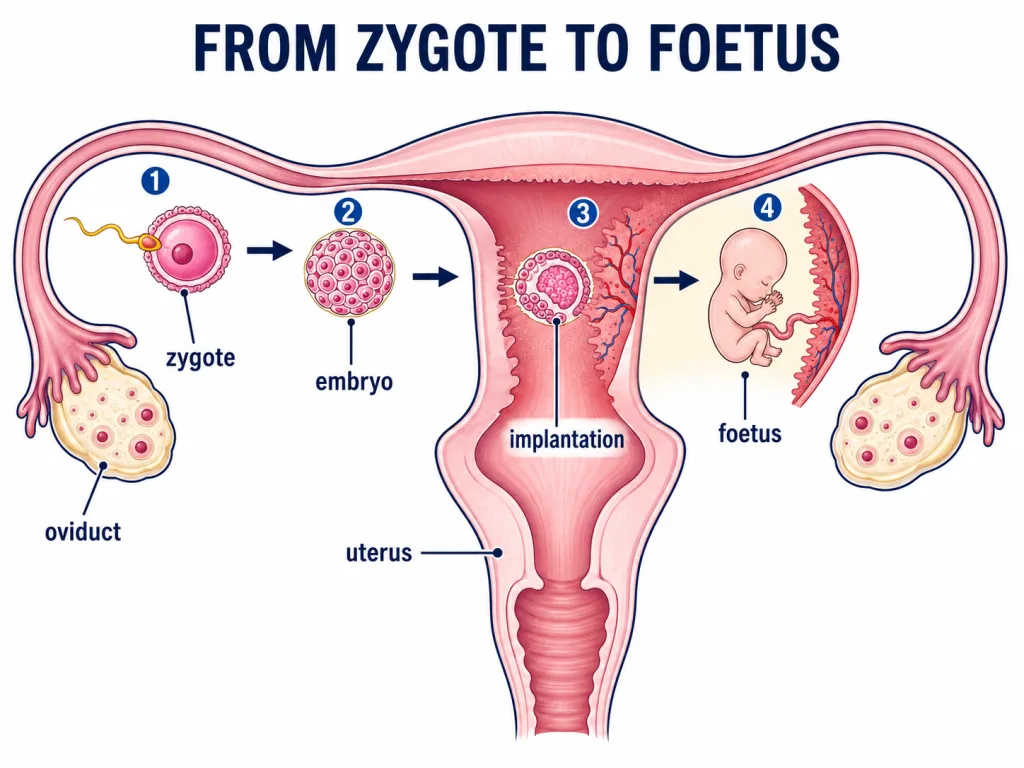
The zygote does not stay a single cell for long. As it travels down toward the uterus, it starts dividing — one cell becomes two, two become four, and so on — forming a ball of cells called the embryo.
The embryo then reaches the uterus and becomes implanted (embedded) in the thick, spongy lining of the uterus. This is why the uterine lining was prepared in the first place.
Inside the uterus the embryo continues to grow and develops organs (body parts) — at this stage it is called a foetus. So the sequence is:
Zygote → Embryo (ball of cells, implants in uterus) → Foetus (organs develop)
[Board Trap] Keep the three stages in order: zygote (one cell) → embryo (dividing ball of cells that implants) → foetus (recognisable body parts). Getting the sequence right is worth easy marks.
The Placenta — the Baby's Lifeline
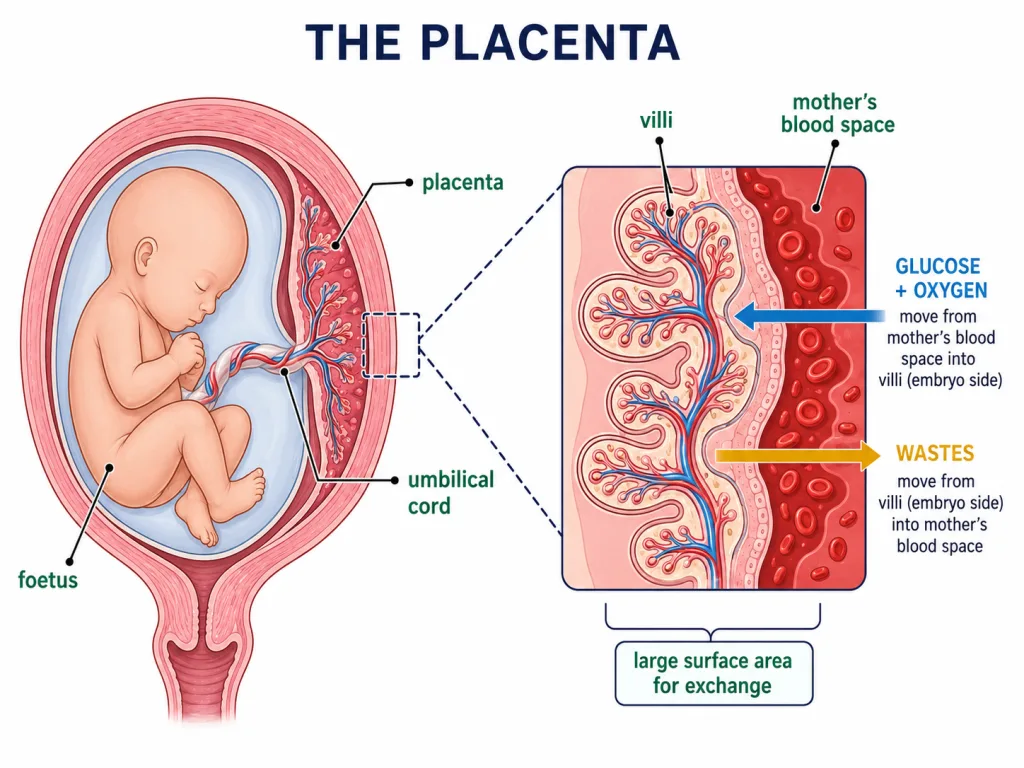
How does the growing embryo get food and oxygen while sealed inside the mother? Through a special tissue called the placenta.
The placenta is a disc-shaped tissue embedded in the wall of the uterus. Its clever design gives a large surface area for exchange between mother and embryo:
- On the embryo's side, the placenta has finger-like projections called villi.
- On the mother's side, there are blood spaces that surround these villi.
This arrangement allows two-way traffic:
- Glucose and oxygen pass from the mother's blood to the embryo (nutrition and respiration).
- Waste substances generated by the embryo pass from the embryo into the mother's blood, to be removed by the mother's body.
[NEET Important] The villi + blood spaces design is exactly like other exchange surfaces you have studied (villi of the small intestine, alveoli of the lungs): whenever the body needs efficient exchange, it increases surface area.
Gestation and Birth
The embryo, and then the foetus, keeps growing inside the mother's uterus. The full development of the child inside the mother's body takes about nine months. This period is called gestation.
When development is complete, the baby is born as a result of rhythmic contractions of the muscles of the uterus. These powerful, repeated contractions push the baby out through the vagina (the birth canal).
After birth, the baby is fed on the mother's milk — which is why, during puberty and pregnancy, the female breasts mature to be able to produce milk.
Story so far, in one line
Fertilisation (oviduct) → zygote → embryo (implants in uterus) → foetus → ~9 months (nourished by placenta) → birth by uterine muscle contractions.
Memory Capsule — Section 6
Quick revision: fertilisation to birth.
The sequence (learn this chain!)
Sperm + Egg → Zygote (in oviduct) → Embryo (ball of cells, implants in uterus) → Foetus (organs form) → Birth.
Placenta
1. What: disc-shaped tissue embedded in the uterine wall. 2. Structure: villi on embryo's side + blood spaces on mother's side → large surface area. 3. Function: glucose + O₂ (mother → embryo); wastes (embryo → mother).
Key numbers & facts
• Gestation period ≈ 9 months. • Birth = rhythmic contractions of uterine muscles. • Implantation happens in the thick uterine lining.
One-liners
• Placenta = the connection for nutrition, respiration and waste removal of the embryo. • Zygote → embryo → foetus (memorise the order).
Solved Examples
Example 1: NCERT — How Does the Embryo Get Nourishment?
How does the embryo get nourishment inside the mother's body?
Solution: The embryo gets nourishment from the mother's blood through a special tissue called the placenta.
- The placenta is a disc embedded in the uterine wall.
- It has villi on the embryo's side and blood spaces on the mother's side, giving a large surface area.
- Through it, glucose and oxygen pass from the mother to the embryo, and the embryo's wastes pass into the mother's blood.
Takeaway: Always name the placenta AND describe its villi/blood-space structure for full marks.
Example 2: The Correct Sequence
Arrange in the correct order: foetus, zygote, embryo. Where does each stage occur?
Solution: Correct order: Zygote → Embryo → Foetus.
- Zygote: the single cell formed by fertilisation in the oviduct.
- Embryo: the dividing ball of cells that implants in the uterus.
- Foetus: the stage in the uterus where organs/body parts have developed.
Takeaway: One cell → ball of cells → recognisable body. Never reverse this order.
Example 3: Structure–Function of the Placenta
Describe the structure of the placenta and explain how its structure suits its function.
Solution: Structure: The placenta is a disc-shaped tissue embedded in the uterine wall. It bears villi on the embryo's side, and these are surrounded by blood spaces on the mother's side.
How structure suits function: The villi and blood spaces provide a large surface area for exchange. This allows efficient passage of glucose and oxygen from mother to embryo and wastes from embryo to mother.
Takeaway: This is a classic 3-mark "structure suits function" question — the magic phrase is large surface area for exchange.
Example 4: Gestation and Birth
What is the gestation period in humans, and how is the baby born?
Solution:
- The gestation period (time for the full development of the child inside the mother) is about nine months.
- The baby is born as a result of rhythmic contractions of the muscles of the uterus, which push the baby out through the vagina.
Takeaway: Two facts, two marks: ~9 months, and birth by uterine muscle contractions.
Example 5: Synthesis — The Whole Journey
A sperm has just fertilised an egg. Trace, step by step, everything that happens until a baby is born.
Solution:
- Fertilisation in the oviduct → zygote forms.
- The zygote divides repeatedly while moving to the uterus → forms an embryo (ball of cells).
- The embryo implants in the thick, spongy uterine lining.
- The embryo grows and develops organs → becomes a foetus.
- The placenta supplies glucose and oxygen and removes wastes throughout.
- After about 9 months (gestation), rhythmic uterine muscle contractions push the baby out → birth.
Takeaway: This single chain can answer almost any long-answer question in this section.