
Puberty in Girls — and the Job of the Female System
Just as boys go through puberty, so do girls — and some changes are shared (body hair in armpits and genital region, oily skin, pimples, new awareness of the body). But some changes are specific to girls:
- Breast size begins to increase, with darkening of the skin of the nipples.
- Menstruation begins at around this time.
The female reproductive system has a bigger task than the male one. It must not only produce the female germ-cells (eggs), but also receive sperms, allow fertilisation, and then nourish and shelter the developing baby for about nine months. Its design reflects all of these jobs.
[NEET Important] The female gamete (egg/ovum) is large and non-motile and stores food for the early embryo — the opposite of the small, motile sperm.
The Ovaries — Where Eggs are Made
The female germ-cells, the eggs (ova), are produced in a pair of organs called the ovaries. The ovaries also produce some hormones (such as oestrogen), so — like the testes — they have a double role: making gametes and making hormones.
A remarkable fact: when a baby girl is born, her ovaries already contain thousands of immature eggs. She is born with her lifetime's stock of eggs; no new ones are made later.
At puberty, these eggs start to mature. Then, month by month, one egg is released by one of the ovaries roughly every month. This release is what starts the monthly cycle.
[Board Trap] Two numbers to lock in: thousands of immature eggs are present at birth, but only one egg matures and is released per month after puberty.
The Organs of the Female System
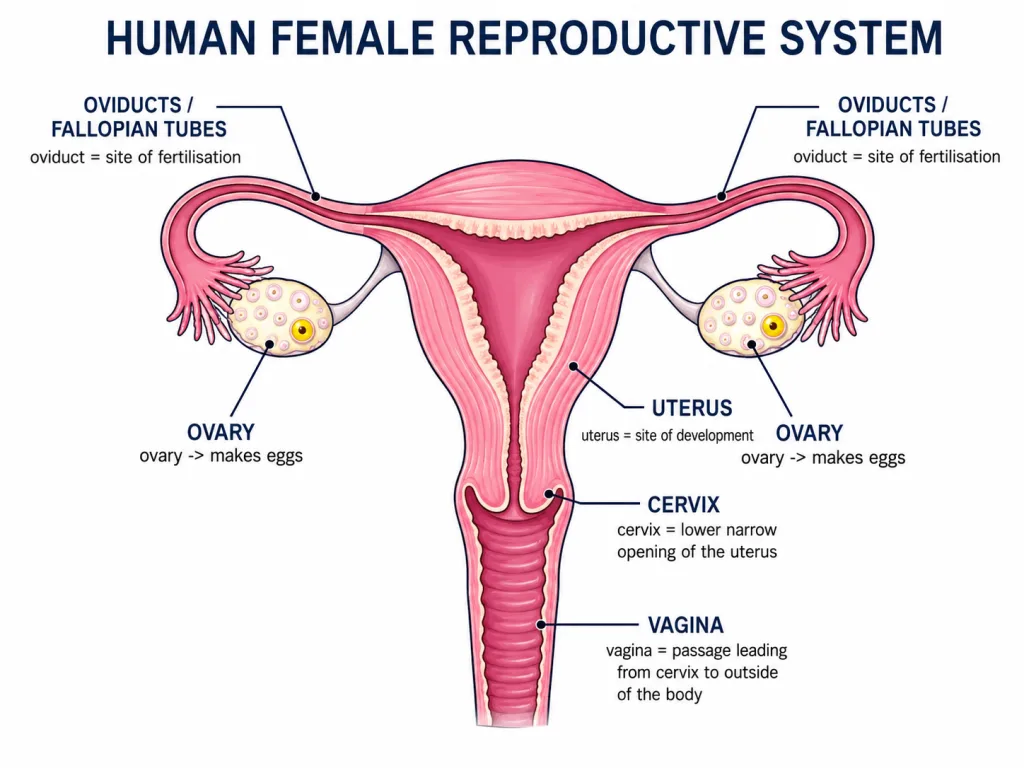
Trace the journey of an egg to understand the organs:
- Ovary — produces and releases the egg.
- Oviduct (Fallopian tube) — a thin tube that carries the egg from the ovary towards the uterus. This is the tube where the egg may meet a sperm.
- Uterus (womb) — the two oviducts unite into this elastic, bag-like structure. This is where a fertilised egg develops into a baby.
- Cervix — the narrow lower opening of the uterus.
- Vagina — the passage that opens to the outside; it is the route by which sperms enter and, later, the baby is born.
Pathway to remember
Ovary → Oviduct (Fallopian tube) → Uterus → Cervix → Vagina
Key Point: The oviduct/Fallopian tube is the site of fertilisation, while the uterus is the site of development of the baby. Mixing these two up is the single most common mistake in this chapter.
Fertilisation — Where Egg Meets Sperm
During sexual intercourse, sperms are deposited in the vagina. They travel upwards, pass through the uterus, and reach the oviduct (Fallopian tube), where they may encounter the egg.
If a sperm fuses with the egg here, fertilisation occurs and a zygote (the first cell of the new individual) is formed. So remember: fertilisation in humans takes place in the oviduct / Fallopian tube, not in the uterus.
The fertilised egg (zygote) then begins its journey down to the uterus, dividing as it goes — but that story continues in the next section on pregnancy.
The Menstrual Cycle — What Happens When the Egg is Not Fertilised
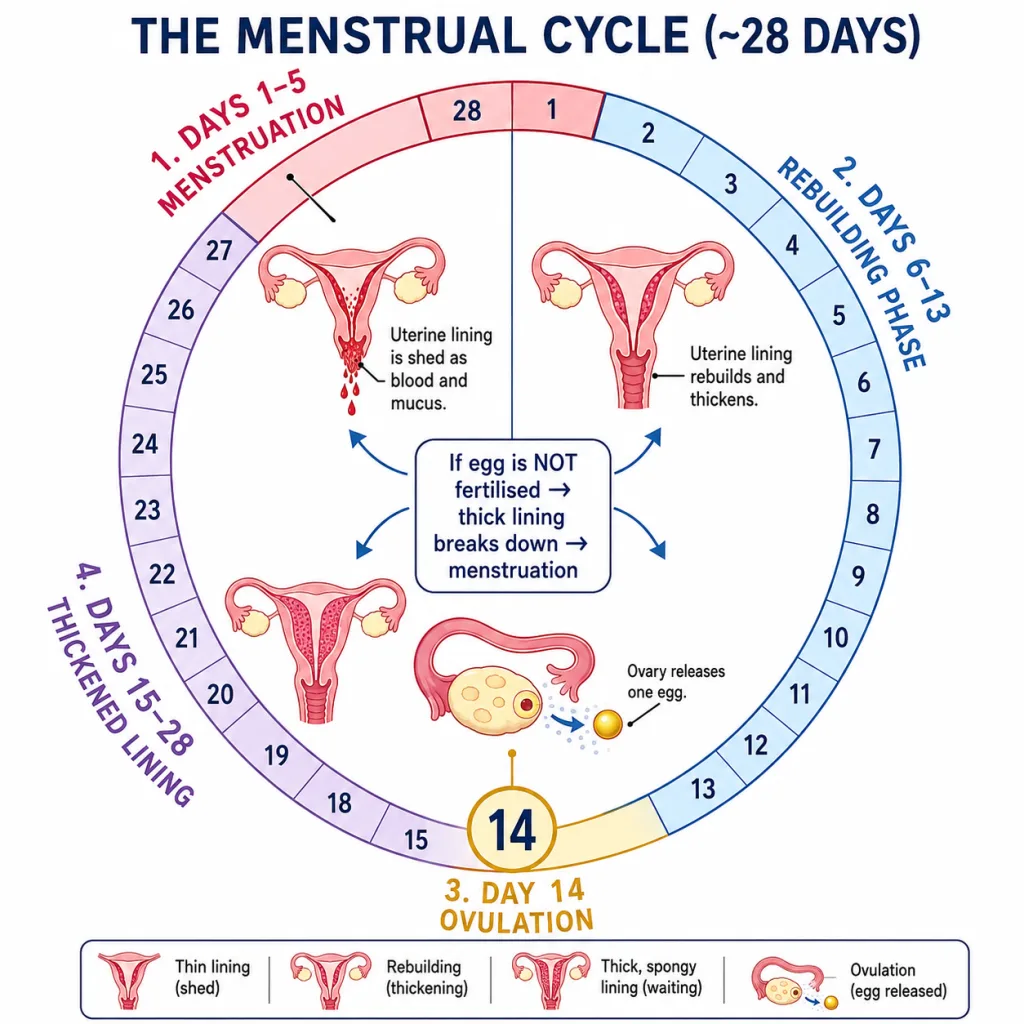
Every month, the body prepares for a possible pregnancy. Since one ovary releases an egg each month, the uterus also prepares itself every month to receive a fertilised egg: its lining (endometrium) becomes thick, spongy and richly supplied with blood, ready to nourish an embryo.
Now there are two possibilities:
If the egg IS fertilised → the embryo implants in this thick lining and pregnancy begins.
If the egg is NOT fertilised → the egg lives for only about one day. The thick uterine lining is now no longer needed. So the lining slowly breaks down and is shed, coming out through the vagina as blood and mucus. This monthly shedding is called menstruation.
Key facts about menstruation:
- It happens roughly every month (about a 28-day cycle).
- It lasts about 2 to 8 days.
- It begins at puberty and is a sign of a working female reproductive system.
[Board Trap] The exam answer to "Why does menstruation occur?" is: because the egg is not fertilised, so the thick uterine lining prepared to nourish an embryo is not needed and breaks down, shed as blood and mucus.
Memory Capsule — Section 5
Quick revision: the female system and the menstrual cycle.
Puberty changes in girls
Breast size increases + nipples darken + menstruation begins (plus shared changes: body hair, oily skin).
Organs & jobs
1. Ovary → makes eggs + hormones; holds thousands of immature eggs at birth; releases one egg/month. 2. Oviduct / Fallopian tube → carries egg; site of fertilisation. 3. Uterus → site of development of baby; two oviducts unite here. 4. Cervix → lower opening of uterus. 5. Vagina → receives sperm; birth canal.
Pathway
Ovary → Oviduct → Uterus → Cervix → Vagina.
Menstruation
• Uterus lining thickens monthly to receive embryo. • Egg not fertilised → egg lives ~1 day → lining breaks → shed as blood + mucus. • Lasts ~2–8 days, roughly every month, starts at puberty.
Don't confuse!
Fertilisation = in oviduct. Development = in uterus.
Solved Examples
Example 1: NCERT — Changes in Girls at Puberty
What are the changes seen in girls at the time of puberty?
Solution: At puberty, girls show:
- Increase in breast size, with darkening of the skin of the nipples.
- Onset of menstruation (monthly menstrual cycle begins).
- Changes common to both sexes: growth of hair in the armpits and genital region, thinner hair on arms and legs, and oily skin (sometimes with pimples).
Takeaway: Give the two girl-specific changes (breasts, menstruation) first — those are the marks-carrying points.
Example 2: NCERT — Why Does Menstruation Occur?
Why does menstruation occur?
Solution: Each month, one ovary releases an egg, and the uterus prepares a thick, spongy, blood-rich lining to receive and nourish a possible embryo.
- If the egg is not fertilised, this lining is no longer needed.
- So the lining breaks down and is shed through the vagina as blood and mucus — this is menstruation.
It lasts about 2–8 days and repeats roughly every month.
Takeaway: The cause of menstruation is simply "no fertilisation → lining not needed → shed.\"
Example 3: The Site of Fertilisation
Where does fertilisation take place in the human female? Trace the path of the sperm to reach the egg.
Solution: Fertilisation takes place in the oviduct (Fallopian tube).
Path of sperm: Sperms are deposited in the vagina → they travel up through the uterus → into the oviduct, where a sperm meets and fuses with the egg to form the zygote.
Takeaway: Fertilisation is in the oviduct — never write "uterus" here. The uterus is only for development.
Example 4: Eggs at Birth vs Eggs per Month
How many eggs are present in the ovaries at birth, and how many are released after puberty?
Solution:
- At birth, the ovaries already contain thousands of immature eggs.
- After puberty, only one egg matures and is released each month by one of the two ovaries.
Takeaway: A girl is born with all her eggs; they simply mature one at a time, monthly, after puberty.
Example 5: Name the Organ
Name the female reproductive organ that: (a) produces eggs, (b) is the site of fertilisation, (c) is where the baby develops, (d) receives the sperm.
Solution: (a) Produces eggs → Ovary (b) Site of fertilisation → Oviduct (Fallopian tube) (c) Where the baby develops → Uterus (d) Receives the sperm → Vagina
Takeaway: Learn each organ by its single main job — these one-mark "name the organ" questions are guaranteed easy marks.