
Reproductive Health — Being Ready, Not Just Mature
Here is an important idea the NCERT makes carefully: sexual maturation is gradual, and it happens while the body is still growing. So reaching some degree of sexual maturity does not automatically mean the body or the mind is ready for sexual activity, or for having and raising children.
Young people face many kinds of pressure around these choices — from friends (to take part in activities whether they want to or not), from families (to marry and have children), and even from government agencies (to avoid having children). In this situation, making informed choices can be difficult.
Reproductive health means being in a state of complete physical and mental well-being in all matters relating to reproduction. It includes making responsible, informed decisions, staying free of sexually transmitted infections, and planning if and when to have children.
Why Contraception? Two Reasons
The sexual act always carries the potential to lead to pregnancy. A pregnancy makes major demands on a woman's body and mind, and if she is not ready, her health can be adversely affected.
There is a second concern too: the sexual act can also transmit diseases (covered fully in the next section).
To deal with both, people use contraception — methods to prevent unwanted pregnancy (and, in some cases, also reduce disease transmission). Preventing pregnancy until a person is physically, mentally and socially ready is a key part of family planning.
Methods of Contraception
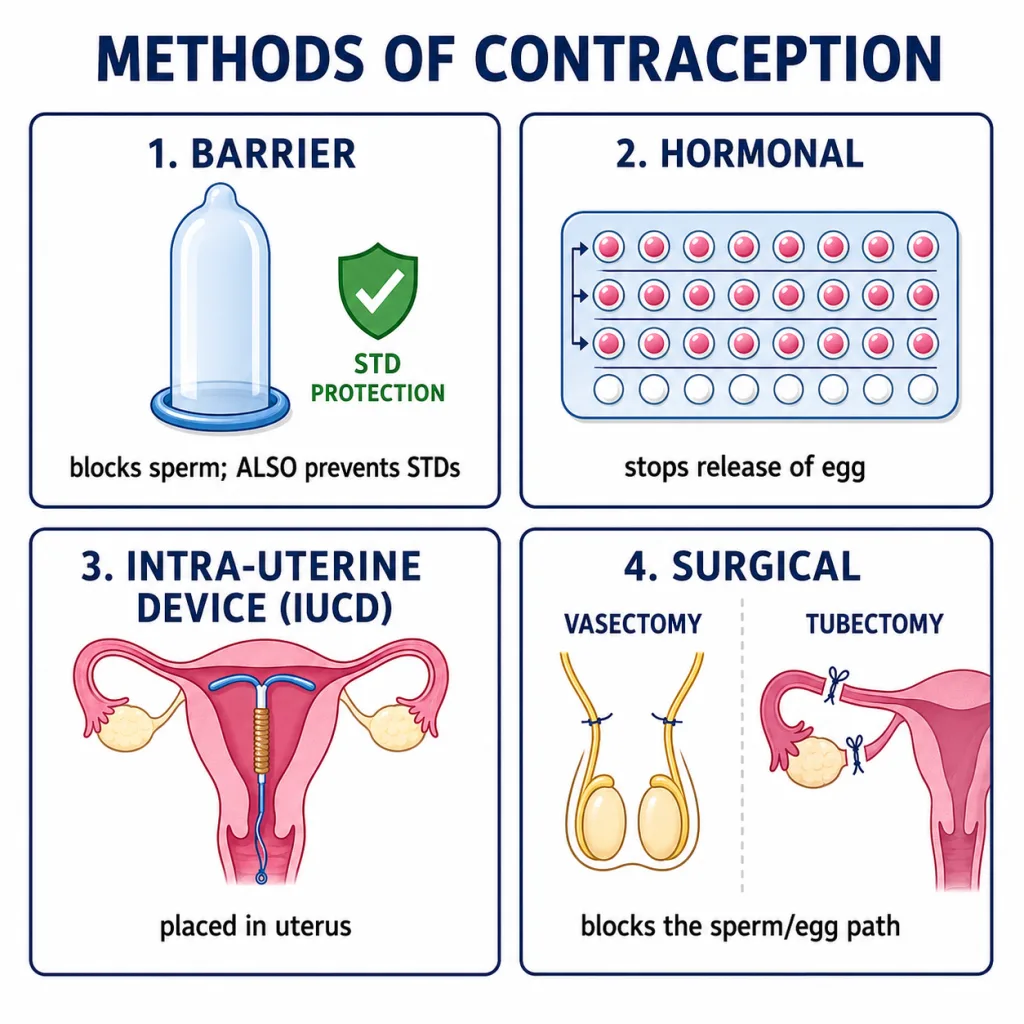
The NCERT groups contraceptive methods into a few clear categories. Think of them by how they stop a pregnancy.
1. Barrier (mechanical) methods
A physical barrier stops the sperm from reaching the egg.
- Condom worn on the penis, or similar coverings worn in the vagina.
- Bonus: barrier methods also help prevent the transmission of many sexually transmitted diseases — a second, important benefit.
2. Hormonal (chemical) methods
These change the hormonal balance of the body so that eggs are not released, and fertilisation cannot occur.
- Usually taken orally as pills ("oral pills").
- Because they alter hormones, they can cause side-effects.
3. Intra-uterine devices (IUCDs)
Devices such as the loop or the copper-T are placed inside the uterus to prevent pregnancy.
- They can cause side-effects due to irritation of the uterus.
- Important: an IUCD does NOT protect against sexually transmitted diseases.
4. Surgical methods
- In the male, the vas deferens is blocked (so sperm cannot be delivered) — called vasectomy.
- In the female, the fallopian tube is blocked (so the egg cannot reach the uterus) — called tubectomy.
- In both, fertilisation cannot take place. These are safe in the long run, but surgery itself can cause infection or other problems if not done properly.
- Surgery can also be used to remove unwanted pregnancies — but this may be misused, as in illegal sex-selective abortion.
Key Point: Only barrier methods (condoms) do the double duty of preventing pregnancy and reducing STD transmission. Pills, copper-T and surgery prevent pregnancy but do not protect against STDs.
Sex Ratio, Female Foeticide and Population
Because surgery can be used to remove pregnancies, it is sometimes misused by people who do not want a particular child — leading to the illegal, sex-selective abortion of female foetuses.
The NCERT is firm on this: for a healthy society, the female–male sex ratio must be maintained. Because of reckless female foeticide, the child sex ratio is declining alarmingly in some sections of society — even though prenatal (before-birth) sex determination has been prohibited by law.
Finally, reproduction is how populations grow. The rates of birth and death in a population determine its size. The large and expanding size of the human population is a concern for many, because it can make it harder to raise everyone's standard of living — though the NCERT also notes that inequality in society, not just population size, is a major reason for poor living standards.
[Board Trap] Remember: prenatal sex determination is banned by law in India. Questions on "why maintain the sex ratio" or "consequences of female foeticide" are common value-based questions.
Memory Capsule — Section 7
Quick revision: reproductive health and contraception.
Big idea
Sexual maturity ≠ readiness. Reproductive health = physical + mental well-being + informed choices.
Why contraception?
1. Avoid unwanted pregnancy (protects the woman's health). 2. (Barrier only) reduce STD transmission.
Four categories (learn the "how")
1. Barrier → condom → blocks sperm + also prevents STDs. 2. Hormonal → oral pills → stop egg release; side-effects. 3. IUCD → loop / copper-T in uterus; irritation side-effects; no STD protection. 4. Surgical → vasectomy (block vas deferens) / tubectomy (block fallopian tube).
Social points
• Sex ratio must be maintained. • Female foeticide → declining child sex ratio. *• Prenatal sex determination = illegal. *• Population size set by birth rate & death rate.*
Solved Examples
Example 1: NCERT — Different Methods of Contraception
What are the different methods of contraception?
Solution: Contraceptive methods fall into these categories:
- Barrier (mechanical) methods — e.g. condoms and vaginal coverings, which stop sperm from reaching the egg (and also help prevent STDs).
- Hormonal methods — e.g. oral pills, which change the hormonal balance so that eggs are not released.
- Intra-uterine devices (IUCDs) — e.g. the loop or copper-T, placed in the uterus.
- Surgical methods — blocking the vas deferens in males (vasectomy) or the fallopian tube in females (tubectomy).
Takeaway: Name the category AND give an example for each — that structure earns full marks.
Example 2: NCERT — Will a Copper-T Protect from STDs?
If a woman is using a copper-T, will it help in protecting her from sexually transmitted diseases?
Solution: No. A copper-T is an intra-uterine device placed inside the uterus; it only helps prevent pregnancy. It does not create any barrier at the vaginal/penile contact, so it cannot prevent the transmission of sexually transmitted diseases.
Only barrier methods (like condoms) help protect against STDs.
Takeaway: This is a favourite exam question — the answer is a clear "No," with the reason that copper-T is not a barrier method.
Example 3: NCERT — Reasons for Adopting Contraceptive Methods
What could be the reasons for adopting contraceptive methods?
Solution: Contraceptive methods are adopted to:
- Prevent unwanted pregnancy, so that a woman's health is not harmed when she is not ready for pregnancy.
- Control the size of the human population, since an expanding population makes it harder to improve everyone's standard of living.
- Reduce the spread of sexually transmitted diseases (in the case of barrier methods like condoms).
Takeaway: Give at least two distinct reasons (health + population) for a 2-mark question; add STD prevention for a 3-mark one.
Example 4: How Surgical Methods Work
Explain how surgical methods prevent pregnancy in males and females. What is a drawback?
Solution:
- In the male, the vas deferens is blocked by surgery, so sperms cannot be delivered (vasectomy).
- In the female, the fallopian tube is blocked, so the egg cannot reach the uterus (tubectomy).
- In both cases, fertilisation cannot occur, so pregnancy is prevented.
Drawback: Although safe in the long run, the surgery itself can cause infections or other problems if not performed properly.
Takeaway: The logic is the same for both sexes — physically block the path so egg and sperm cannot meet.
Example 5: Value-Based — Female Foeticide
Why is it important to maintain the female–male sex ratio, and what has the government done about sex determination?
Solution: A balanced female–male sex ratio is essential for a healthy society. Reckless female foeticide (illegal sex-selective abortion of female foetuses) has caused the child sex ratio to decline alarmingly in some sections of society.
To prevent this, prenatal sex determination has been prohibited by law in India.
Takeaway: For value-based questions, mention both the social need (balanced ratio) and the legal action (ban on prenatal sex determination).