
Puberty — The Body Gets Ready to Reproduce
Let's begin where the NCERT does — with your own body. From childhood you keep getting taller, you lose milk teeth and grow new ones. That is simple growth — the body becoming larger. But in the early teenage years a different set of changes begins. These cannot be explained as mere enlargement; the appearance of the body changes and new sensations appear. This phase is called puberty.
Why does it happen now and not earlier? While the body is still busy growing to adult size, most of its resources go into that growth, so the reproductive tissues are not a priority. As general body growth slows down, the reproductive tissues start to mature — and that period is puberty.
Changes common to both boys and girls
- Thick hair grows in new areas — armpits and the genital region between the thighs (the skin there may darken).
- Thinner hair appears on arms, legs and face.
- Skin often becomes oily, and pimples may develop.
- A new awareness of one's own body and of others.
Changes specific to boys
- New thick hair growth on the face (a few scattered hairs first, becoming uniform slowly).
- The voice begins to crack (deepens).
- The penis occasionally becomes enlarged and erect.
These changes do not happen all at once or at an exact age — early and fast in some, slow in others. They are all signals of sexual maturation, telling others that the body is becoming capable of reproduction. The hormone behind the boys' changes is testosterone, made in the testes.
[NEET Important] The signals of puberty (hair pattern, voice change) matter biologically because animals must be able to recognise sexual maturity in one another before mating.
Overview — What the Male System Does
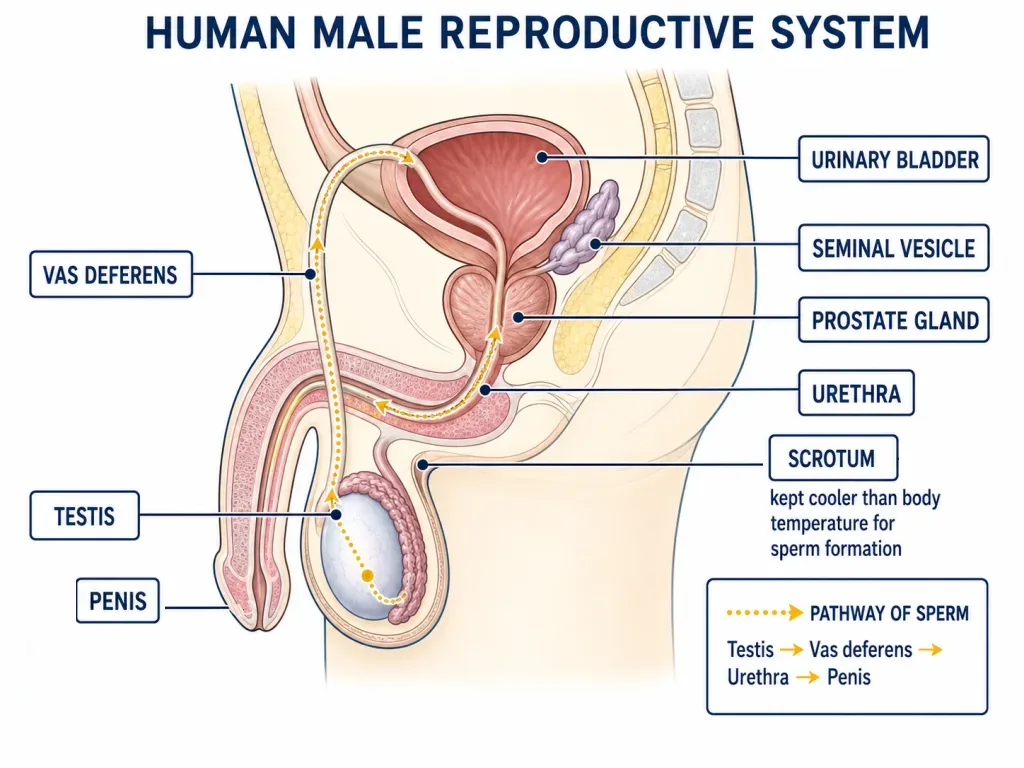
Think of it this way: the male reproductive system has two jobs, and its parts split neatly between them.
- Produce the male germ-cells (sperms) — done by the testes.
- Deliver those sperms to the site of fertilisation — done by the vas deferens, urethra, associated glands and penis.
So as we go through the parts, keep asking: is this part making sperm, or moving it?
Key Point: The male gamete is the sperm — a tiny, motile cell. "Motile" (able to swim) is the defining feature of the male gamete; the female gamete, by contrast, is large and non-motile because it stores food.
The Testes and the Scrotum
The formation of sperms (called spermatogenesis) takes place in a pair of organs called the testes.
Here is a detail examiners love: the testes are located outside the abdominal cavity, in a small pouch of skin called the scrotum. Why hang them outside the body? Because sperm formation needs a temperature lower than the normal body temperature (about 2–3 °C lower). The scrotum acts like a natural cooling chamber.
The testes do two things at once:
- Produce sperms.
- Secrete the male sex hormone, testosterone.
Testosterone has a double role — it regulates the formation of sperms, and it brings about the changes in appearance seen in boys at puberty (facial hair, voice change, etc.).
[Board Trap] A very common 1-mark question: "Why are the testes located outside the abdominal cavity?" → Because sperm production requires a temperature lower than body temperature. Memorise this one line.
The Path of the Sperm — Ducts and Glands
Once sperms are made in the testes, they travel out through a tube called the vas deferens.
The vas deferens then joins a tube coming from the urinary bladder. Because of this joining, the urethra becomes a common passage for both sperms and urine in the male (not at the same time, of course).
Along the way, two glands add their secretions to the sperms:
- The seminal vesicles
- The prostate gland
These secretions do two useful things: they place the sperms in a fluid that makes their transport easier, and the fluid provides nutrition to the sperms. Sperms + this fluid together are called semen.
Finally, the semen leaves the body through the penis, which delivers the sperms into the female body.
Quick pathway to memorise
Testes → Vas deferens → Urethra (joined by seminal vesicle & prostate secretions) → Penis
Structure of a Sperm
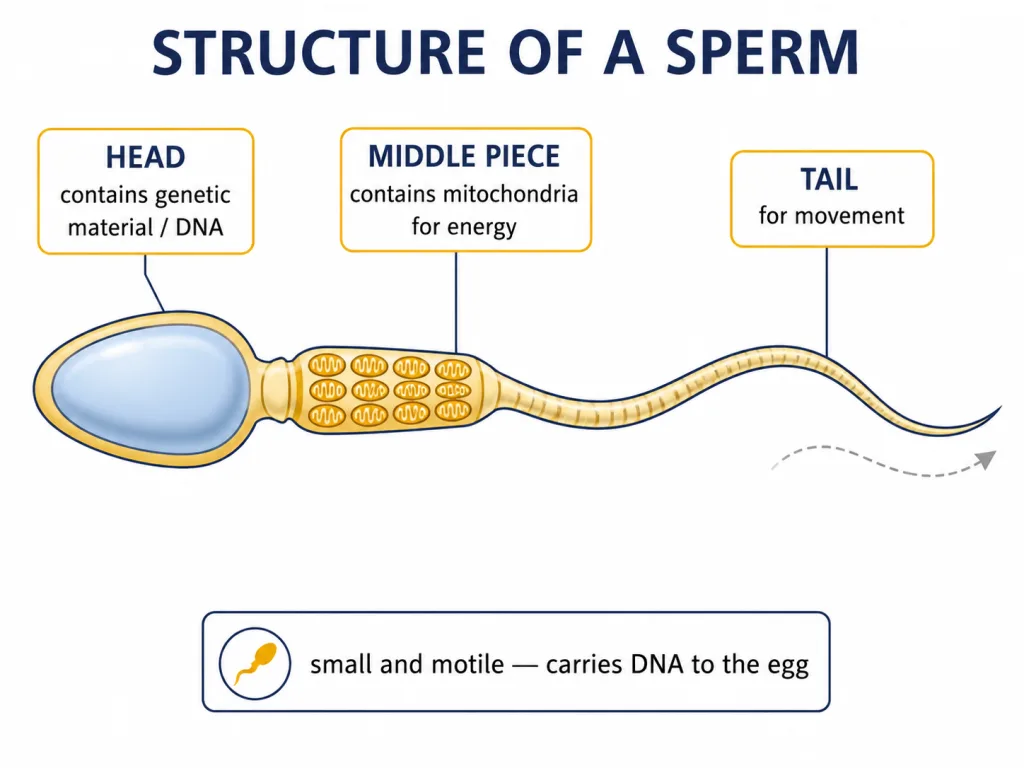
A sperm is one of the smallest cells in the human body. It is built for one purpose — to travel and deliver DNA. It has:
- A head, which contains mainly the genetic material (DNA).
- A long tail, which lashes back and forth to help the sperm move (swim) towards the female germ-cell.
Because it carries almost nothing but genetic material and a means of movement, the sperm contributes the father's DNA to the zygote but no food store — that is the female gamete's job.
[NEET Important] Contrast the two gametes: the sperm is small and motile (with a tail); the egg is large, non-motile and stores food. This division of labour is the whole logic of having two different sexes.
Memory Capsule — Section 4
Quick revision: the human male reproductive system.
The two functions
1. Produce sperm → testes. 2. Deliver sperm → vas deferens, urethra, glands, penis.
Key organs & jobs
1. Testes (in scrotum) → make sperms + secrete testosterone. 2. Scrotum → holds testes outside body → keeps them cooler than body temp (needed for sperm formation). 3. Vas deferens → carries sperm from testes. 4. Urethra → common passage for sperm and urine. 5. Seminal vesicle + Prostate → add fluid → easier transport + nutrition (semen). 6. Penis → delivers sperm into female.
Sperm structure
Head (genetic material) + Tail (for movement). Small and motile.
One-liners for the exam
• Testes outside body → lower temperature for sperm formation. • Testosterone → sperm formation + male puberty changes. • Urethra = common path for urine + sperm.
Solved Examples
Example 1: NCERT — Functions of the Testis
What are the functions performed by the testis in human beings?
Solution: The testes perform two main functions:
- Production of sperms — the testes are the site where the male germ-cells (sperms) are formed.
- Secretion of the hormone testosterone — this hormone regulates sperm formation and brings about the male secondary sexual characters at puberty (facial hair, deepening of voice, etc.).
Takeaway: Whenever a question says "functions of testis," always give both the gamete role and the hormone role — that's how you get full marks.
Example 2: Why the Scrotum is Outside the Body
Why are the testes located in the scrotum, outside the abdominal cavity?
Solution: Sperm formation requires a temperature lower than the normal internal body temperature (by about 2–3 °C). The scrotum, being outside the abdominal cavity, is cooler and provides the ideal temperature for the production of healthy sperms.
Takeaway: This is a favourite 1-mark board question — the key phrase is "lower than body temperature.\"
Example 3: NCERT — Role of Seminal Vesicles and Prostate Gland
What is the role of the seminal vesicles and the prostate gland?
Solution: The seminal vesicles and prostate gland add their secretions to the sperms as they pass along the vas deferens. These secretions:
- Provide a fluid medium in which the sperms can move easily (making their transport easier).
- Provide nutrition to the sperms.
Together, the sperms and this fluid form semen.
Takeaway: The glands don't make sperm — they make the fluid that carries and feeds it.
Example 4: The Common Passage Problem
Name the structure that serves as a common passage for both sperms and urine in the human male. Explain how this comes about.
Solution: The urethra serves as the common passage.
The vas deferens (carrying sperms from the testes) unites with a tube coming from the urinary bladder (carrying urine). After this junction, the single tube — the urethra — carries both urine and sperms out of the body through the penis (though never simultaneously).
Takeaway: In the male, the reproductive and urinary tracts share the final exit; in the female they are separate.
Example 5: Trace the Path + Sperm Structure
(a) Trace the path of a sperm from where it is made to where it leaves the body. (b) Draw/describe the structure of a sperm.
Solution: (a) Path: Testes (sperm formed) → Vas deferens → Urethra (secretions of seminal vesicle and prostate added here) → Penis → out of the body.
(b) Structure of a sperm: A sperm has a head containing mainly the genetic material (DNA) and a long tail that helps it swim towards the egg. It is a tiny, motile cell.
Takeaway: Learn the pathway as a single arrow-chain — it is easy marks in a 3-mark question.