
Introduction to Sexual Reproduction in Plants
Most flowering plants reproduce sexually through flowers.
Flower = the reproductive organ of a plant.
Why Flowers?
Flowers are nature's reproductive marvels: 1. Contain male and female parts. 2. Attract pollinators (bees, butterflies). 3. Enable transfer of pollen. 4. Develop into fruits with seeds. 5. Seeds = next generation.
Brief Process
1. Flower forms male gametes (pollen). 2. Flower forms female gametes (ovule). 3. Pollination = pollen reaches stigma. 4. Fertilization = pollen fuses with ovule → zygote. 5. Zygote develops into embryo. 6. Ovule becomes seed. 7. Ovary becomes fruit. 8. Seed germinates → new plant.
Types of Flowers
Bisexual flowers: Have both male and female parts. Examples: hibiscus, mustard, rose, lily.
Unisexual flowers: Have only male OR female parts. Examples: papaya (separate male and female plants), watermelon, cucumber.
Why Sexual Reproduction in Plants?
1. Variation in offspring. 2. Better adaptation to environment. 3. Combine traits from two parents. 4. Long-term species survival.
Plants spend lots of energy on flowers — testimony to importance of sexual reproduction!
[NCERT — important]
Structure of a Flower
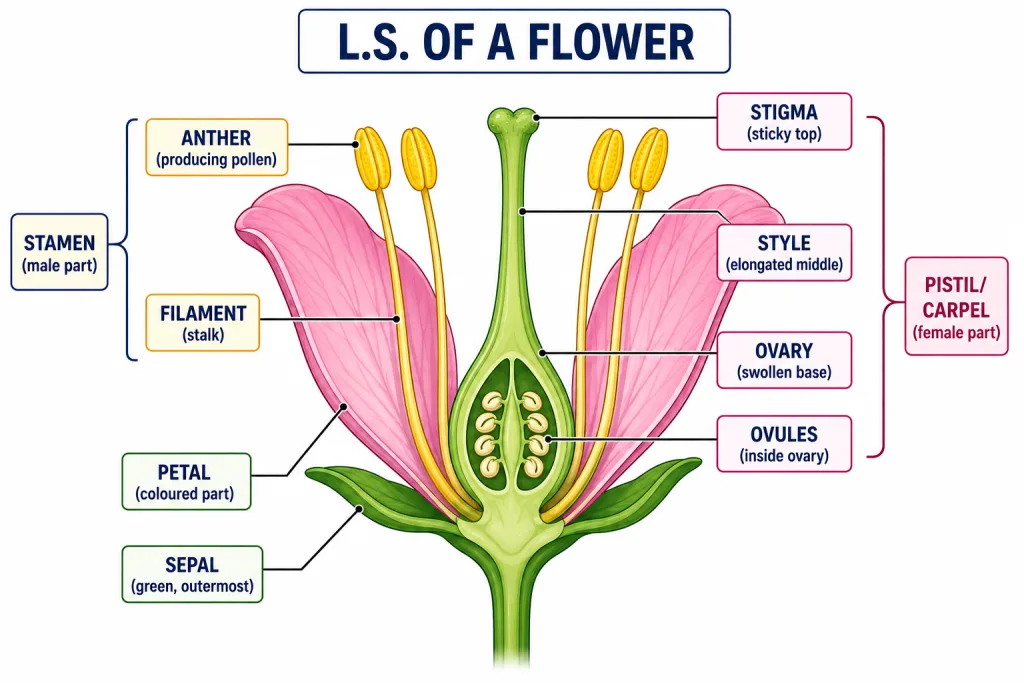
A typical flower has 4 main parts (whorls), arranged from outside to inside.
The 4 Whorls (Outer to Inner)
1. Calyx (Outermost) — green leaf-like sepals
Function: protect bud before flower opens.
Example: green parts at base of rose flower.
Sepals = leaves of calyx.
2. Corolla — colourful petals
Function: attract pollinators (bees, butterflies).
Often brightly coloured, fragrant.
Petals = leaves of corolla.
3. Androecium — male reproductive part
Made of stamens (male organs).
Each stamen has 2 parts: 1. Filament — long stalk. 2. Anther — bag-like structure on top.
Anther produces pollen grains (male gametes).
Number of stamens varies by species.
4. Gynoecium / Pistil — female reproductive part
Made of carpel(s).
Each carpel has 3 parts: 1. Stigma — sticky top, receives pollen. 2. Style — long stalk connecting stigma to ovary. 3. Ovary — basal swollen part containing ovules.
Ovary contains ovules (female gametes).
Diagram of a Flower
         |  Stigma  |
         |          |
         |   Style   |     ← Female part
         |          |       (Pistil/Gynoecium)
         |  Ovary   |
         |  (with    |
         |  ovules)  |
          \________/
            |
          Sepals (green) ← Calyx
        Petals (colourful) ← Corolla
        Stamens around → Anther → Pollen ← Androecium (Male)
              ↑
         Filament
Classification by Sex Parts
Bisexual flower: Has both stamens AND pistil. Examples: hibiscus, mustard, lily. Self-pollination possible.
Unisexual flower: Only stamens (male) OR only pistil (female). Examples: papaya, watermelon, cucumber. Cross-pollination needed.
Important Functions Summary
| Part | Function |
|---|---|
| Sepal | Protects bud |
| Petal | Attracts pollinators |
| Stamen | Produces pollen (male) |
| Anther | Pollen sacs |
| Pistil | Female part |
| Stigma | Receives pollen |
| Style | Pollen tube grows here |
| Ovary | Contains ovules |
| Ovule | Becomes seed after fertilisation |
Flower as Reproductive Unit
A flower is essentially a modified shoot with reproductive purpose.
All four whorls work together: 1. Sepals + petals → attract & protect. 2. Stamens + pistil → produce gametes. 3. Pollination → bring them together. 4. Fertilization → create new life.
[NCERT — diagram-based question]
Pollination
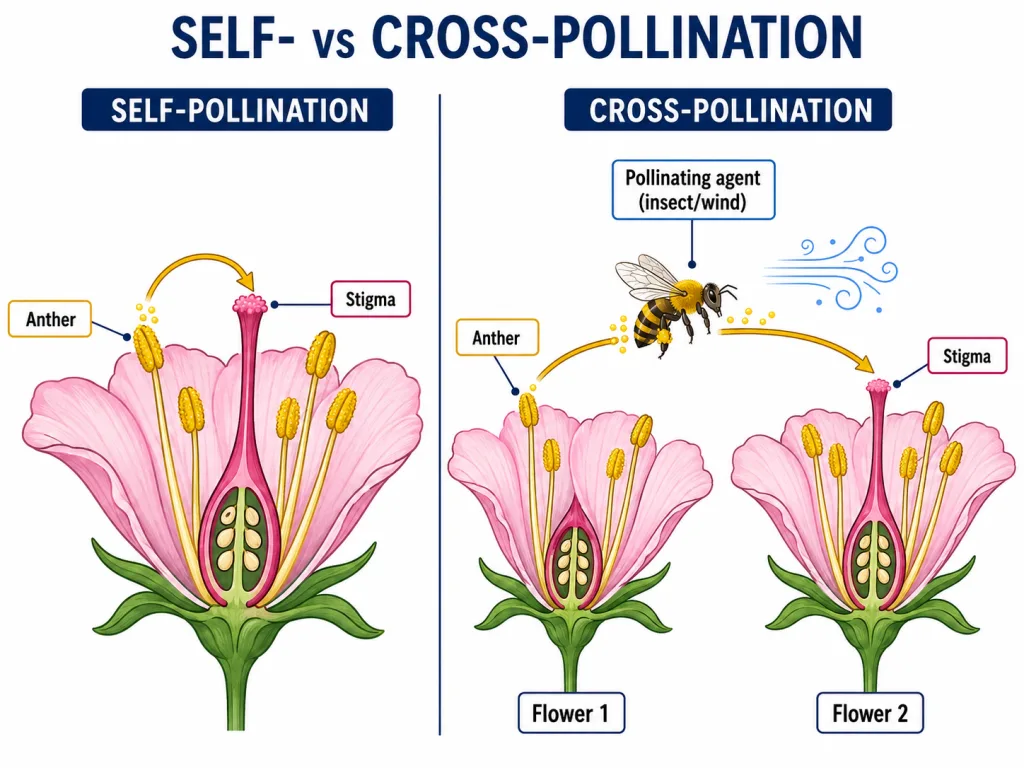
'Pollination' = transfer of pollen grains from anther (male) to stigma (female) of a flower.
Essential step before fertilization.
Types of Pollination
1. Self-pollination (Autogamy)
Pollen transferred: 1. From anther to stigma of same flower, OR 2. To another flower of same plant.
Common in bisexual flowers.
Examples: pea, wheat, mustard, rice.
Advantages: 1. Reliable — no need for external agent. 2. Less waste of pollen. 3. Reproduction guaranteed even when isolated.
Disadvantages: 1. No genetic variation. 2. Inbreeding effects. 3. Less adaptability.
2. Cross-pollination (Allogamy)
Pollen transferred from anther of one flower to stigma of another plant (different individual).
Examples: maize, sunflower, papaya.
Advantages: 1. Genetic variation. 2. Better adaptability. 3. Stronger offspring.
Disadvantages: 1. Need external agent (wind, insect). 2. Less reliable. 3. More pollen wasted.
Agents of Cross-Pollination
Plants depend on agents to transfer pollen.
1. Insects (Bees, Butterflies, Moths)
Most common agent.
Flowers attract insects with: 1. Bright colours (red, yellow, blue). 2. Fragrance. 3. Nectar (sugary reward).
Insects pick up pollen on body, transfer to next flower.
Examples: rose, hibiscus, sunflower.
2. Wind
Pollen dispersed by wind currents.
Wind-pollinated flowers: 1. Small, dull-coloured. 2. No fragrance, no nectar. 3. Light, dry pollen — easily airborne. 4. Large feathery stigmas — catch pollen. 5. Many pollen grains produced.
Examples: maize, wheat, rice, grasses, palm trees.
3. Water
Pollen carried by water currents.
Less common.
Examples: water plants like Vallisneria, Hydrilla.
4. Animals (Birds, Bats)
Some flowers attract birds (hummingbirds), bats.
Examples: 1. Birds — Strelitzia, hibiscus. 2. Bats — banana, durian (night-blooming flowers).
Adaptations for Pollination
For Insect Pollination: 1. Bright colours. 2. Sweet fragrance. 3. Sticky pollen (sticks to insect body). 4. Nectar reward. 5. Specific flower shapes.
For Wind Pollination: 1. Light, dry pollen. 2. Large amounts of pollen. 3. Stigmas exposed and feathery. 4. No fragrance. 5. Flowers small, often clustered.
For Water Pollination: 1. Pollen waterproof or floating. 2. Flowers near water. 3. Specific water-related adaptations.
Comparison: Self vs Cross Pollination
| Feature | Self | Cross |
|---|---|---|
| Pollen source | Same flower/plant | Different plant |
| Variation | Low | High |
| Reliability | High | Lower |
| Agents | None needed | Wind/insect/etc. |
| Adaptation | Simple flowers | Showy flowers |
| Examples | Pea, wheat | Maize, papaya |
Significance
Pollination is critical for: 1. Plant reproduction — without it, no seeds. 2. Food production — most crops need pollination. 3. Biodiversity — variety in plants. 4. Ecosystem health — pollinators are key.
Decline in bee populations = global concern!
[NCERT — important]
Fertilization in Plants
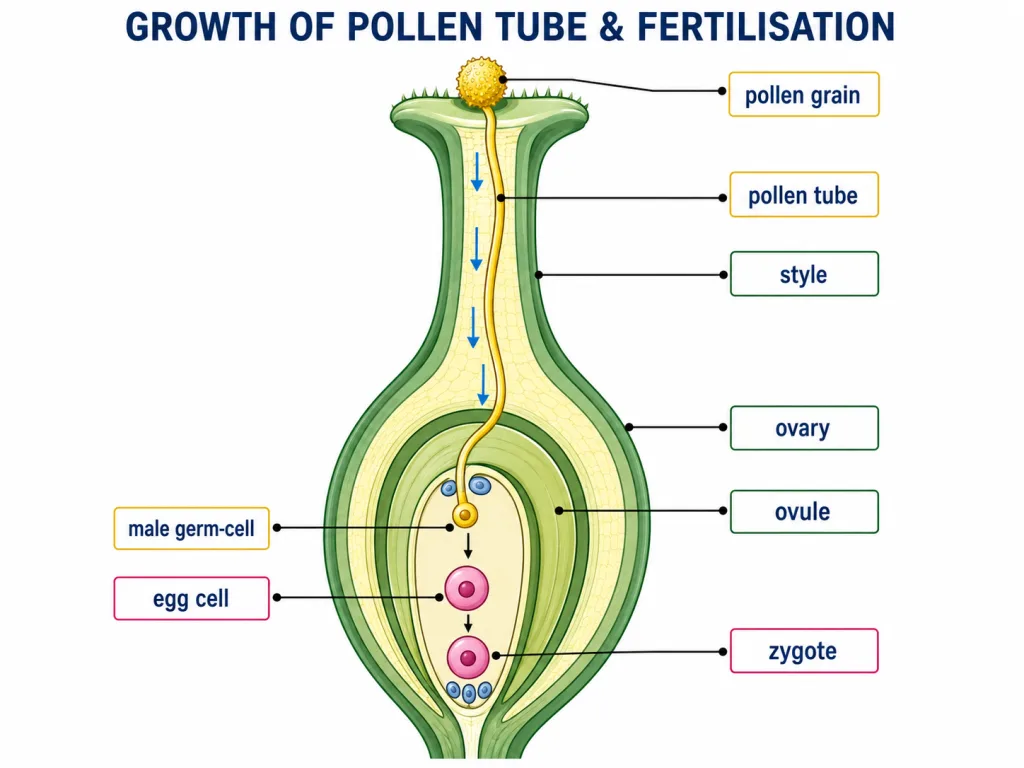
'Fertilization' = fusion of male gamete (in pollen) with female gamete (in ovule) to form a zygote.
This is when new life begins.
Steps of Fertilization
Step 1: Pollen Lands on Stigma 1. Pollen grain reaches stigma during pollination. 2. Stigma is sticky — pollen adheres.
Step 2: Pollen Tube Formation 1. Pollen grain absorbs nutrients from stigma. 2. Pollen grain germinates (becomes active). 3. Pollen tube grows from pollen grain. 4. Pollen tube grows down through style. 5. Reaches ovary.
Pollen tube carries male gametes.
Step 3: Tube Enters Ovule 1. Pollen tube enters ovule through small opening (micropyle). 2. Releases two male gametes. 3. Double fertilization in flowering plants:
- One male gamete + egg → zygote (becomes embryo).
- Second male gamete + 2 polar nuclei → endosperm (food for embryo).
Step 4: Zygote Forms 1. Male gamete fuses with egg. 2. Zygote = first cell of new plant. 3. Zygote contains DNA from both parents. 4. Develops into embryo over time.
Diagram: Pollen Tube Growth
Pollen grain on stigma
       |
  Pollen germinates
       |
  Pollen tube grows down through style
       |
  Tube enters ovule (through micropyle)
       |
  Male gamete + Egg = Zygote
Post-Fertilization Changes
1. Zygote develops into embryo: 1. Cell division begins. 2. Embryo has tiny shoot (plumule) and root (radicle). 3. Stores food (cotyledons or endosperm).
2. Ovule becomes seed: 1. Ovule wall hardens → seed coat (testa). 2. Embryo inside protected. 3. Food stored for germination.
3. Ovary becomes fruit: 1. Ovary wall develops into fruit wall (pericarp). 2. Other floral parts wither (sepals, petals, stamens). 3. Fruit protects seeds and aids dispersal.
Fruits = ripened ovaries with seeds inside.
Examples: 1. Mango — fleshy fruit with one seed inside. 2. Tomato — fleshy fruit with many seeds. 3. Pea pod — dry fruit with seeds in line. 4. Orange — fleshy fruit with juicy segments.
Seed Structure (Brief)
Seed has: 1. Seed coat (testa) — protective outer layer. 2. Embryo — tiny plant.
- Plumule — future shoot.
- Radicle — future root.
- Cotyledons — seed leaves with stored food. 3. Endosperm — additional food (in some seeds).
Germination
Seed germinates when conditions are right: 1. Water — softens seed coat. 2. Oxygen — for respiration. 3. Temperature — warm, suitable. 4. Light (some seeds).
Process: 1. Seed absorbs water, swells. 2. Radicle emerges first (becomes root). 3. Plumule emerges (becomes shoot). 4. Cotyledons provide food until leaves form. 5. New plant established.
Why So Many Seeds and Fruits?
Plants produce many seeds because: 1. Most don't survive (eaten, lost). 2. Need enough for some to grow. 3. Spread to new areas. 4. Long-term species survival.
Hence: nature's strategy of 'overproduction'.
[NCERT — important]
Memory Capsule — Section 3
Quick revision: Sexual reproduction in plants.
Flower Parts (Outer to Inner)
1. Calyx = sepals (green, protect bud). 2. Corolla = petals (colourful, attract). 3. Androecium = stamens (male).
- Filament + Anther (with pollen). 4. Gynoecium / Pistil = carpel (female).
- Stigma + Style + Ovary (with ovules).
Key Definitions
1. Pollination = pollen reaches stigma. 2. Fertilization = pollen + ovule → zygote. 3. Pollen tube = grows from pollen, carries male gametes. 4. Zygote = first cell of new plant. 5. Seed = ripened ovule. 6. Fruit = ripened ovary.
Pollination Types
Self-pollination: 1. Same flower or same plant. 2. Examples: pea, wheat. 3. No variation.
Cross-pollination: 1. Different plant. 2. Examples: maize, papaya. 3. High variation.
Pollination Agents
1. Insects — bees, butterflies (most flowers). 2. Wind — grasses, maize, wheat. 3. Water — Vallisneria, Hydrilla. 4. Animals — birds (Strelitzia), bats (banana).
Process Sequence
1. Pollination (pollen → stigma). 2. Pollen germination. 3. Pollen tube grows down style. 4. Enters ovule through micropyle. 5. Male gamete + egg = zygote. 6. Zygote → embryo. 7. Ovule → seed. 8. Ovary → fruit.
Bisexual vs Unisexual
Bisexual (both parts): Hibiscus, mustard, rose.
Unisexual (one part): Papaya (separate male/female plants), watermelon.
Diagram Reminders
Stigma sticky. Style is the tube. Ovary swollen. Anther produces pollen. Filament holds anther.
One-liner Insights
1. Flower = reproductive organ. 2. Pollen = male; Ovule = female. 3. Pollination ≠ Fertilization. 4. Seed = ripened ovule. 5. Fruit = ripened ovary. 6. Bees are nature's pollinators.
Real-world
1. Bees declining — pollination crisis. 2. Honeybees — pollinate 70% of crops. 3. Wind-pollination in grasses. 4. Hybrid plants = cross-pollination + selection. 5. Apple, mango, almond — depend on insects.
[Quick reference for plants!]
Example 1: NCERT — Pollination vs Fertilization
Differentiate between pollination and fertilization.
Solution:
Pollination
Definition: Transfer of pollen grains from anther (male) to stigma (female) of a flower.
Just transfer — no fusion yet.
Types: Self (same flower/plant) or Cross (different plant).
Agents: insects, wind, water, animals.
Result: pollen lands on stigma.
Fertilization
Definition: Fusion of male gamete (from pollen) with female gamete (in ovule) to form zygote.
Actual fusion of gametes.
Process: 1. Pollen germinates on stigma. 2. Pollen tube grows through style. 3. Reaches ovule. 4. Male gamete fuses with egg. 5. Zygote formed.
Result: zygote begins → embryo.
Comparison Table
| Feature | Pollination | Fertilization |
|---|---|---|
| Definition | Transfer of pollen | Fusion of gametes |
| What happens | Pollen → stigma | Male + Egg = Zygote |
| Where | Outside ovule | Inside ovule |
| Stage | Before fertilization | After pollination |
| Result | Pollen on stigma | Zygote forms |
| Type | Physical process | Genetic process |
| Variation | Determined by source | Always one fusion |
Sequence
Pollination → Pollen germination →
Pollen tube → Reaches ovule →
Fertilization → Zygote → Embryo → Seed
Key Points
1. Pollination ≠ Fertilization. 2. Pollination is a prerequisite for fertilization. 3. Pollination can occur without fertilization (if pollen doesn't germinate). 4. Both essential for sexual reproduction.
Real-life Connections
1. Hybrid crops — controlled cross-pollination. 2. Bees decline = pollination crisis. 3. Failed fertilization = no fruit/seed.
[NCERT — important]
Example 2: NCERT — Flower Structure
Draw a labelled diagram of a flower and describe the function of each part.
Solution:
Flower Diagram
          Stigma (sticky)
            |
         Style (tube)
            |
         Ovary (with ovules)

    Stamens (Anther + Filament)

    Petals (colourful)

    Sepals (green)
Detailed Function Description
1. Sepals (Calyx) — Green leaf-like structures
Function: 1. Protect the flower bud before it opens. 2. Like a 'covering' for unborn flower. 3. Often green; some species have colourful sepals.
2. Petals (Corolla) — Colourful, often fragrant
Function: 1. Attract pollinators (bees, butterflies, birds). 2. Bright colours visible to insects. 3. Fragrance attracts from far. 4. Provide landing platform.
3. Stamens (Androecium) — Male part
Each stamen has: 1. Filament — long stalk supporting anther. 2. Anther — bag-like structure on top.
- Contains pollen sacs.
- Produces pollen grains (male gametes).
- Releases pollen when mature.
Function: produces and releases male gametes (pollen).
4. Pistil (Gynoecium) — Female part
Has 3 parts: 1. Stigma — sticky top.
- Function: catches pollen during pollination.
- Sticky to hold pollen grain.
2. Style — long tube.
- Function: pollen tube grows through it to reach ovary.
- Length varies by species.
3. Ovary — basal swollen part.
- Function: contains ovules (female gametes).
- After fertilization, ovary becomes fruit.
Each ovule = potential seed.
Bisexual Flower
Has both stamens and pistil. Examples: hibiscus, mustard, rose. Self-pollination possible.
Unisexual Flower
Has only stamens (male) OR only pistil (female). Examples: papaya, watermelon, cucumber. Cross-pollination needed.
Whorls Summary Table
| Whorl | Components | Type | Function |
|---|---|---|---|
| Calyx | Sepals | Outermost | Protect bud |
| Corolla | Petals | Second | Attract pollinators |
| Androecium | Stamens | Third | Produce pollen (male) |
| Gynoecium | Pistil | Innermost | Produce/receive ovules (female) |
Importance
The flower is a complete reproductive unit: 1. Sepals + Petals → attract & protect. 2. Stamens → produce male gametes. 3. Pistil → produce female gametes & receive pollen. 4. After fertilization, ovule → seed; ovary → fruit.
All four whorls work together for successful sexual reproduction.
[Board: 5-mark question]
Example 3: Application — Adaptations for Pollination
What adaptations do flowers have for: (a) insect pollination, (b) wind pollination?
Solution:
(a) Insect Pollination Adaptations
Flowers pollinated by insects (bees, butterflies, moths) have:
1. Bright Colours 1. Visible to insects. 2. Bees see ultraviolet patterns. 3. Common colours: yellow, red, blue, white. 4. Helps insects locate flower.
2. Fragrance 1. Attracts insects from far. 2. Sweet, pleasant scent. 3. Some flowers smell like rotting flesh — attract flies (rare).
3. Nectar 1. Sugary liquid as reward. 2. Found at base of flower. 3. Insect goes deep to reach nectar. 4. Body brushes against anther — pollen sticks.
4. Sticky or Spiny Pollen 1. Sticks to insect body. 2. Heavy, doesn't fly off. 3. Transferred to next flower.
5. Specific Shapes 1. Tube-shaped — bees crawl in. 2. Landing platform — petals. 3. Some flowers have specific 'keys' that fit specific insects. 4. Co-evolution: orchid-bee mutual adaptations.
6. Position of Stamens and Stigma 1. Often at level where insect contacts. 2. Pollen brushes off, lands on stigma.
Examples: rose, hibiscus, sunflower, lily, marigold.
(b) Wind Pollination Adaptations
Flowers pollinated by wind (grasses, cereals) have:
1. Small, Dull Flowers 1. No need to attract insects. 2. Often green/brown. 3. Flowers in clusters or spikes.
2. No Fragrance 1. Not needed for wind dispersal. 2. Saves energy.
3. No Nectar 1. No insect reward needed. 2. Saves resources.
4. Light, Dry Pollen 1. Floats easily in air. 2. Travels far on wind currents. 3. Smooth, not sticky. 4. Produced in HUGE quantities.
5. Exposed Stamens 1. Anthers held outside flower. 2. Wind easily blows pollen away. 3. Sometimes, stamens hang on long filaments.
6. Feathery Stigmas 1. Large surface area. 2. Branched, sticky. 3. Catches airborne pollen. 4. Stigma exposed (not enclosed).
7. Many Pollen Grains 1. Most lost to wind. 2. Need many for some to reach stigma. 3. Single grass plant can produce billions of pollen grains.
Examples: maize, wheat, rice, grasses, sugarcane.
Comparison Table
| Feature | Insect-pollinated | Wind-pollinated |
|---|---|---|
| Colour | Bright | Dull/green |
| Fragrance | Yes | No |
| Nectar | Yes | No |
| Pollen | Sticky, heavy | Light, dry, abundant |
| Stigma | Small, often inside | Large, feathery, exposed |
| Stamens | Inside flower | Hanging out |
| Pollen quantity | Less | Lots |
| Examples | Rose, sunflower | Maize, grass |
Why These Adaptations?
Plants evolved over millions of years to maximise pollination success.
Insect pollination = efficient (specific, low waste). Wind pollination = wasteful but reliable (no living agent needed). Plants chose strategy based on environment, body type, evolutionary history.
Real-world Importance
1. Crops — many depend on insect pollination (apple, mango, pumpkin). 2. Cereals — wind-pollinated (wheat, rice, maize). 3. Pollinator decline — affects crop yields. 4. Climate change — disrupts pollination timing.
Understanding these adaptations is essential for agriculture and conservation.
[NEET + Application]
Example 4: NCERT — Post-Fertilization Changes
After fertilization in a flower, what happens to: (a) ovule, (b) ovary, (c) other floral parts? Explain with examples.
Solution:
(a) Ovule → Seed
The ovule undergoes major changes:
1. Zygote develops into embryo: 1. Cell divisions begin. 2. Embryo has plumule (shoot), radicle (root), cotyledons (food).
2. Endosperm formation: 1. Second male gamete + 2 polar nuclei → endosperm. 2. Provides food for embryo (in some seeds).
3. Seed coat formation: 1. Ovule wall hardens. 2. Becomes testa (outer hard coat). 3. Tegmen = inner soft coat. 4. Protects embryo.
4. Loss of water: 1. Seed dries out. 2. Becomes dormant. 3. Can survive long periods.
Seed = mature ovule with embryo + food + coat.
Examples: 1. Mango seed — large, with one cotyledon. 2. Pea seed — small, with two cotyledons. 3. Wheat seed — endospermic. 4. Coconut seed — large with stored food.
(b) Ovary → Fruit
The ovary transforms:
1. Ovary wall develops: 1. Ovary wall = pericarp (fruit wall). 2. Has 3 layers in fleshy fruits:
- Epicarp (outer skin).
- Mesocarp (middle, often fleshy).
- Endocarp (inner, around seeds).
2. Cells divide and grow: 1. Ovary swells. 2. Stores food (sugars, water). 3. Becomes attractive to dispersers.
3. Ripening: 1. Colour changes (green → yellow/red). 2. Sugars accumulate. 3. Aroma develops. 4. Becomes soft (or hard, depending on type).
Examples of fruits: 1. Mango — fleshy, one seed (drupe). 2. Tomato — fleshy, many seeds (berry). 3. Pea pod — dry, seeds in line (legume). 4. Apple — fleshy with core (pome). 5. Watermelon — large fleshy with many seeds. 6. Coconut — fibrous coat, hard endocarp, food inside.
(c) Other Floral Parts
Most other parts wither and fall off:
1. Sepals (calyx): 1. Usually wither and fall. 2. Some persist (e.g., tomato, brinjal — green calyx remains).
2. Petals (corolla): 1. Usually wither and fall. 2. They have served their purpose (attracting pollinators).
3. Stamens (androecium): 1. After releasing pollen, wither and fall. 2. Sometimes leave scars on fruit.
4. Style and Stigma: 1. Wither after fertilization. 2. Sometimes persist as scar on fruit (e.g., apple — flower scar at end).
The flower transforms into fruit + seed; rest is discarded.
Diagram: Flower to Fruit
Flower (with all parts)
         ↓
Fertilization occurs
         ↓
Ovule → Seed
Ovary → Fruit
Other parts wither
         ↓
Mature Fruit with seeds
         ↓
Dispersal
         ↓
Germination → New plant
Significance
1. Seeds carry genetic information for next generation. 2. Fruits protect seeds and aid dispersal. 3. Sweet fruits attract animals → seeds dispersed. 4. Dry fruits dispersed by wind, water, animals. 5. Plants ensure long-term species survival.
Examples of Dispersal
1. Wind — dandelion (parachute), maple (winged seeds). 2. Water — coconut floats. 3. Animals — fruits eaten, seeds excreted (e.g., berries, mango). 4. Burrs — stick to fur.
Plants are clever: invest in fruits to ensure offspring spread!
[NCERT — important]
Example 5: Synthesis — Complete Reproductive Cycle
Describe the complete sexual reproductive cycle in a flowering plant, from flower formation to seed germination.
Solution:
Stage 1: Flower Formation
1. Plant matures, produces flowers. 2. Flower has 4 whorls:
- Sepals (calyx) — protect.
- Petals (corolla) — attract.
- Stamens (androecium) — male.
- Pistil (gynoecium) — female. 3. Flower is reproductive organ.
Stage 2: Gamete Formation
Male gametes: 1. In anther (top of stamen). 2. Pollen sacs contain pollen mother cells. 3. Meiosis → pollen grains (haploid). 4. Each pollen grain has male gamete inside.
Female gametes: 1. In ovary (base of pistil). 2. Ovule contains megaspore mother cell. 3. Meiosis → megaspores → female gamete (egg, haploid). 4. Egg surrounded by 7-celled embryo sac.
Stage 3: Pollination
1. Pollen transferred from anther to stigma. 2. Self-pollination — same flower/plant. 3. Cross-pollination — different plant. 4. Agents: insects, wind, water, animals. 5. Pollen lands on sticky stigma.
Stage 4: Pollen Germination & Tube Growth
1. Pollen absorbs water/nutrients from stigma. 2. Pollen germinates. 3. Pollen tube grows down through style. 4. Tube carries 2 male gametes. 5. Reaches ovary, enters ovule through micropyle.
Stage 5: Fertilization (Double Fertilization)
Inside ovule:
Fusion 1: One male gamete + Egg → Zygote (2n).
Fusion 2: Second male gamete + 2 polar nuclei → Endosperm (3n).
This is double fertilization — unique to flowering plants.
Stage 6: Embryo and Seed Development
1. Zygote divides repeatedly. 2. Forms embryo:
- Plumule (future shoot).
- Radicle (future root).
- Cotyledons (food storage). 3. Endosperm provides food (some seeds). 4. Ovule wall hardens → seed coat. 5. Seed = mature ovule with embryo.
Stage 7: Fruit Development
1. Ovary wall thickens. 2. Fills with food (sugars, water). 3. Develops colour, fragrance. 4. Becomes fruit. 5. Other floral parts wither.
Stage 8: Dispersal
Seeds dispersed away from parent: 1. Wind — light, winged seeds (dandelion, maple). 2. Water — floating seeds (coconut, lotus). 3. Animals — eaten then excreted (berries); stick to fur (burrs). 4. Explosive — pod bursts (impatiens).
Why dispersal? Avoid crowding, spread to new areas.
Stage 9: Germination
Seed sprouts when conditions right:
Conditions: 1. Water (softens seed). 2. Oxygen (respiration). 3. Temperature (warm). 4. Light (sometimes).
Process: 1. Seed absorbs water, swells. 2. Radicle emerges first (becomes root). 3. Plumule emerges (becomes shoot). 4. Cotyledons provide food. 5. New plant grows.
Stage 10: Maturation and Cycle Continues
1. New plant grows leaves, stem. 2. Performs photosynthesis. 3. Eventually produces flowers. 4. Cycle repeats.
Diagram: Complete Cycle
Flower → Gametes → Pollination →
   ↓
Fertilization → Zygote/Endosperm →
   ↓
Embryo/Seed → Fruit → Dispersal →
   ↓
Germination → Seedling → Mature plant →
   ↓
New flowers → REPEAT
Why This Is Important
1. Variation through cross-pollination. 2. Survival through fruit/seed protection. 3. Spread through dispersal. 4. Continuity through cycles.
Key Takeaways
1. Pollination ≠ Fertilization (sequence matters). 2. Double fertilization = unique to angiosperms. 3. Seed = ripened ovule. 4. Fruit = ripened ovary. 5. Dispersal ensures species spread.
Real-life Example: Mango
1. Mango tree produces flowers (March). 2. Pollinated by insects (bees). 3. Fertilization in ovary. 4. Ovule → seed (with embryo). 5. Ovary → fleshy fruit. 6. Animal eats fruit, scatters seed. 7. Seed germinates → new mango plant!
Same cycle for all flowering plants.
[Board: 5-mark synthesis]