
From Producers to Consumers
In Section 2 you learnt how plants make their own food — they are the producers of every food chain. Now we meet everyone else: the heterotrophs, the consumers, who can't make food but need to eat it.
'Heterotroph' = an organism that depends on other organisms (or their products) for organic food.
The word breaks down nicely:
- Hetero = other.
- Troph = feeding.
- Together: "feeding on others."
Every animal, every fungus, every parasite, every you and me — we are all heterotrophs.
Why is heterotrophic nutrition so varied?
Because different heterotrophs eat in radically different ways. A cow grazes grass. A fungus secretes enzymes onto bread and absorbs the digested mush. A tapeworm lives inside our intestine and steals our food. A single-celled Amoeba engulfs its prey whole.
NCERT classifies all these strategies into three main types, based on how the heterotroph gets its food.
The Three Types of Heterotrophic Nutrition
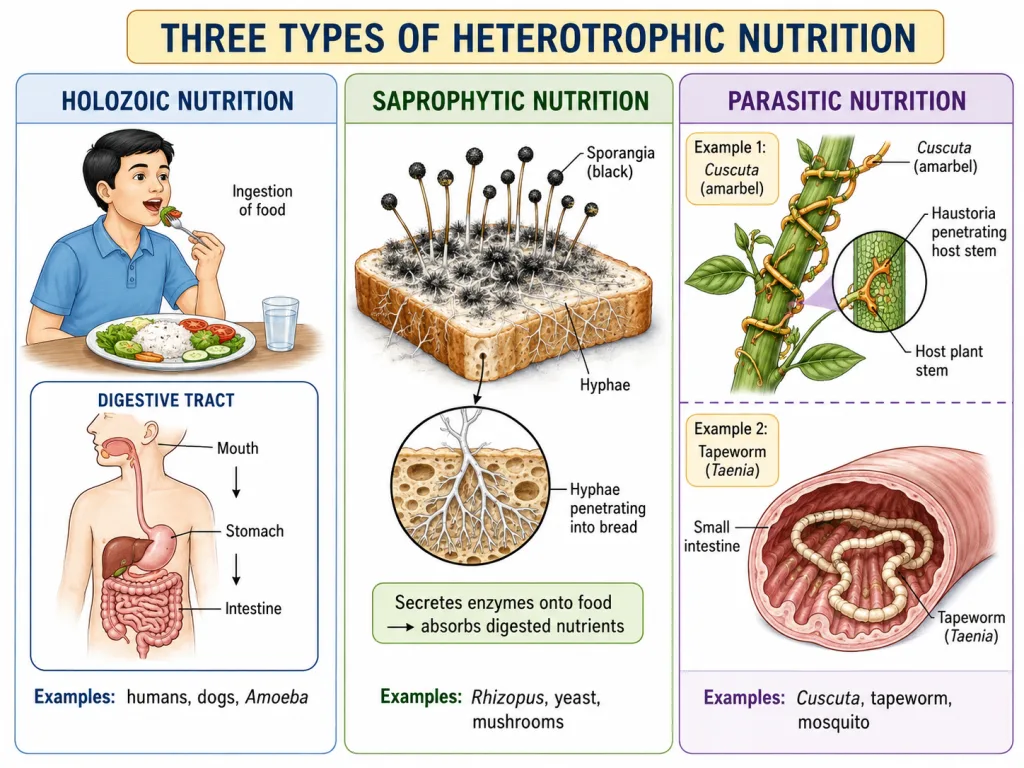
Type 1: Holozoic Nutrition ("whole-food eating")
'Holozoic' = ingesting solid food, then digesting it inside the body.
Word origin: holos (whole) + zoikos (animal-like). "Eating whole, animal-style."
Steps:
- Ingestion — taking solid food into the body.
- Digestion — breaking it down inside the body, into smaller absorbable molecules.
- Absorption — taking nutrients into cells.
- Assimilation — using nutrients for growth and energy.
- Egestion — expelling undigested waste.
Examples:
- Macroscopic: humans, cats, cows, fish, snakes, frogs, every animal you can name.
- Microscopic: Amoeba and Paramecium (yes, even single-celled organisms can be holozoic).
The dominant strategy in the animal kingdom.
Type 2: Saprophytic Nutrition ("rot-feeding")
'Saprophyte' = an organism that feeds on dead and decaying organic matter, by secreting digestive enzymes onto it and then absorbing the digested nutrients.
Word origin: sapros (rotten) + phyton (plant). "Eating the rotten."
Mechanism — extracellular digestion: Unlike holozoic feeders, saprophytes don't ingest the food first. Instead:
- They secrete digestive enzymes onto the food (outside the body).
- The enzymes break the food into simpler molecules.
- The simpler molecules are then absorbed through the body surface.
Digestion happens outside the cell. This is why fungi can decompose bread without eating it!
Examples:
- Rhizopus (bread mould).
- Yeast.
- Mushrooms.
- Most fungi and many bacteria.
Ecological role: Saprophytes are nature's decomposers — they recycle dead matter back into the ecosystem. Without them, dead leaves and bodies would pile up forever.
Type 3: Parasitic Nutrition ("host-feeding")
'Parasite' = an organism that lives in or on another living organism (the host) and obtains food from it, usually causing harm to the host.
Word origin: para (beside) + sitos (food). "Eating beside (someone else's) food."
Key features:
- Lives on (ectoparasite) or inside (endoparasite) the host.
- The host is usually alive (unlike saprophytes which feed on dead matter).
- The host is harmed but usually not immediately killed.
Examples:
| Parasite | Type | Host | Notes |
|---|---|---|---|
| Cuscuta (Amarbel) | Plant parasite | Other plants | Has no chlorophyll; wraps around host plant; sends haustoria into the host to suck nutrients. |
| Tapeworm (Taenia) | Endoparasite | Humans, pigs, cattle | Lives in intestine; absorbs digested food directly. |
| Plasmodium | Endoparasite | Humans (via mosquito) | Causes malaria; lives in liver and RBCs. |
| Leech | Ectoparasite | Mammals | Sucks blood. |
| Mosquito | Ectoparasite | Mammals | Sucks blood (female only). |
| Roundworm, hookworm | Endoparasite | Human intestine | Cause anaemia, malnutrition. |
Quick comparison
| Feature | Holozoic | Saprophytic | Parasitic |
|---|---|---|---|
| Food source | Solid food (often alive when eaten or freshly killed) | Dead, decaying matter | Live host |
| Digestion | Inside body (intracellular or in gut) | Outside body (extracellular) | Inside parasite's body OR uses host's digestion |
| Examples | Humans, Amoeba | Rhizopus, mushrooms | Cuscuta, tapeworm |
| Effect on food source | Killed and eaten | Already dead | Harmed but kept alive |
[Board Important] "Differentiate between holozoic, saprophytic, and parasitic nutrition." This is a classic 3-mark question. Always give one example of each.
Nutrition in Amoeba — Holozoic at the Cellular Level
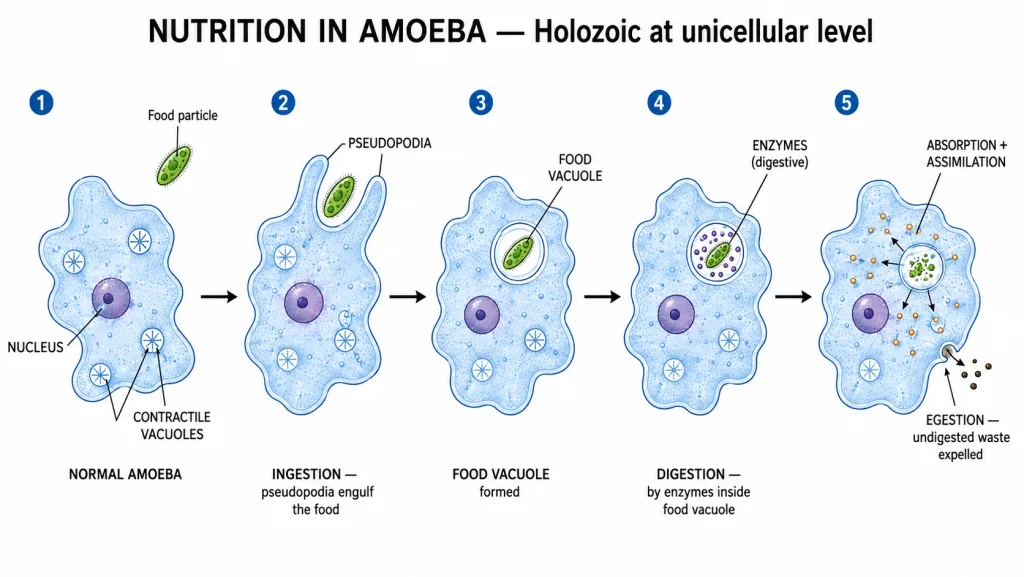
Amoeba is a single-celled organism — but it still performs all the steps of holozoic nutrition. The clever trick is that one cell does everything that organs do in a multicellular animal.
The 5-step process in Amoeba
Step 1: INGESTION (engulfing the food)
When Amoeba detects a food particle (e.g., a smaller organism, a bit of organic matter), it sends out pseudopodia — temporary finger-like projections of its cytoplasm.
'Pseudopodia' = false feet. They extend around the food, eventually surrounding it completely.
This process of engulfing food using pseudopodia is called phagocytosis (literally "cell-eating").
Step 2: FOOD VACUOLE FORMATION
Once the pseudopodia meet on the other side, the food is now enclosed inside a small vesicle within the cytoplasm — called a food vacuole.
This is essentially Amoeba's "stomach" — a temporary digestive chamber.
Step 3: DIGESTION (intracellular)
Digestive enzymes are secreted from the surrounding cytoplasm into the food vacuole. These enzymes break down the food into simpler molecules — proteins → amino acids, starch → glucose, fats → fatty acids and glycerol.
Notice this is intracellular digestion — happening inside a cell. This is different from human digestion, which is extracellular (happens in the gut lumen, outside cells, then absorbed).
Step 4: ABSORPTION + ASSIMILATION
The digested nutrients pass from the food vacuole into the surrounding cytoplasm. There they are used:
- For energy (broken down via respiration).
- For growth (used to build new cell parts).
- For storage (saved as food reserves).
This is the assimilation step — nutrients become part of the cell.
Step 5: EGESTION
The undigested leftovers in the food vacuole are pushed to the cell surface, and the cell membrane temporarily opens to expel them — like a tiny sneeze in reverse.
Unlike multicellular animals which have a fixed anus, Amoeba can egest from any part of its surface.
Why this is brilliant
A single cell — Amoeba — does in 5 steps what humans need a full digestive system to do. No mouth, no stomach, no intestine. Just one cell, doing it all.
Comparison table — Amoeba vs Human nutrition
| Step | Amoeba | Human |
|---|---|---|
| Ingestion | Pseudopodia engulf food | Mouth + hands |
| Digestion | Food vacuole (intracellular) | Mouth + stomach + intestine (extracellular) |
| Absorption | Cytoplasm | Small intestine villi |
| Assimilation | Cytoplasm uses molecules | Body cells via blood |
| Egestion | Any part of cell surface | Anus |
[Board Important] "Describe nutrition in Amoeba with a labelled diagram." 5-mark Board question. Must include: pseudopodia, food vacuole, intracellular digestion, expulsion from any part of cell membrane.
Nutrition in Paramecium — A Specialised Single Cell
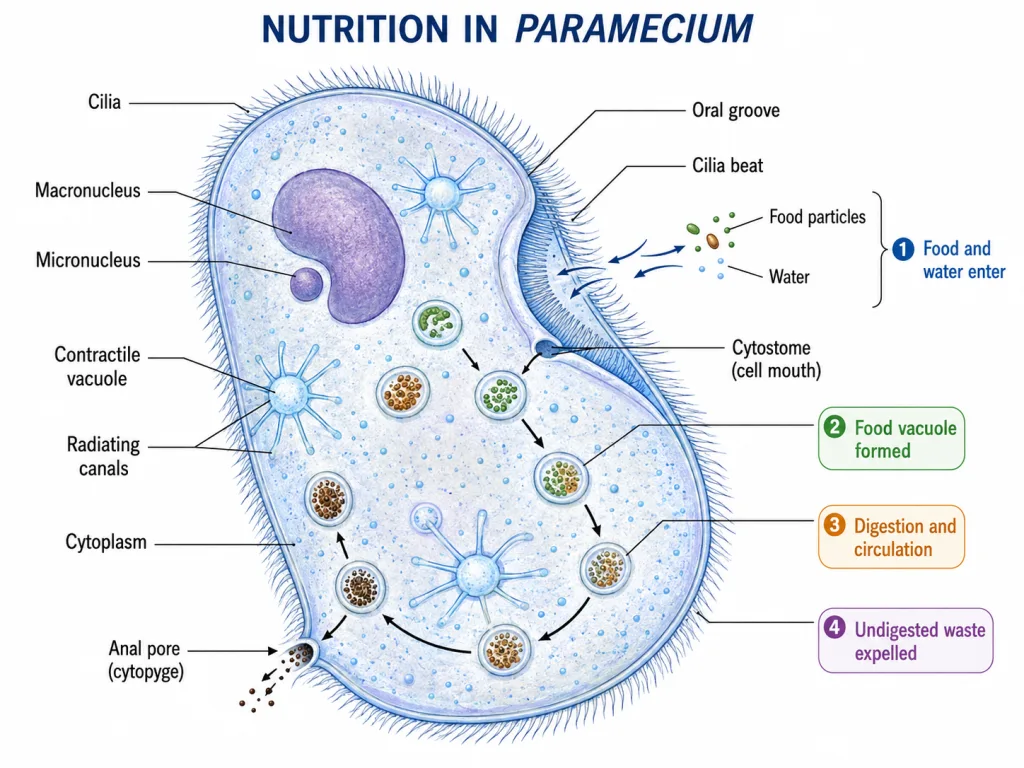
Paramecium is another single-celled holozoic feeder, but with a much more specialised structure than Amoeba. Where Amoeba is flexible and blob-like, Paramecium has a fixed slipper-like shape with dedicated structures for feeding.
The key structures of Paramecium
- Cilia — tiny hair-like projections covering the entire cell surface. They beat in coordinated waves.
- Oral groove — a curved cleft on one side of the cell, lined with longer cilia.
- Cytostome — the "cell mouth" at the bottom of the oral groove.
- Food vacuole — same as Amoeba.
- Cytopyge (anal pore) — a fixed spot for waste expulsion (unlike Amoeba, this is permanent).
- Macronucleus + Micronucleus — controls vegetative + reproductive functions.
- Contractile vacuoles — osmoregulation (more on this in Section 8).
How Paramecium feeds
Step 1: Cilia create a current. The cilia in the oral groove beat in coordinated waves, creating a water current that sweeps small food particles (bacteria, tiny algae) into the groove.
Step 2: Food enters via cytostome. The food particles are pushed down the oral groove to the cytostome, where they enter the cytoplasm.
Step 3: Food vacuole forms. As food enters, it gets enclosed in a food vacuole (just like in Amoeba).
Step 4: Vacuole circulates and digests. The food vacuole moves around inside the cytoplasm in a specific path (called cyclosis). As it moves, enzymes are secreted into it, and digestion proceeds.
Step 5: Nutrients absorbed; waste expelled at cytopyge. Digested nutrients diffuse into the cytoplasm. Undigested matter exits through the fixed anal pore (cytopyge) — unlike Amoeba which can egest from anywhere.
Amoeba vs Paramecium — Important differences
| Feature | Amoeba | Paramecium |
|---|---|---|
| Shape | Irregular, flexible | Fixed slipper-shape |
| Locomotion | Pseudopodia | Cilia |
| Ingestion | Pseudopodia engulf food | Cilia sweep food into oral groove |
| Mouth | Anywhere (temporary) | Fixed cytostome |
| Egestion | Anywhere on cell surface | Fixed cytopyge (anal pore) |
| Nuclei | One | Two (macro + micro) |
| Digestion | Intracellular (food vacuole) | Intracellular (food vacuole) |
Key takeaway: Both are unicellular, both are holozoic, both use food vacuoles for digestion — but Paramecium is more specialised with permanent feeding structures, while Amoeba is more flexible.
[NEET-foundation] The cilia of Paramecium and the pseudopodia of Amoeba are different cellular structures. Pseudopodia are cytoplasmic extensions (no microtubules). Cilia are microtubule-based, with a 9+2 arrangement. (You'll meet this detail in Class 11.)
The 5 Steps of Holozoic Nutrition (Detailed)
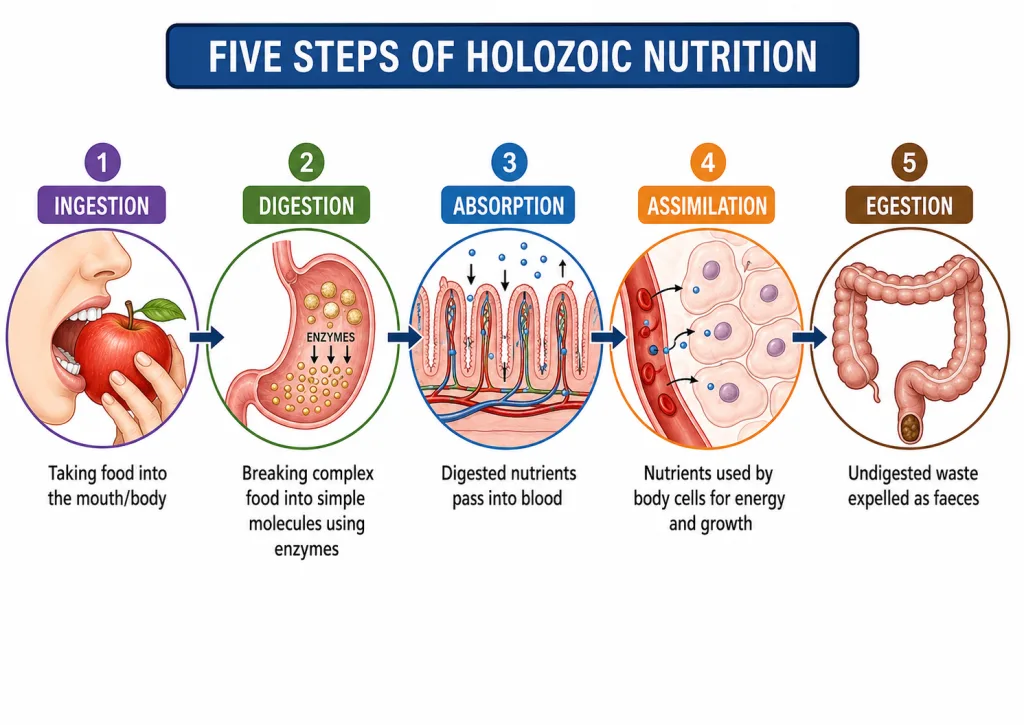
Whether in a human or an Amoeba, holozoic nutrition follows the same five steps. Let's pin them down precisely — these are Board exam favourites.
Step 1: INGESTION
'Ingestion' = the taking in of food into the body.
- In humans: through the mouth.
- In Amoeba: by pseudopodia.
- In Paramecium: through the cytostome (cell mouth).
- In a snake: by swallowing whole.
This is the easiest step to recognise — it's literally "eating."
Step 2: DIGESTION
'Digestion' = the breakdown of complex food molecules into simpler ones, which can be absorbed by the body.
Food, when ingested, is usually too complex to enter cells directly. Starch is too big to cross a cell membrane. Proteins are too big. Fats are too big. Digestion is the process of breaking them down:
| Complex food | Digested into |
|---|---|
| Starch (carbohydrate) | Glucose |
| Proteins | Amino acids |
| Fats | Fatty acids + Glycerol |
Digestion is done by enzymes — biological catalysts that speed up chemical reactions.
Two types of digestion:
- Intracellular — inside the cell (e.g., Amoeba, Paramecium).
- Extracellular — outside the cell, in a gut/digestive tract (e.g., humans, animals, saprophytes).
Step 3: ABSORPTION
'Absorption' = the passage of digested nutrients from the digestive system into the body fluids (blood/lymph in animals; cytoplasm in single cells).
- In humans: mostly through the villi of the small intestine into the blood.
- In Amoeba: from food vacuole into cytoplasm.
This step moves nutrients from "food chamber" to "transport system."
Step 4: ASSIMILATION
'Assimilation' = the use of absorbed nutrients by body cells for energy, growth, and repair.
After absorption, the nutrients reach individual cells, where they are:
- Burnt in respiration to release ATP.
- Used to build new molecules (proteins, DNA, etc.).
- Stored for later use (glycogen, fats).
Assimilation = nutrients actually becoming part of the body's living tissue.
Step 5: EGESTION
'Egestion' = the removal of undigested food (waste) from the body.
Not all food can be digested. Cellulose (fibre) in vegetables, for example, isn't digestible by humans. The waste exits:
- In humans: through the anus as faeces.
- In Amoeba: through any part of the cell membrane.
- In Paramecium: through the cytopyge.
Important distinction: Egestion vs Excretion
Don't confuse these two!
| Egestion | Excretion |
|---|---|
| Removal of undigested food | Removal of metabolic waste from cells |
| Comes from food that was never absorbed | Comes from food that was used and broken down (e.g., urea from protein metabolism) |
| Exits through anus | Exits through kidneys (urine), lungs (CO₂), skin (sweat) |
| Not really a "life process" by itself — part of nutrition | A life process of its own (Section 8) |
A biscuit you ate but didn't fully digest? Egestion when it leaves. The urea formed when your body broke down a protein? Excretion.
[Board Important] "Differentiate between egestion and excretion." Easy 2-mark question. Always note: egestion = undigested food; excretion = metabolic waste.
Memory Capsule — Section 3
A compact recap before moving to Section 4 (Human Digestive System).
Three types of heterotrophic nutrition
| Type | Method | Example |
|---|---|---|
| Holozoic | Ingest, digest inside | Humans, cows, Amoeba |
| Saprophytic | Secrete enzymes onto dead matter, absorb | Rhizopus, mushrooms |
| Parasitic | Live on/in living host | Cuscuta, tapeworm |
Amoeba — 5 steps of nutrition
- Ingestion — pseudopodia engulf food.
- Food vacuole formation.
- Digestion — intracellular, in food vacuole.
- Absorption + Assimilation — nutrients into cytoplasm.
- Egestion — undigested waste pushed out anywhere on cell surface.
Paramecium — Key feature
- Slipper-shaped with cilia all over.
- Oral groove + cytostome for ingestion.
- Cytopyge for egestion (fixed location, unlike Amoeba).
5 steps of holozoic nutrition (universal)
- Ingestion — taking food in.
- Digestion — breaking complex into simple.
- Absorption — nutrients into blood/cytoplasm.
- Assimilation — using nutrients in cells.
- Egestion — expelling undigested waste.
Egestion vs Excretion (DON'T confuse)
- Egestion = undigested food → anus.
- Excretion = metabolic waste (urea, etc.) → kidneys.
Saprophytic mechanism — extracellular digestion
- Enzymes go OUT.
- Food digested OUTSIDE the body.
- Nutrients absorbed back IN.
This is why Rhizopus can decompose bread without eating it.
Examples by category
Holozoic: Human, cow, Amoeba, Paramecium, lion. Saprophytic: Rhizopus, yeast, mushroom, bread mould, most bacteria of decomposition. Parasitic: Cuscuta (Amarbel) — plant parasite; Tapeworm, roundworm, Plasmodium, leech, mosquito — animal parasites.
NCERT-canonical points
- Amoeba uses pseudopodia for ingestion and food vacuole for digestion.
- Saprophytes secrete digestive juices on the food and then absorb the nutrients.
- Parasites obtain food from a living host, often causing harm.
One-line takeaway
Heterotrophs come in three flavours — holozoic (eat whole food), saprophytic (digest dead matter outside the body, then absorb), and parasitic (steal from a living host). Amoeba and Paramecium prove that even single-celled organisms can be holozoic.
Solved Examples
Example 1: Classify each organism by type of heterotrophic nutrition
Classify the following organisms into holozoic, saprophytic, or parasitic: (a) Cow, (b) Mushroom, (c) Tapeworm, (d) Amoeba, (e) Yeast, (f) Cuscuta (Amarbel), (g) Plasmodium, (h) Bread mould (Rhizopus).
Solution:
Apply the criteria from the three types:
- Holozoic — ingests solid food, digests inside.
- Saprophytic — digests dead matter externally, absorbs.
- Parasitic — lives on/in living host.
| Organism | Type | Why |
|---|---|---|
| (a) Cow | Holozoic | Ingests grass with mouth, digests in stomach + intestines |
| (b) Mushroom | Saprophytic | Grows on dead organic matter, secretes enzymes, absorbs |
| (c) Tapeworm | Parasitic | Lives inside human intestine, absorbs host's digested food |
| (d) Amoeba | Holozoic | Engulfs food with pseudopodia, digests in food vacuole |
| (e) Yeast | Saprophytic | Secretes enzymes onto sugars, absorbs |
| (f) Cuscuta | Parasitic | A plant that lives on host plants, sucks nutrients via haustoria |
| (g) Plasmodium | Parasitic | Lives inside human liver/RBCs, causes malaria |
| (h) Bread mould | Saprophytic | Grows on bread, secretes enzymes, absorbs digested nutrients |
Answer: As above.
[Board Important] This is a frequent 2-3 mark Board question. Always pair the organism with a 1-line justification.
Example 2: NCERT in-text — Describe nutrition in Amoeba
With a labelled diagram, describe the process of nutrition in Amoeba.
Solution:
Step-by-step process
Step 1: Ingestion (engulfing food) Amoeba is a single-celled animal-like protist. When it senses food (a smaller organism, a particle of organic matter), it extends finger-like cytoplasmic projections called pseudopodia around it. The pseudopodia meet on the other side, enclosing the food inside the cell. This engulfing process is called phagocytosis.
Step 2: Food vacuole formation The enclosed food is now inside a small bubble of membrane within the cytoplasm — called a food vacuole. This serves as Amoeba's "temporary stomach."
Step 3: Digestion (intracellular) Digestive enzymes are secreted from the cytoplasm into the food vacuole. These enzymes break down the complex food molecules:
- Proteins → amino acids.
- Carbohydrates → glucose.
- Fats → fatty acids + glycerol.
This is intracellular digestion (digestion inside the cell).
Step 4: Absorption + Assimilation The digested nutrients diffuse from the food vacuole into the surrounding cytoplasm. Inside the cytoplasm, they are:
- Burnt to release ATP (energy).
- Used to build new molecules.
- Stored as food reserves.
The step where the cell uses these nutrients is called assimilation.
Step 5: Egestion Undigested matter remains in the (now empty) food vacuole. The vacuole moves to the cell surface, and the cell membrane temporarily opens to push the waste out. Unlike multicellular animals, Amoeba can egest from any part of its surface — it has no fixed anus.
Labelled diagram (described)
The standard Class 10 diagram shows 4-5 stages side by side:
- Amoeba with normal shape + food particle nearby.
- Pseudopodia extending around food.
- Food enclosed in a food vacuole.
- Digestion happening inside food vacuole (enzymes shown).
- Egestion of waste from cell membrane.
Why this is special
Amoeba is a single cell that performs the entire holozoic nutrition cycle. In humans, this requires a whole digestive system (mouth, stomach, intestines, anus). In Amoeba, it happens entirely inside one cell — using one vacuole.
Answer: Amoeba ingests food via pseudopodia (engulfing it), encloses it in a food vacuole, digests it with enzymes (intracellular digestion), absorbs the nutrients into the cytoplasm, and egests undigested matter through any part of the cell membrane.
[Board Important] 5-mark Board favourite. Always include: pseudopodia, food vacuole, intracellular digestion, no fixed mouth/anus.
Example 3: Saprophyte feeding mechanism
How does Rhizopus (bread mould) obtain its food? Why is this called "extracellular digestion"?
Solution:
Rhizopus — the classic saprophyte
Rhizopus is a fungus that grows on bread, fruits, and other organic matter. Anyone who has seen mouldy bread has seen Rhizopus in action.
Step-by-step feeding mechanism
Step 1: Hyphae penetrate the food. Rhizopus has thread-like filaments called hyphae that grow into the bread. The network of hyphae is called the mycelium.
Step 2: Hyphae secrete digestive enzymes ONTO the food. This is the key step. The hyphae secrete enzymes outward, onto the surrounding bread:
- Amylase — digests starch into sugars.
- Protease — digests proteins into amino acids.
- Lipase — digests fats into fatty acids.
The enzymes act on the bread outside the fungal cells.
Step 3: Bread gets digested OUTSIDE the fungus. The enzymes break down the bread's starch, proteins, and fats into smaller absorbable molecules. The bread, in effect, becomes a thin nutrient soup right next to the fungus.
Step 4: Hyphae absorb the digested nutrients. Now the simple, soluble nutrients can be absorbed through the hyphal walls and into the fungus.
Why is this called extracellular digestion?
"Extra" = outside. "Cellular" = of the cell.
Extracellular digestion = digestion happening outside the cells of the organism.
In Rhizopus:
- The enzymes go out of the fungus.
- The digestion happens outside in the food.
- Only the digested nutrients come back in.
This is the opposite of intracellular digestion (like Amoeba), where food first comes inside the cell (in a food vacuole) and is digested there.
Why is this strategy useful?
- No need to ingest solid food — useful if the food is too big or hard.
- Useful for decomposing dead matter — saprophytes don't need teeth.
- Recycles nutrients — fungi and decomposing bacteria break down dead leaves, bodies, etc., back to the soil.
Comparison
| Feature | Saprophytic (Rhizopus) | Holozoic (Amoeba) |
|---|---|---|
| Food | Dead matter | Live or fresh particles |
| Digestion | Extracellular (outside) | Intracellular (in food vacuole) |
| Mouth | None | Pseudopodia engulf food |
| Examples | Rhizopus, yeast, mushroom | Amoeba, Paramecium, humans |
Answer: Rhizopus secretes digestive enzymes onto the bread (outside its body). These enzymes break the bread's complex molecules into simpler ones. The simple nutrients are then absorbed through the fungal hyphae. Because digestion happens outside the fungal cells, in the food itself, it is called extracellular digestion.
[Board Important] 3-mark Board favourite — especially the extracellular concept.
Example 4: Why is Cuscuta classified as a parasite?
Cuscuta (Amarbel) lives on plants but doesn't kill them outright. Why is it still classified as a parasite and not as a saprophyte?
Solution:
This is a careful classification question. Let's reason it through.
What is Cuscuta?
Cuscuta (Amarbel in Hindi) is a leafless climbing plant that wraps around other plants. It has thin, thread-like yellow-orange stems and no chlorophyll of its own — so it cannot make its own food.
How does Cuscuta feed?
- Cuscuta wraps around a host plant.
- It develops special suckers called haustoria that penetrate the host's stem.
- The haustoria reach into the host's xylem and phloem.
- Cuscuta then sucks water, minerals (from xylem), and food (from phloem) from the host.
Saprophyte or parasite?
Let's compare against the two definitions:
Saprophyte: feeds on dead and decaying organic matter.
- Does Cuscuta do this? NO. The host plant is alive while being fed upon.
Parasite: lives on or in a living host and obtains food from it, causing harm.
- Does Cuscuta do this? YES. It lives on a living plant and steals its nutrients via haustoria.
Hence Cuscuta is clearly a parasite, not a saprophyte.
"But Cuscuta doesn't kill the host immediately!"
This is actually a defining feature of parasites! A successful parasite does NOT kill its host immediately — that would kill its food source. Parasites:
- Cause damage and weakening.
- Sometimes eventually kill the host (e.g., severe Cuscuta infestation can kill the host plant).
- But they keep the host alive long enough to feed off it for a long time.
An organism that kills its food source instantly is a predator, not a parasite.
Other examples like Cuscuta
- Tapeworm in human intestine — lives off our digested food, weakens us.
- Plasmodium in human RBCs — causes malaria, can be deadly but takes time.
- Mistletoe — another plant parasite, lives on trees.
All fit the same pattern: live host + obtain food from it + cause harm = parasite.
Answer: Cuscuta is a parasite because it lives on a living host plant and obtains food from it via haustoria, causing harm. It is not a saprophyte because saprophytes feed on dead matter — Cuscuta's host is alive throughout the relationship. The fact that Cuscuta doesn't kill its host immediately is normal parasitic behaviour: a successful parasite keeps its host alive to feed off it longer.
[Board Important] A standard 2-3 mark Board question. Must mention: living host, haustoria, harm without immediate killing.
Example 5: Five steps of holozoic nutrition explained
List and briefly explain the five steps of holozoic nutrition. Use the example of a human eating a banana to illustrate.
Solution:
The five universal steps of holozoic nutrition are: Ingestion → Digestion → Absorption → Assimilation → Egestion. Let's trace a banana through your body.
Step 1: INGESTION
Taking food into the body.
You peel the banana, bring it to your mouth, and bite it. The banana flesh (which is mostly starch + some sugars + some proteins + some fats + fibre) is now inside your mouth.
That's ingestion.
Step 2: DIGESTION
Breaking complex molecules into simple ones using enzymes.
From mouth to small intestine, your body does this to the banana:
- In mouth: salivary amylase starts digesting starch into maltose.
- In stomach: acidic environment, protein digestion begins.
- In small intestine: pancreatic juice + bile + intestinal juice complete the work:
- Starch → glucose.
- Proteins → amino acids.
- Fats → fatty acids + glycerol.
Now the banana exists in your gut as a simple-molecule soup.
Step 3: ABSORPTION
Moving digested nutrients into the body's transport system.
The simple molecules (glucose, amino acids, etc.) are absorbed through the villi of the small intestine into the blood.
Now the banana's molecules are inside you — not just inside your gut.
Step 4: ASSIMILATION
Using absorbed nutrients in body cells.
Blood carries glucose to muscle cells, brain cells, liver cells, every cell. Each cell uses the glucose for:
- Energy (broken down via respiration → ATP).
- Building new molecules.
- Storage (as glycogen in liver, or fat).
This is the actual use of the banana's energy and materials by your body.
Step 5: EGESTION
Removing undigested waste.
The banana wasn't 100% digestible. The fibre (cellulose) can't be broken down by human enzymes. It passes through the small intestine and large intestine untouched. Finally it leaves your body through the anus as part of faeces.
That's egestion.
Important: Egestion ≠ Excretion
The banana fibre leaving as faeces is egestion — undigested food. The urea your body produced from the digested protein, leaving via urine, is excretion — metabolic waste.
Summary table
| Step | What happens to the banana | Location |
|---|---|---|
| 1. Ingestion | Bite, chew, swallow | Mouth |
| 2. Digestion | Complex → simple molecules | Mouth → stomach → intestine |
| 3. Absorption | Glucose/amino acids enter blood | Small intestine villi |
| 4. Assimilation | Cells use the nutrients | Body cells via blood |
| 5. Egestion | Fibre leaves as faeces | Anus |
Answer: Ingestion (mouth) → Digestion (gut with enzymes) → Absorption (small intestine villi → blood) → Assimilation (body cells use nutrients) → Egestion (undigested fibre leaves as faeces via anus).
[Board Important] 3-5 mark Board question. Always pair each step with: (a) one-line definition, (b) one human example.
Example 6: Differentiate between Amoeba and Paramecium nutrition
Compare nutrition in Amoeba and Paramecium. List at least 4 differences.
Solution:
Both are single-celled holozoic feeders, but the mechanisms are quite different.
Side-by-side comparison
| Feature | Amoeba | Paramecium |
|---|---|---|
| Body shape | Irregular, constantly changing (no fixed shape) | Fixed slipper-shape |
| Locomotory structure | Pseudopodia (cytoplasmic extensions) | Cilia (hair-like projections covering whole body) |
| Ingestion | Pseudopodia engulf food (phagocytosis) | Cilia in oral groove sweep food into cytostome |
| Mouth | None fixed — any part of cell surface | Fixed cytostome (cell mouth) at base of oral groove |
| Food entry path | Direct engulfing | Oral groove → cytostome → food vacuole |
| Food vacuole | Forms anywhere | Forms at cytostome; then circulates in cytoplasm |
| Digestion | Intracellular, in food vacuole | Intracellular, in food vacuole |
| Egestion | Anywhere on cell surface — no fixed spot | Through fixed anal pore (cytopyge) |
| Number of nuclei | One nucleus | Two nuclei (macronucleus + micronucleus) |
| Specialised structures | None — very flexible | Cilia, oral groove, cytostome, cytopyge |
What's COMMON to both?
- Both are unicellular.
- Both are holozoic heterotrophs.
- Both use a food vacuole for digestion (intracellular).
- Both absorb digested nutrients into the cytoplasm.
- Both expel undigested waste from the cell surface.
What's the deeper pattern?
Amoeba represents the "flexible single-cell" strategy — no specialisation, whole cell does everything. Paramecium represents the "specialised single-cell" strategy — different parts of the cell have different jobs.
Both are single-celled, but Paramecium is more evolved toward specialisation — almost like a preview of multicellular complexity, but compressed into a single cell.
Key memorable contrasts
- Shape — flexible vs fixed.
- Movement — pseudopodia vs cilia.
- Mouth — anywhere vs cytostome.
- Egestion — anywhere vs cytopyge.
If you remember these 4 contrasts, you can build out the rest.
Answer: Differences include (1) Amoeba has irregular shape with pseudopodia; Paramecium has fixed slipper-shape with cilia. (2) Amoeba ingests by engulfing with pseudopodia (anywhere); Paramecium ingests via fixed oral groove + cytostome. (3) Amoeba egests anywhere on its surface; Paramecium egests via fixed cytopyge. (4) Amoeba has one nucleus; Paramecium has two. Common to both: unicellular, holozoic, intracellular digestion in food vacuole.
[Board Important] A 3-mark Board-style comparison. Tabular answer preferred.