
Two Ways to Get Food — Autotrophic vs Heterotrophic
In Section 1 we listed the six life processes. The first one — nutrition — is the one that powers all the others. No food = no energy = no respiration = no life.
NCERT divides nutrition into two big categories, based on whether the organism makes its own food or not:
1. Autotrophic nutrition ("self-feeding")
'Autotroph' = an organism that makes its own organic food from simple inorganic substances (CO₂, water, minerals) using an external energy source (usually sunlight).
- Examples: all green plants, algae, cyanobacteria.
- Method: photosynthesis — uses sunlight.
- Significance: autotrophs are the producers of every food chain on Earth. Without them, no other life form could exist.
2. Heterotrophic nutrition ("other-feeding")
'Heterotroph' = an organism that cannot make its own food and depends on other organisms (or their products) for organic food.
- Examples: all animals, fungi, most bacteria, humans.
- Method: ingest plants/animals and digest them (Section 3).
Why is autotrophic nutrition so important?
Every single piece of food you eat — vegetables, meat, milk, even chocolate — can be traced back to a green plant. You eat plants directly, or you eat animals that ate plants, or you eat animals that ate animals that ate plants. All food energy on Earth started in a chlorophyll molecule capturing a photon of sunlight. That is why this section matters.
NCERT-canonical phrase: "Photosynthesis is the process by which autotrophs take in substances from the outside and convert them into stored forms of energy." Memorise this exact wording — it appears in many Board questions.
Photosynthesis — The Master Equation
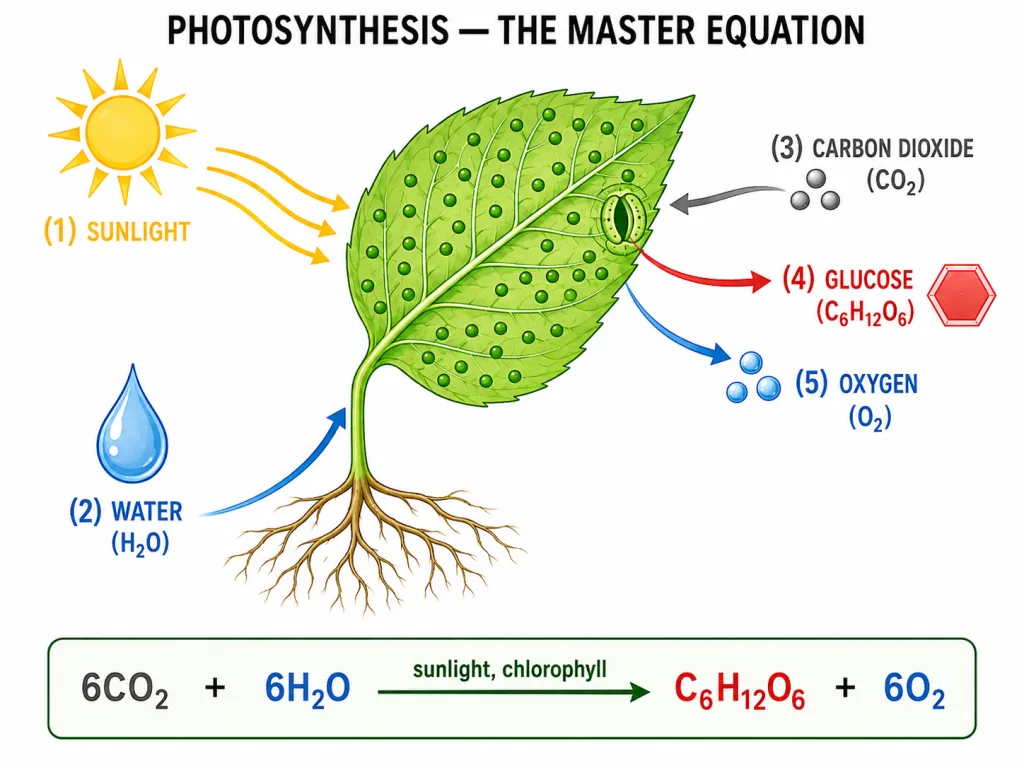
'Photosynthesis' = the process by which green plants (and some bacteria) synthesise their own food from carbon dioxide and water using sunlight energy trapped by chlorophyll, releasing oxygen as a by-product.
The word itself unpacks the meaning: photo = light + synthesis = building. Building (food) using light.
The Equation You Must Memorise
In words: six molecules of carbon dioxide plus six molecules of water, in the presence of sunlight and chlorophyll, give glucose plus six molecules of oxygen.
Write this equation out about ten times until it's automatic. It is the single most tested equation in Class 10 Biology.
Breaking down the equation
| Component | Source | Role |
|---|---|---|
| CO₂ (6 molecules) | From the air — enters via stomata | Raw material; provides carbon atoms for glucose |
| H₂O (6 molecules) | From the soil — absorbed by roots, transported via xylem | Raw material; provides hydrogen and oxygen atoms |
| Sunlight | From the sun | Energy source — light energy gets converted to chemical energy |
| Chlorophyll | Green pigment in chloroplasts | Catalyst — traps the light energy |
| Glucose (C₆H₁₂O₆) | Product | Stored chemical energy + carbon skeleton for all other organic molecules |
| O₂ (6 molecules) | Product (released through stomata) | By-product — but vital for every aerobic organism (including us) |
Three Necessary Raw Materials
For photosynthesis to happen, the plant needs all three of these in place:
- Sunlight — the energy.
- Water (H₂O) — supplied to the leaf via roots and xylem.
- Carbon dioxide (CO₂) — taken in from the air through stomata.
Remove any one of these, and photosynthesis stops. (This is the principle behind many classic NCERT experiments — discussed below.)
What Happens to the Glucose?
The glucose produced is used in three main ways:
- Immediate energy — broken down via respiration to release ATP.
- Storage — converted into starch (a polymer of glucose) and stored in chloroplasts, leaves, roots, fruits.
- Building materials — used to make cellulose (cell walls), proteins (with N from soil), and oils.
Starch in your potato? Glucose from a chloroplast turned into a storage polymer.
[Board Important] The full equation, with sunlight + chlorophyll above the arrow, is a 1-mark question that appears almost every year. Don't lose easy marks — memorise it precisely.
Inside the Leaf — Where Photosynthesis Actually Happens
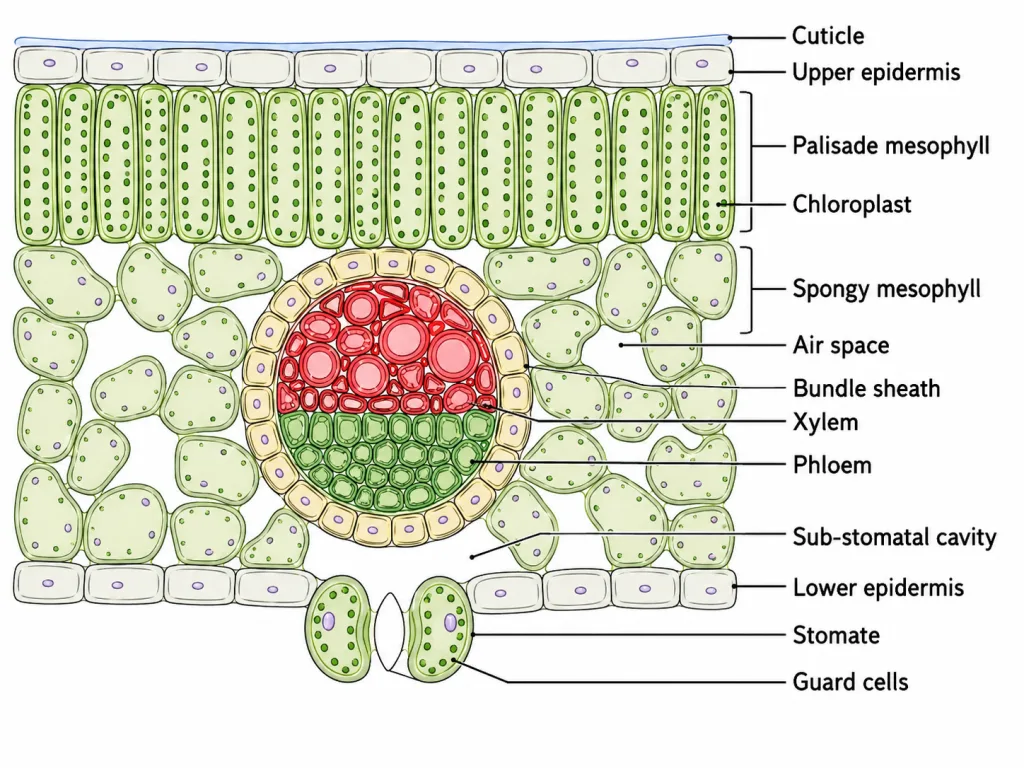
A leaf is not just a green tab on a stem — it is a purpose-built solar panel and gas-exchange device. Let's open one up and see the design.
The leaf has FIVE layers (top to bottom)
1. Cuticle + Upper Epidermis Function: protection and waterproofing.
- A thin, waxy cuticle on top reduces water loss.
- A single layer of flat, colourless epidermal cells beneath. (Transparent on purpose — they let sunlight through to deeper layers.)
2. Palisade Mesophyll — the main site of photosynthesis
- Closely packed, column-shaped cells.
- Packed with chloroplasts (dozens per cell).
- Positioned just below the upper surface to catch maximum sunlight.
3. Spongy Mesophyll — gas exchange chamber
- Loosely packed, irregularly-shaped cells.
- Big air spaces between cells.
- Fewer chloroplasts than palisade.
- The air spaces allow CO₂ to diffuse to every photosynthetic cell.
4. Vascular Bundle (Vein) — plumbing system
- Contains xylem (water in) and phloem (sugar out).
- Brings water from roots to the photosynthesis sites; takes glucose away to storage organs.
5. Lower Epidermis with Stomata
- Has tiny pores called stomata (singular: stoma).
- Each stoma is guarded by two guard cells.
- This is where CO₂ enters and O₂ exits.
Why this design is brilliant
Every layer has a job:
- Top is transparent + waxy → lets light in, keeps water in.
- Palisade just below → catches the light.
- Spongy with air spaces → lets CO₂ travel inside.
- Vein in the middle → delivers water, removes sugar.
- Stomata at the bottom → minimises water loss (they face down, away from direct sun).
Evolution has optimised every detail.
The Chloroplast — Where Photosynthesis Actually Happens at the Molecular Level
Inside a palisade mesophyll cell, the chloroplast is the actual factory:
- Outer membrane + inner membrane — double envelope (like mitochondria).
- Stroma — fluid inside.
- Thylakoids — disc-shaped membranes stacked like coins.
- A stack of thylakoids = granum (plural: grana).
- Chlorophyll is embedded in thylakoid membranes.
Light reactions happen in the thylakoid; dark reactions happen in the stroma. (Don't worry about details — Class 11.)
[NEET-foundation] Master the leaf cross-section now. In Class 11 you'll add C3 vs C4 anatomy on top of this. All Class 10 Board diagrams of a leaf use exactly this five-layer scheme.
The Two Stages of Photosynthesis (Class 10 Level)
Class 10 introduces the two stages of photosynthesis at a conceptual level. (Class 11 goes deeper into the molecular details — you'll meet ATP, NADPH, the Calvin cycle, etc. later.)
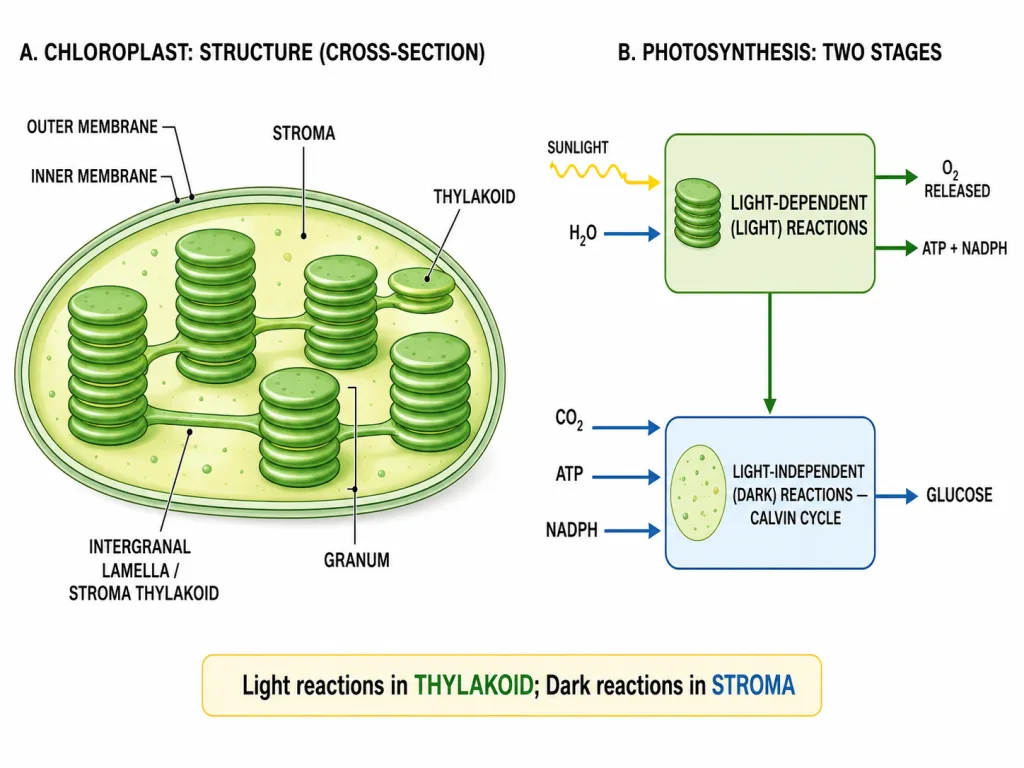
Stage 1: Light-Dependent Reactions (Light Reactions)
'Light reactions' = the stage that requires light. Happens in the thylakoid membranes of the chloroplast.
What happens:
- Chlorophyll absorbs sunlight (mostly red and blue wavelengths).
- Water is split (a process called photolysis):
- Oxygen is released as a by-product.
- Light energy is converted to chemical energy stored in molecules (ATP and NADPH) — Class 10 mentions "energy currency."
Summary: Light + H₂O → O₂ + (energy molecules)
Stage 2: Light-Independent Reactions (Dark Reactions / Calvin Cycle)
'Dark reactions' (a misleading name — they can happen in the light too; "light-independent" is more accurate) = the stage that doesn't directly need light. Happens in the stroma of the chloroplast.
What happens:
- CO₂ is taken in through stomata and reaches the chloroplast.
- CO₂ is fixed into a sugar using the energy molecules (ATP, NADPH) from the light reactions.
- The end product is glucose (C₆H₁₂O₆).
Summary: CO₂ + (energy molecules) → Glucose
The Two Stages Together
When you add these together, you get the master equation we memorised.
Why are they called light and dark?
- Light reactions — need light to split water. They cannot happen in the dark.
- Dark reactions — do not directly need light (they use ATP/NADPH made earlier). They CAN happen in the dark, but only briefly, until the energy molecules run out.
Modern terminology prefers "light-dependent" and "light-independent" reactions, because both actually happen mostly during the day.
[Board Important] A 3-mark Board question asks: "Differentiate between light and dark reactions." Pin the answer to (a) where they happen (thylakoid vs stroma), (b) what they need (light vs not directly), (c) what they produce (energy molecules + O₂ vs glucose).
Stomata — The Gates of the Leaf
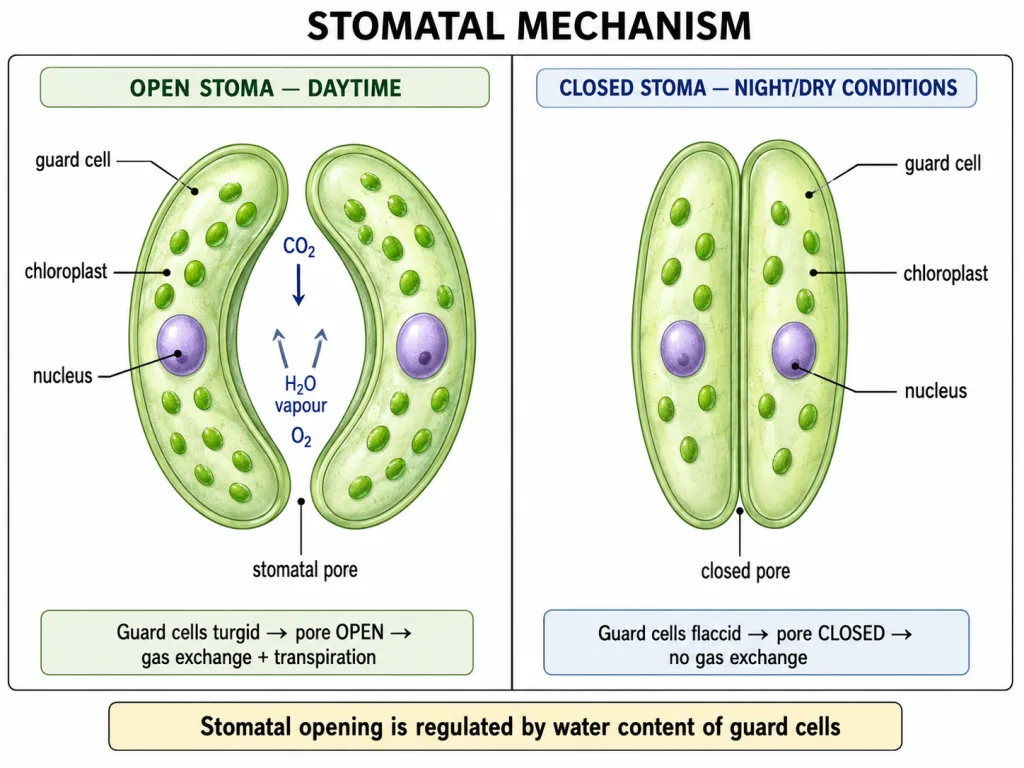
Stomata are the tiny pores on the leaf surface (mostly on the lower epidermis). Each leaf can have thousands of them.
Functions of Stomata
- Gas exchange:
- CO₂ enters for photosynthesis.
- O₂ exits as a by-product.
- Transpiration:
- Water vapour exits (which actually pulls water up from roots — see Section 7).
Structure of a Stoma
- Pore (slit) in the centre.
- Two guard cells flank the pore (kidney-shaped / bean-shaped).
- Guard cells contain chloroplasts (unlike other epidermal cells).
- Guard cells have uneven cell walls — the inner wall (facing the pore) is thicker than the outer wall.
How Do Stomata Open and Close?
This is one of the most beautiful pieces of plant physiology — it depends on turgor pressure (water content) of the guard cells.
When the guard cells take in water (TURGID):
- Both cells swell.
- The thinner outer walls expand more than the thicker inner walls.
- The guard cells curve outward, like two crescents bowing apart.
- The pore opens. → Gas exchange and transpiration can happen.
When the guard cells lose water (FLACCID):
- Both cells shrink.
- The guard cells become straight again.
- The pore closes. → Gas exchange and transpiration stop.
When Are Stomata Open vs Closed?
| Condition | Stomata | Why? |
|---|---|---|
| Daytime, normal | Open | Light triggers water uptake by guard cells → turgid → open |
| Daytime, very hot/dry | Closed | Plant conserves water — preventing dehydration |
| Night | Closed (mostly) | No photosynthesis happening — no need for CO₂ |
| Drought | Closed | Water conservation overrides photosynthesis needs |
Trade-Off: Photosynthesis vs Water Loss
This is the key conflict in a plant's life:
- To photosynthesise, stomata must be open → but open stomata also lose water.
- To conserve water, stomata must be closed → but then photosynthesis stops.
The plant must balance these constantly. In dry environments, special adaptations evolve — like sunken stomata in cacti, or CAM photosynthesis (you'll meet this in Class 11).
[NEET-foundation] "Why do guard cells have chloroplasts when other epidermal cells don't?" Because guard cells need their own photosynthesis-derived ATP to actively pump K⁺ ions in (which causes water uptake and stomatal opening). Subtle but tested.
Three Classic Experiments You Must Know
NCERT mentions three experiments that demonstrate the essential requirements of photosynthesis. Each is a Board favourite.
Experiment 1: Showing CO₂ is Necessary (Bell Jar Experiment)
Setup:
- Take two potted plants of the same kind, kept in the dark for 48 hours (de-starched).
- Put plant A inside a sealed bell jar containing a beaker of KOH (potassium hydroxide) — KOH absorbs CO₂.
- Put plant B inside a similar bell jar containing a beaker of water (control).
- Place both in sunlight for a few hours.
Test:
- Take one leaf from each plant.
- Boil it in water, then in alcohol (removes chlorophyll, makes leaf colourless).
- Add iodine solution.
Result:
- Plant A's leaf (no CO₂) — does NOT turn blue-black. (No starch made, because no photosynthesis.)
- Plant B's leaf (with CO₂) — turns blue-black. (Starch made, photosynthesis happened.)
Conclusion: CO₂ is essential for photosynthesis.
Experiment 2: Showing Sunlight is Necessary (Variegated Leaf or Covered Leaf)
Setup (Covered leaf version):
- Take a de-starched potted plant.
- Cover a part of one leaf with black paper (only the covered part won't receive light; the rest will).
- Place in sunlight for a few hours.
Test: Same iodine starch test.
Result:
- The covered part stays colourless (no starch).
- The uncovered part turns blue-black (starch made).
Conclusion: Sunlight is essential for photosynthesis.
Experiment 3: Showing Chlorophyll is Necessary (Variegated Leaf)
Setup:
- Take a variegated leaf (e.g., Coleus or croton) — it has green parts (with chlorophyll) and white/non-green parts (without chlorophyll).
- Place the plant in sunlight for a few hours after de-starching.
Test: Iodine starch test on the leaf.
Result:
- The green parts turn blue-black (starch present).
- The white/non-green parts remain colourless (no starch).
Conclusion: Chlorophyll is essential for photosynthesis.
The Iodine Starch Test
In all three experiments, we test for starch (not glucose) because:
- Glucose is too quickly used up or converted.
- Starch (glucose polymer) accumulates in the leaf as a storage product.
- Starch + iodine → blue-black colour. This is the standard, reliable test.
Why de-starch first?
Before each experiment, the plant is kept in darkness for 48 hours. This forces the leaves to use up their existing starch (via respiration). After de-starching, any new starch found in the leaf must come from photosynthesis during the experiment.
[Board Important] "Describe an experiment to show that CO₂ is necessary for photosynthesis" is a 3-mark Board question. Always mention: (i) de-starching, (ii) KOH absorbs CO₂, (iii) iodine test, (iv) starch present = photosynthesis happened, (v) conclusion.
Factors That Affect the Rate of Photosynthesis
If photosynthesis is a chemical reaction, anything that changes its rate is called a factor. Class 10 lists four:
1. Light Intensity
- More light → faster photosynthesis.
- But only up to a point. At very high light, the rate plateaus because other factors become limiting.
Practical implication: Plants in shaded forests have lower photosynthetic rates than plants in open fields.
2. Carbon Dioxide Concentration
- Normal atmospheric CO₂ is ~0.04%.
- If CO₂ rises (e.g., in greenhouses where farmers inject CO₂), photosynthesis speeds up.
- If CO₂ drops, photosynthesis slows.
Practical implication: Commercial greenhouses pump in CO₂ to boost crop yield.
3. Temperature
- Optimum is around 25-35°C for most plants.
- Too cold → enzymes slow → photosynthesis slows.
- Too hot → enzymes denature → photosynthesis stops.
4. Water Availability
- Water is a raw material for photosynthesis.
- Drought → less water → photosynthesis slows.
- Also: water shortage closes stomata → no CO₂ entry → photosynthesis stops.
What's NOT Tested in Class 10 But Worth Knowing
- Chlorophyll content — chlorophyll-deficient leaves photosynthesise less.
- Wavelength of light — red and blue light are most effective; green is reflected.
The Concept of the 'Limiting Factor'
At any moment, one factor is limiting the rate (the one that's lowest relative to its optimum). Adjusting that factor speeds up photosynthesis; adjusting any other has no effect until you raise the limiting one.
Example: On a cloudy day, light is limiting. Adding more CO₂ wouldn't help. But on a sunny but dry day, water might be limiting. Adding more light wouldn't help.
[NEET-foundation] The concept of limiting factor is a Class 11 topic. But understanding it at Class 10 level ("the slowest input controls the rate") puts you way ahead.
Memory Capsule — Section 2
A compact recap before moving to Section 3.
The Master Equation (memorise verbatim)
Three raw materials
- Sunlight (energy).
- Water (H₂O, from soil).
- CO₂ (from air, via stomata).
Two products
- Glucose (C₆H₁₂O₆) → stored as starch.
- Oxygen (O₂) → released.
Site of photosynthesis
- Cell: palisade mesophyll cell of leaf.
- Organelle: chloroplast.
- Sub-locations: thylakoid (light reactions) + stroma (dark reactions).
Two stages
| Stage | Where | What |
|---|---|---|
| Light reactions | Thylakoid | Light + H₂O → O₂ + energy molecules |
| Dark reactions | Stroma | CO₂ + energy molecules → glucose |
Leaf cross-section (top → bottom)
- Cuticle (wax)
- Upper epidermis
- Palisade mesophyll (main photosynthesis site, lots of chloroplasts)
- Spongy mesophyll (air spaces, gas exchange)
- Vascular bundle (xylem + phloem)
- Lower epidermis
- Stomata with guard cells
Stomata mechanism
- Open: guard cells turgid (full of water).
- Closed: guard cells flaccid (lost water).
- Inner wall of guard cell is thicker than outer wall — this asymmetry makes them curve.
Three classic experiments
- Bell jar with KOH → CO₂ necessary.
- Covered leaf → sunlight necessary.
- Variegated leaf → chlorophyll necessary.
All use the iodine-starch test (blue-black = starch = photosynthesis occurred).
Four factors affecting rate
- Light intensity.
- CO₂ concentration.
- Temperature (optimum 25-35°C).
- Water availability.
NCERT-canonical phrases
- "Photosynthesis is the process by which autotrophs take in substances from the outside and convert them into stored forms of energy."
- "The opening and closing of the pores [stomata] is a function of the guard cells."
One-line takeaway
A leaf is a solar-powered factory: chlorophyll in chloroplasts traps sunlight to convert CO₂ (from stomata) and water (from xylem) into glucose, releasing O₂ as a by-product.
Solved Examples
Example 1: Write the balanced equation for photosynthesis with required conditions.
State the inputs, outputs, and conditions in a single labelled equation.
Solution:
The balanced equation is:
Inputs (reactants):
- 6 molecules of carbon dioxide (from air, via stomata).
- 6 molecules of water (from soil, via roots and xylem).
Conditions (written above/below the arrow):
- Sunlight — the energy source.
- Chlorophyll — the green pigment that traps the light.
Outputs (products):
- One molecule of glucose (C₆H₁₂O₆) — the food.
- 6 molecules of oxygen (O₂) — released as by-product.
Answer: The full equation above, with sunlight and chlorophyll labelled above/below the arrow.
[Board Important] Easy 1-mark question — but only if you write the arrow conditions. A leaf-bare equation loses half the marks.
Example 2: Tracing the path of CO₂ from air to chloroplast.
A carbon dioxide molecule from the air enters a leaf. Trace its full path to the chloroplast where it is used in photosynthesis. Name every structure it passes through.
Solution:
Follow the molecule step by step:
- Atmosphere — CO₂ floats in air around the leaf.
- Stomata — CO₂ diffuses through this pore (between two guard cells).
- Sub-stomatal cavity — air space immediately inside the stomate.
- Spongy mesophyll air spaces — CO₂ moves through the loose, gas-filled cell network.
- Cell wall + cell membrane of a palisade mesophyll cell — CO₂ diffuses across.
- Cytoplasm of the cell.
- Chloroplast — CO₂ enters the chloroplast.
- Stroma — CO₂ is fixed into glucose in the dark reactions (Calvin cycle).
Path summary:
Answer: Air → stoma → sub-stomatal cavity → spongy mesophyll air spaces → cell wall + plasma membrane → cytoplasm → chloroplast (stroma), where CO₂ is fixed into glucose.
[NEET-foundation] This kind of "trace the molecule" question is common in NEET. Always name every structure, in order.
Example 3: Why are leaves green?
Why do most leaves appear green? Relate your answer to the absorption of light by chlorophyll.
Solution:
The short answer: Leaves appear green because chlorophyll absorbs red and blue light strongly, but reflects green light back to our eyes.
Building the explanation
Step 1: White sunlight contains all visible colours. When sunlight passes through a prism, it splits into the colours of the rainbow — violet, indigo, blue, green, yellow, orange, red (VIBGYOR).
Step 2: Chlorophyll absorbs some colours, but not green. Chlorophyll molecules in leaves are designed to absorb energy from light. They strongly absorb:
- Red light (~640-680 nm).
- Blue light (~430-460 nm).
But they reflect green light (~500-570 nm). The green light bounces off and enters our eyes.
Step 3: Therefore the leaf looks green. Because the only light coming back to us from the leaf is green, our brain perceives the leaf as green.
A neat consequence
Green light is the LEAST useful for photosynthesis. If you grew a plant under green-filtered light only, it would barely photosynthesise — because that's the colour chlorophyll can't absorb.
This is why greenhouses often use red/blue LED lighting now — it matches what chlorophyll wants.
Why are some leaves red, purple, or yellow?
- Red/purple leaves (e.g., Coleus) — contain other pigments called anthocyanins that mask the green chlorophyll.
- Yellow leaves in autumn — chlorophyll breaks down, revealing the carotenoid (yellow/orange) pigments that were there all along.
Answer: Chlorophyll absorbs red and blue light efficiently (using their energy for photosynthesis) but reflects green light. The reflected green light reaches our eyes, making leaves appear green. Green is the least useful colour for photosynthesis, which is why it's the one being reflected away.
[Board Important] A 2-3 mark Board question. Always mention: (a) what colour chlorophyll absorbs, (b) what it reflects, (c) why we see green.
Example 4: Bell jar experiment to demonstrate that CO₂ is necessary for photosynthesis.
Describe the experiment (with diagram) to show that carbon dioxide is essential for photosynthesis. State the role of KOH.
Solution:
Aim
To demonstrate that carbon dioxide is essential for photosynthesis.
Apparatus
- 2 well-watered potted plants (kept in dark for 48 hours — de-starched).
- 2 bell jars with glass plates underneath (airtight seal).
- 1 beaker of KOH (potassium hydroxide) solution.
- 1 beaker of water.
- Vaseline (to seal the gap).
- Iodine solution, alcohol, hot water (for starch test).
Procedure
- De-starch both plants by keeping them in darkness for 48 hours. (This empties the leaves of any old starch.)
- Place the first plant inside Bell Jar A, with a beaker of KOH inside. Seal with Vaseline.
- Place the second plant inside Bell Jar B, with a beaker of water inside. Seal with Vaseline.
- Place both apparatuses in bright sunlight for 6-8 hours.
- Pluck a leaf from each plant.
- Perform the iodine starch test:
- Boil the leaf in water for 2 minutes (kills cells, softens leaf).
- Boil it in alcohol for 5 minutes (removes chlorophyll — leaf turns colourless).
- Rinse in warm water (softens).
- Dip in iodine solution.
Role of KOH
KOH (potassium hydroxide) is a strong base that absorbs CO₂ from the air inside Bell Jar A.
So Plant A is sitting in an atmosphere with no CO₂. Plant B (with just water) has normal CO₂ available.
Observation
| Plant | CO₂ available? | Iodine test result | Conclusion |
|---|---|---|---|
| A (with KOH) | NO | Leaf stays colourless / yellow | No starch → No photosynthesis |
| B (with water) | YES | Leaf turns blue-black | Starch present → Photosynthesis occurred |
Conclusion
Photosynthesis cannot happen in the absence of CO₂. Hence CO₂ is essential for photosynthesis.
Why de-starching first?
If we did not de-starch, the leaves of Plant A would already contain starch from previous photosynthesis, and we couldn't tell whether the starch found was old (pre-existing) or new (made during the experiment). De-starching eliminates this confusion.
Answer: As above — set up two bell jars, one with KOH (no CO₂) and one with water (control). Place in sunlight. Do iodine starch test on leaves. The leaf without CO₂ has no starch; the leaf with CO₂ does. Hence CO₂ is essential for photosynthesis.
[Board Important] Classic 5-mark question. Must include: de-starching, KOH role, iodine test, observation table, conclusion.
Example 5: NCERT in-text — How do stomata open and close?
NCERT asks: "What is the role of the guard cells in the opening and closing of stomata?"
Solution:
Stomata are pores. They don't open or close by themselves — they are controlled by the guard cells that flank them.
The mechanism (turgor-driven)
Step 1: Water enters guard cells. When the plant has plenty of water and it is daytime, K⁺ (potassium) ions are actively pumped into the guard cells. (This uses energy from the chloroplasts inside the guard cells.) Because of the higher solute concentration inside, water flows in by osmosis.
Step 2: Guard cells become turgid. As water enters, the guard cells swell — they become turgid (rigid with water).
Step 3: The cells curve outward. Guard cells have a special asymmetry — their inner wall (facing the pore) is thicker and inelastic, while their outer wall is thinner and elastic. So when they swell, the outer walls expand more than the inner walls. The cells curve outward like two crescents.
Step 4: This curving opens the pore. Because the cells now bow away from each other, a diamond-shaped gap (the stomatal pore) opens between them.
Closing — the reverse
When water is scarce, or at night, K⁺ ions exit the guard cells, water leaves by osmosis, the cells become flaccid (limp), they return to a straight shape, and the pore closes.
Why this matters
- Open stomata: gas exchange + transpiration happen.
- Closed stomata: no gas exchange + no water loss.
The plant trades off photosynthesis (needs open stomata) vs. water conservation (needs closed stomata). Hence the daytime opening / drought closing pattern.
Why do guard cells have chloroplasts?
Unlike other epidermal cells (which are colourless), guard cells contain chloroplasts. This is because they need their own ATP to actively pump K⁺ ions — and the ATP comes from photosynthesis inside the guard cells.
Diagram in your head
Open stoma:                 Closed stoma:
   ( o )                       ( | )
  /     \                     /   \
 Guard   Guard               Guard Guard
 cells turgid                cells flaccid
Answer: Guard cells control stomatal opening/closing by changing their turgor (water content). When K⁺ ions are pumped in, water follows by osmosis, the cells swell, and because the inner wall is thicker than the outer, they curve outward — opening the pore. When water leaves, the cells become flaccid, return to a straight shape, and the pore closes. Guard cells need chloroplasts to provide ATP for the active K⁺ pumping.
[Board Important] Classic 3-mark NCERT in-text question. Must include: turgor pressure, asymmetric walls, curve outward, K⁺ ion pumping.
Example 6: A leaf is the workshop of food synthesis. Justify with 4 structural adaptations.
Name any four structural adaptations of a leaf that make it well-suited for photosynthesis.
Solution:
A leaf is a purpose-built solar panel + gas-exchange device. Here are four key structural adaptations:
Adaptation 1: Broad, flat surface
The leaf blade is broad and flat to maximise the surface area exposed to sunlight. This is the leaf's solar-panel design — more area = more light captured = more photosynthesis.
Adaptation 2: Thin structure
The leaf is thin so that light penetrates through to the lower mesophyll layers, and so that CO₂ doesn't have to diffuse far before reaching a photosynthetic cell. Diffusion is slow over thick tissues — thinness solves the problem.
Adaptation 3: Stomata for gas exchange
Tiny pores called stomata (mainly on the lower epidermis) allow CO₂ to enter and O₂ to exit. Without stomata, no CO₂ could reach the photosynthetic cells.
Adaptation 4: Chloroplast-rich palisade mesophyll
Just below the upper epidermis sits the palisade mesophyll — densely packed cells crammed with chloroplasts. This is the layer where most of the photosynthesis happens. By positioning it just below the transparent upper surface, the leaf catches sunlight efficiently.
Optional 5th and 6th adaptations (for 5-mark questions)
- Vascular bundles (veins) — bring water from roots, take glucose to storage.
- Spongy mesophyll with air spaces — lets CO₂ diffuse freely to every cell.
- Waxy cuticle on top — reduces water loss while still letting light in.
Why this matters
Every feature of the leaf has been selected by evolution to do one job: capture light, take in CO₂, make glucose. The leaf is not just a green flap — it is a precision-engineered factory.
Answer: Four key adaptations are: (1) broad and flat — maximises light capture; (2) thin — short diffusion path for CO₂ and light; (3) stomata — for gas exchange; (4) chloroplast-rich palisade mesophyll — site of photosynthesis. (Additional: cuticle, vascular bundles, air spaces.)
[Board Important] A standard 3-mark Board question. Always pair each adaptation with its function — "broad surface → maximum light capture," not just "broad surface."