
Why Plants Also Need a Transport System
In Section 6 we saw how the human body uses a four-chambered heart, kilometres of blood vessels, and 5 litres of blood to move materials around. Now look at a giant Banyan or Eucalyptus tree — 30 metres tall, no heart, no muscles, no nervous system. Yet water somehow rises from the deepest roots to the highest leaves. How?
What plants need to transport
Like animals, plants also need a transport system because:
Going UP (from roots to leaves):
- Water — absorbed from the soil; required for photosynthesis and to keep cells turgid.
- Minerals — nitrates, phosphates, potassium, magnesium, etc. — absorbed from soil; required as raw materials for various molecules.
Going DOWN (and SIDEWAYS, from leaves to other parts):
- Food (sucrose) — manufactured in green leaves by photosynthesis; needs to reach roots, fruits, growing buds, storage organs.
Unlike animals where everything moves around in one fluid (blood), plants use two separate transport tissues that work in opposite directions and carry different things.
The two plant transport tissues
| Tissue | Carries | Direction | Mostly |
|---|---|---|---|
| Xylem | Water + minerals | Roots → leaves (UPWARD) | Dead cells |
| Phloem | Food (sugars) | Leaves → all parts (BOTH ways) | Living cells |
Together, xylem and phloem make up the plant's vascular system. Vascular plants (flowering plants, ferns, conifers) are also called tracheophytes — because their xylem includes tracheid cells.
How is this possible without a pump?
Plants don't have a heart, so they can't push water using pressure (like our left ventricle does). Instead, they use a clever combination of:
- Osmosis — to absorb water at the roots.
- Root pressure — a mild push from below.
- Capillary action — water rises in narrow tubes.
- Transpiration pull — the BIG one: water loss from leaves creates a suction that pulls water up.
We'll see each in detail below.
A scale-comparison with humans
| Feature | Human body | Tall plant (e.g., tree) |
|---|---|---|
| Pump | Heart (muscular) | No pump |
| Driving force | Heart contraction (pressure) | Transpiration pull (suction) + root pressure |
| Fluid | Blood | Sap (xylem sap and phloem sap) |
| Transport vessels | Arteries, veins, capillaries | Xylem and phloem |
| Speed | Fast (seconds to minutes) | Slow (cm to metres per hour) |
Plants achieve transport with far less energy than animals do — but the trade-off is that it's much slower.
NCERT-canonical phrase: "In plants, the transport system carries energy stores from leaves and raw materials from roots. These two pathways are constructed as independently organised conducting tubes."
Xylem and Phloem — The Plant Vascular Tissues
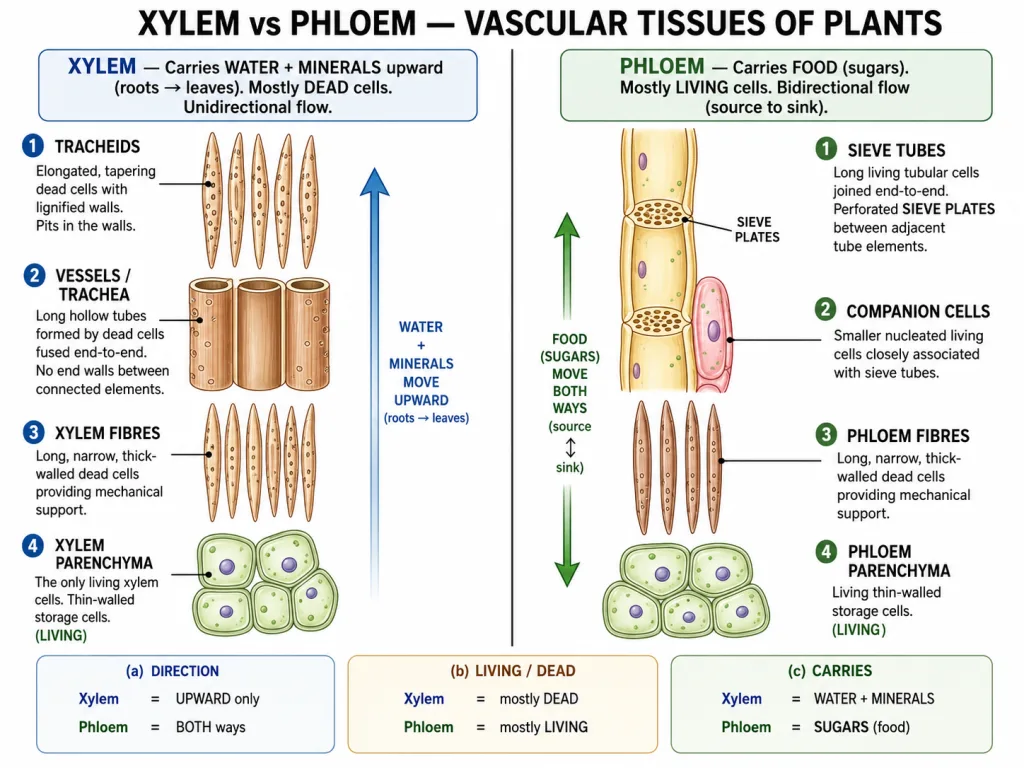
Both xylem and phloem are complex tissues — each made of several different cell types working together.
XYLEM — the water highway
Function: Conducts water and dissolved minerals from roots upward to all other parts of the plant. Also provides mechanical support.
Four cell types in xylem:
| Cell type | Living/Dead | Role |
|---|---|---|
| Tracheids | Dead | Long tapering tubes; conduct water |
| Vessels (= tracheae) | Dead | Long hollow tubes formed by fused cells (no end walls); main water highway |
| Xylem fibres | Dead | Mechanical support |
| Xylem parenchyma | LIVING | Store food; the only living xylem cells |
Three out of four xylem cell types are DEAD — and that's actually useful. Dead cells have no protoplasm to obstruct flow, so water can move freely.
The walls of tracheids and vessels are thickened with lignin — a tough, water-resistant material. This:
- Makes the tubes strong (no collapse under suction).
- Makes them impermeable (no water leaks out sideways).
- Adds mechanical support to the plant (wood = mostly lignified xylem).
The wood you see in a tree trunk is almost entirely DEAD xylem.
PHLOEM — the food highway
Function: Transports food (mainly sucrose, the dissolved form of sugar) from sites of photosynthesis (leaves) to sites where it's needed (roots, fruits, growing buds, storage organs).
Four cell types in phloem:
| Cell type | Living/Dead | Role |
|---|---|---|
| Sieve tubes | LIVING (but no nucleus) | Long tubes joined end-to-end via perforated sieve plates; the food highway |
| Companion cells | LIVING (with nucleus) | Sit beside sieve tubes; control their activity |
| Phloem fibres | Dead | Mechanical support |
| Phloem parenchyma | LIVING | Storage |
Three out of four phloem cell types are LIVING — opposite of xylem. Phloem transport requires energy (active transport at loading sites), so living cells are essential.
Sieve plates: The end walls between adjacent sieve tube cells have tiny pores (looks like a sieve). Food-laden sap flows from one cell to the next through these pores.
Companion cells are unique to flowering plants. They have a nucleus and run the metabolic show — sieve tubes have lost their nucleus, so they depend on their companion.
Where in the plant are they found?
Xylem and phloem run together as vascular bundles throughout the plant:
- In the roots: they bring up water from soil, and bring food down for storage.
- In the stem: they form rings of vascular bundles (in monocots, scattered bundles).
- In the leaves: they form the veins you see — both the midrib and the network of smaller veins.
In a typical stem, the vascular bundles are arranged with xylem inside (closer to the centre) and phloem outside (closer to the bark).
XYLEM vs PHLOEM — comparison table
| Feature | Xylem | Phloem |
|---|---|---|
| Conducts | Water + dissolved minerals | Food (mainly sucrose) |
| Direction | UPWARD only (unidirectional) | BOTH ways (source to sink) — bidirectional |
| Mostly | Dead cells | Living cells |
| Wall material | Lignified | Cellulose; thin walls |
| Driving force | Transpiration pull (mainly) + root pressure | Active transport + osmotic pressure |
| Provides support | YES (wood is xylem) | Limited |
| Found in vascular bundle | Inner side | Outer side |
This comparison is a classic 3-mark Board question. Memorise the SIX major differences.
[Board Important] "Differentiate between xylem and phloem." — Always include: direction, cell type (living/dead), substance transported, wall material, and driving force.
How Water Moves UP — Transpiration Pull
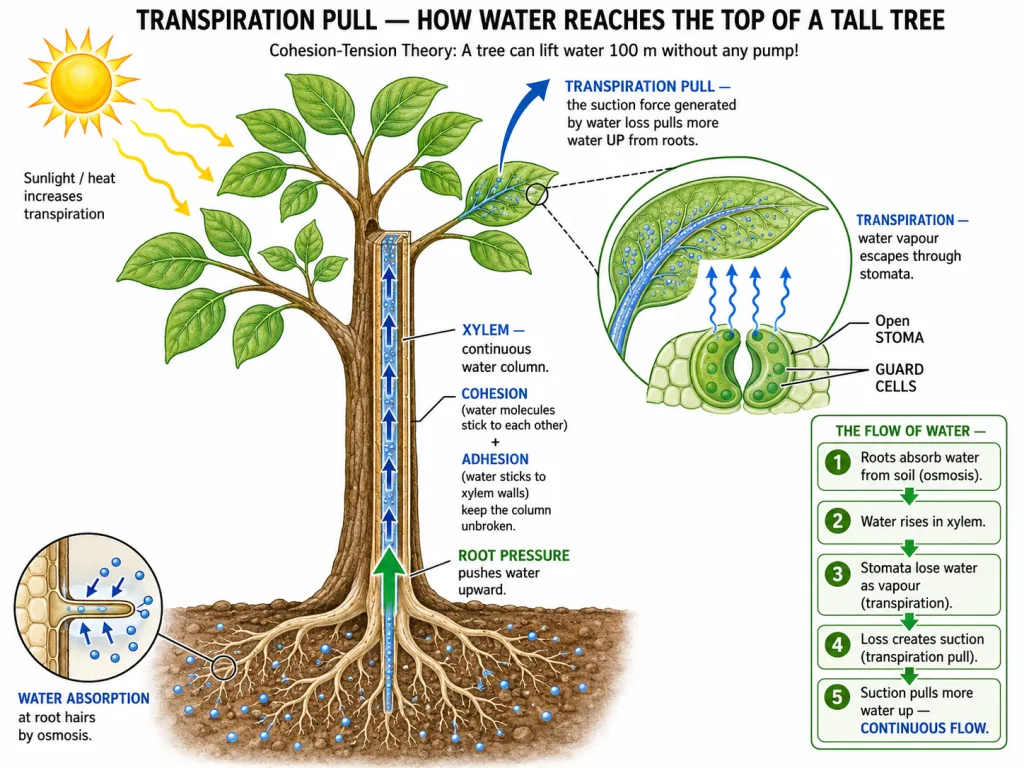
Now we tackle the biggest puzzle: how does water from the soil reach the topmost leaves of a 30-metre-tall tree without any pump?
The answer comes in three steps.
Step 1: Water enters roots by OSMOSIS
The root has thin extensions called root hairs (Section 2). Each root hair cell has:
- A high solute concentration inside (sugars, salts, etc.).
- Soil water around it has a lower solute concentration.
By osmosis (movement of water from low concentration of solutes to high), water enters the root hair cell.
From the root hair, water passes cell-to-cell across the root cortex until it reaches the xylem in the centre.
This osmotic uptake creates a slight pressure called root pressure.
Step 2: Root pressure — a mild push from below
Root pressure is the positive pressure developed in the xylem of roots due to continuous water absorption.
Effect: It can push water upward by a few metres — useful in small herbs and at night when transpiration is low.
Limitation: Root pressure alone cannot push water up tall trees (it works for maybe 1-2 metres maximum). For taller plants, another force is needed.
Evidence for root pressure: Guttation — early morning droplets of water seen on leaf tips of grasses. This is liquid water forced out by root pressure (not transpiration, which produces vapour).
Step 3: Transpiration pull — the BIG force
This is the main mechanism for moving water up tall plants.
What is transpiration?
Transpiration = loss of water in the form of water vapour from the aerial parts of a plant (mainly through stomata in leaves).
During the day, when stomata open for CO₂ entry (for photosynthesis):
- Water vapour from inside the leaf escapes through the stomata.
- The leaf cells now have less water → they 'suck' water from neighbouring cells.
- This 'sucking' is transmitted down the entire xylem column, all the way to the roots.
- Water gets pulled UP — like sipping juice through a straw.
Why does it work for tall trees?
Because of two physical properties of water:
- Cohesion — water molecules stick to each other (hydrogen bonds). So when one water molecule is pulled up, it drags the next one along.
- Adhesion — water molecules stick to the walls of the xylem tubes. This stops the column from breaking.
Together, cohesion + adhesion + transpiration pull = Cohesion-Tension Theory.
Result: A continuous, unbroken column of water from the deepest root tip to the highest leaf — pulled upward by suction from transpiration. Trees can lift water up to 100 metres this way without using any pump.
Day vs night water flow
- Day: Stomata open → high transpiration → strong transpiration pull → fast water flow.
- Night: Stomata mostly closed → low transpiration → root pressure becomes the main force → slow water flow.
So root pressure is mainly a night-time / early-morning mechanism, while transpiration pull is the main daytime mechanism.
A simple analogy
Think of drinking a cold drink with a straw:
- Your mouth = leaves (where suction is generated).
- The straw = xylem (continuous tube).
- The liquid in the glass = soil water.
When you suck on the straw, you create low pressure at the top → atmospheric pressure pushes the liquid up.
Similarly, transpiration creates low pressure at the leaves → water is pulled up through the xylem.
Plants are essentially sipping water from the soil 24×7.
Speed of water transport
- In a fast-growing tree like Eucalyptus: water moves up at about 15 m/hour through xylem.
- In a slower tree: about 1 m/hour.
Compare this to blood flow in humans (~1 m/sec in aorta) — plants are 1000× slower. But they don't need speed.
[NEET-foundation] "How is water transported in plants?" — Always mention: (1) osmotic uptake at root hairs, (2) root pressure (limited), and (3) transpiration pull (main force) with cohesion-tension theory.
Transpiration — More Than Just Water Loss
We've seen transpiration as the driver of water transport. But why does a plant 'allow' itself to lose so much water? After all, it spends a lot of energy absorbing water — and then it just lets it escape as vapour. Wasteful?
Actually no — transpiration is intentional and useful.
Definition
Transpiration = the loss of water in the form of water vapour from the aerial (above-ground) parts of a plant — mostly through stomata in leaves, but also (in small amounts) through lenticels on stems and cuticle on leaf surfaces.
Quantitatively, a single large tree can lose hundreds of litres of water per day by transpiration.
Why is transpiration important? (NCERT favourite!)
Transpiration serves four useful functions:
1. Absorption and upward transport of water
As we just saw, transpiration is the driving force for the rise of water in plants. Without transpiration, water would not reach the topmost leaves of a tall tree.
2. Transport of minerals
The water that rises in xylem also carries dissolved minerals (N, P, K, Mg, etc.) from the soil. If water didn't move, minerals wouldn't reach the leaves either.
3. Cooling of the leaf
When water evaporates (becomes vapour), it absorbs heat from its surroundings. So when leaves transpire on a hot sunny day, the evaporation cools the leaf — just like sweating cools your body!
Without transpiration, leaves exposed to direct sunlight would overheat and damage their chlorophyll.
4. Maintaining turgor (shape and rigidity)
The constant flow of water through the plant keeps cells turgid (full of water). Turgid cells push against their walls, giving the plant its shape and keeping leaves spread out (maximum sunlight capture).
When transpiration is too high (and water uptake can't keep up), plants wilt — droopy leaves are a sign of water deficit.
Where does transpiration happen?
Three pathways:
| Pathway | % of total | Description |
|---|---|---|
| Stomatal | ~80-90% | Through open stomata in leaves (the main route) |
| Cuticular | ~5-10% | Through the waxy cuticle on leaf surfaces |
| Lenticular | ~0.1% | Through lenticels on stems (small openings) |
Stomata are the main route — so the plant can control transpiration by opening/closing stomata.
Stomatal control — guard cells revisited
Recall from Section 2: each stoma is bordered by two guard cells (kidney-shaped, with chloroplasts).
- Stomata OPEN when guard cells become turgid (full of water). Their kidney shape makes them bow outward, opening the pore.
- Stomata CLOSE when guard cells become flaccid (lose water). The kidney shape straightens, closing the pore.
Plants close stomata to reduce water loss when:
- Sun is too intense / temperature too high (would lose too much water).
- Soil is dry (would dehydrate faster).
- Night-time (no photosynthesis, no need for CO₂ entry).
Factors affecting transpiration rate
Transpiration rate increases with:
| Factor | Effect |
|---|---|
| Higher temperature | Increases evaporation |
| Lower humidity | Steeper water gradient → more loss |
| More wind | Removes water vapour around leaf, maintaining gradient |
| More light | Opens stomata → more loss |
| Larger leaf area | More surface to lose from |
| Healthier soil water supply | Plant transpires freely |
Transpiration decreases when:
- Stomata are partially closed.
- Air is calm and humid.
- Soil is dry (plant restricts loss to conserve water).
The 'transpiration vs guttation' trap
A common NEET/Board trap:
| Feature | Transpiration | Guttation |
|---|---|---|
| What's lost | Water VAPOUR | Liquid WATER |
| From where | Stomata (mostly) | Hydathodes (specialised pores) |
| When | Daytime (high) | Mostly early morning |
| Driver | Sun, low humidity | Root pressure |
| Where seen | Invisible (vapour) | Visible droplets on leaf edges |
Both are forms of water loss, but the mechanism and form are different.
Why don't desert plants transpire much?
Desert plants (cacti, etc.) have:
- Few stomata (less water loss).
- Stomata sunken into pits (humid microclimate near them).
- Thick cuticle (less cuticular transpiration).
- Stomata open at night (CAM photosynthesis — different mechanism).
- Leaves reduced to spines (less surface).
Result: desert plants transpire 90% less than typical mesophytic plants.
[Board Important] "Why is transpiration important for a plant?" — Always list FOUR reasons: water transport, mineral transport, cooling, turgor maintenance. Don't say it's 'just water loss' — mark loss!
Translocation — How Food Moves in Phloem
We've handled water (xylem); now: how does food (sugar) move from leaves to other parts? This process has a special name — translocation.
Why translocation is harder than water transport
Water transport is one-way — always from roots to leaves. Driven by simple physical forces (transpiration pull, no energy needed).
Food transport is more complex:
- It must go to many different destinations (roots, fruits, growing buds, storage organs).
- It must sometimes go UP (e.g., to a growing fruit at the top of the plant), sometimes DOWN (e.g., to roots), sometimes SIDEWAYS.
- It requires ENERGY (ATP) to load and unload the food.
Unlike xylem, phloem translocation is an active process — it uses ATP.
Source and sink
The key concept in translocation:
- Source = where food is produced or released. Usually leaves (photosynthesis) or storage organs in spring (mobilising stored starch).
- Sink = where food is needed or stored. Usually roots, fruits, growing buds, storage tubers.
Phloem transports food from source to sink. Since sources and sinks can be anywhere, phloem transport is bidirectional — same plant, same phloem tissue can carry food up in one place and down in another at the same time.
Direction depends on where the source and sink are — not on gravity.
The three steps of translocation
Step 1: Loading at the source (leaves)
In leaf cells, photosynthesis produces glucose. Glucose is converted to sucrose (more soluble, more stable for transport).
Sucrose is actively pumped (using ATP) into the sieve tubes of the phloem in the leaf veins.
As sucrose enters the sieve tubes, water also follows by osmosis (because high sucrose means low water potential). The sieve tube cell now contains a high-pressure sugary solution.
Step 2: Transport along the phloem
The high pressure at the source 'pushes' the sugary sap along the sieve tubes — like squeezing toothpaste from one end of a tube.
The sap can move at ~1 m/hour — much slower than xylem water transport, but adequate.
Step 3: Unloading at the sink
At the sink (e.g., a growing fruit, or a root tip), sucrose is actively removed from the sieve tubes (using ATP) — and used or stored.
As sucrose exits, water also exits (by osmosis). This reduces pressure in the phloem at the sink end.
Net effect: High pressure at source, low pressure at sink → sap flows from source to sink. This is the pressure-flow hypothesis (or Münch's hypothesis) — a key NCERT term.
Translocation summary diagram (verbal)
LEAF (source)                       FRUIT (sink)
   ↓                                    ↑
Photosynthesis →                       Use/storage
Glucose → Sucrose                   ← Sucrose removed (ATP)
   ↓ (loaded into phloem, ATP)
HIGH pressure                       LOW pressure
   ↓
   →→→→→→→→ Phloem flow →→→→→→→→→→→→→→→→
Phloem transport vs xylem transport — comparison
| Feature | Xylem (water) | Phloem (food) |
|---|---|---|
| Carries | Water + minerals | Sugars (sucrose) |
| Direction | Unidirectional (up) | Bidirectional (source to sink) |
| Driving force | Transpiration pull (passive) | Pressure flow (active, ATP) |
| Cells used | Mostly dead (tracheids, vessels) | Mostly living (sieve tubes, companion cells) |
| Speed | Fast (15 m/hour) | Slower (1 m/hour) |
| Energy needed | NO (passive) | YES (ATP) |
The key insight: Xylem transport is passive (driven by physics — evaporation and capillary action). Phloem transport is active (driven by biology — ATP-powered loading/unloading).
What happens when a tree is 'girdled'?
Girdling = removing a ring of bark (which contains phloem, but leaves the inner xylem intact).
Result:
- Water transport (xylem) still works — leaves remain green for a while.
- Food transport (phloem) is blocked — sugars can't go down to roots.
- Roots starve → die → tree dies (slowly, weeks to months).
This famous experiment proves that phloem is the food-carrying tissue and runs through the outer layers (bark).
NCERT-canonical phrase
The NCERT textbook says: "The transport of soluble products of photosynthesis is called translocation, and it occurs in the part of the vascular tissue known as phloem."
[Board Important] "What is translocation? How does it occur?" — 3-mark Board question. Always mention source-sink concept, role of ATP (active process), and pressure-flow.
Memory Capsule — Section 7
A compact recap before moving to Section 8 (Excretion).
Why plants need transport
- UP — water + minerals from roots to leaves.
- DOWN/SIDEWAYS — food (sucrose) from leaves to roots, fruits, growing parts.
Two tissues, two directions, two purposes.
Xylem and phloem — the vascular tissues
| Xylem | Phloem | |
|---|---|---|
| Carries | Water + minerals | Food (sucrose) |
| Direction | UPWARD only | BOTH ways (source → sink) |
| Cells | Mostly DEAD | Mostly LIVING |
| Walls | Lignified | Cellulose |
| Driving force | Transpiration pull | Active transport (ATP) |
| Speed | ~15 m/hour | ~1 m/hour |
Xylem cell types (4)
- Tracheids — dead, tapering tubes.
- Vessels (trachea) — dead, long hollow tubes (most efficient water conductors).
- Xylem fibres — dead, support.
- Xylem parenchyma — LIVING, storage.
Phloem cell types (4)
- Sieve tubes — living (no nucleus), with sieve plates.
- Companion cells — living (with nucleus), run sieve tube metabolism.
- Phloem fibres — dead, support.
- Phloem parenchyma — living, storage.
Water transport — 3 mechanisms
- Osmosis at root hairs — water enters from soil.
- Root pressure — mild push from roots (mostly at night/early morning); shown by GUTTATION.
- Transpiration pull — the BIG force; evaporation at leaves creates suction that pulls water up.
Cohesion-Tension Theory: Water molecules cohere (stick to each other) and adhere (stick to xylem walls), forming an unbroken column from root to leaf — pulled up by transpiration.
Transpiration — definition
Loss of water in the form of water vapour from aerial parts of a plant, mainly through stomata.
Four functions of transpiration (Board favourite!)
- Drives upward water transport.
- Drives mineral transport (in the same water flow).
- Cools the leaf (evaporation = heat loss).
- Maintains turgor (cells stay firm, plant doesn't wilt).
Transpiration pathways (% of total)
- Stomatal — ~80-90% (main route).
- Cuticular — ~5-10%.
- Lenticular — ~0.1%.
Stomatal control
- Open when guard cells are TURGID (more water → guard cells bow outward).
- Closed when guard cells are FLACCID (less water → guard cells straighten).
Closing during heat/drought reduces water loss.
Transpiration vs guttation
- Transpiration: water VAPOUR through stomata; daytime; driven by sun.
- Guttation: liquid WATER through hydathodes; early morning; driven by root pressure.
Translocation — food transport
- Active process (uses ATP).
- Bidirectional (source to sink).
- Sources: leaves (photosynthesis) or storage organs.
- Sinks: roots, fruits, buds, tubers.
- Mechanism: Pressure-flow (Münch's) hypothesis — sucrose loaded at source (high pressure), unloaded at sink (low pressure), sap flows source → sink.
Three steps of translocation
- Loading at source — sucrose actively pumped into phloem; water follows by osmosis.
- Transport — pressure pushes sap through sieve tubes.
- Unloading at sink — sucrose actively removed; water exits.
Girdling experiment
Remove bark (= remove phloem) → water transport (xylem) still works, food transport stops → roots die → tree dies. Proves phloem is in the outer layers and carries food.
NCERT-canonical phrases
- "In plants, the transport system carries energy stores from leaves and raw materials from roots."
- "Loss of water in the form of vapour from the aerial parts of the plant is known as transpiration. Transpiration helps in the absorption and upward movement of water and minerals dissolved in it from roots to the leaves. It also helps in temperature regulation."
- "The transport of soluble products of photosynthesis is called translocation, and it occurs in the part of the vascular tissue known as phloem."
One-line takeaway
Plants move water UP using xylem (driven by transpiration pull, mostly dead cells, fast and passive) and move food in BOTH DIRECTIONS using phloem (driven by ATP-powered pressure flow from source to sink, living cells, slow and active).
Solved Examples
Example 1: How does water reach the top of a tall tree without any pump?
Explain the mechanism by which water rises in a tall plant.
Solution:
This is the most famous question in plant transportation. The answer comes in three parts.
The puzzle
A Eucalyptus tree can be 100 metres tall. Water at the base has to climb up 100 metres against gravity to reach the topmost leaf. In a human body, this would need a heart-like pump. But plants have no pump. How?
Step 1: Osmosis at root hairs
Root hair cells have a high concentration of dissolved substances (salts, sugars) inside compared to the surrounding soil water. By osmosis, water moves from soil (low solute) into root hair (high solute).
Water then passes from cell to cell across the root cortex until it reaches the xylem at the centre of the root.
Step 2: Root pressure (limited)
The continuous absorption of water at the roots generates a slight positive pressure in the root xylem, called root pressure. This can push water upward — but only by a few metres at best. So root pressure alone CANNOT explain water transport in tall trees.
Evidence: Guttation (water droplets on leaf edges in early morning) is caused by root pressure.
Step 3: Transpiration pull — the main mechanism
When stomata in leaves open (for CO₂ entry during photosynthesis), water vapour escapes from the leaf — this is transpiration.
As water vapour escapes, the leaf cells become 'thirsty' and pull water from neighbouring cells. This 'pull' is transmitted down through the xylem all the way to the roots.
The transpiration at the top creates a SUCTION that pulls water up — exactly like sipping juice through a straw.
Why doesn't the water column break?
Two properties of water keep the column unbroken:
- Cohesion — water molecules stick to each other (because of hydrogen bonding).
- Adhesion — water molecules stick to the xylem cell walls.
Together: Cohesion-Tension Theory (or the Dixon-Joly theory). The water column behaves like a single chain of molecules — pull one, the rest follow.
Day vs night water transport
- Day: Transpiration pull dominates (stomata open).
- Night: Root pressure dominates (stomata mostly closed, transpiration low).
A simple analogy
Think of a 100-metre-long straw dipped in a glass of water. If you suck at the top, the water rises — even though no pump pushed it up. Plants do the same: leaves 'suck' (via transpiration), and water rises through xylem.
Speed of water transport in xylem
About 15 m/hour in fast-growing trees — so water can reach a 30 m tall tree's top in about 2 hours.
Answer: Water rises in tall plants through three combined mechanisms: (1) osmosis at root hairs pulls water from soil into roots; (2) root pressure pushes water up a few metres (limited); and (3) transpiration pull — the main force — created when water vapour escapes through leaf stomata, generating a suction that pulls water up through the xylem. The water column doesn't break because of cohesion (water molecules stick to each other) and adhesion (water sticks to xylem walls), as explained by the Cohesion-Tension Theory. Together, these forces can lift water up to 100 metres without any pump.
[Board Important] Classic 3-mark question. Always cover all three: osmosis, root pressure, and (mainly) transpiration pull with cohesion-tension theory.
Example 2: Differentiate between xylem and phloem (6 differences)
Compare xylem and phloem in terms of structure and function.
Solution:
This is one of the most-asked 3-mark Board questions. Memorise the six key differences.
Difference 1: What they carry
| Xylem | Phloem |
|---|---|
| Water + dissolved minerals | Food (sucrose, dissolved in water) |
Difference 2: Direction of transport
| Xylem | Phloem |
|---|---|
| Unidirectional — only UPWARD (roots → leaves) | Bidirectional — BOTH WAYS (source ↔ sink) |
Reason: water always comes from below (soil) and goes up to leaves. Food can be needed at many places, so it must go both up and down.
Difference 3: Living or dead cells
| Xylem | Phloem |
|---|---|
| Mostly DEAD cells (3 out of 4 cell types are dead) | Mostly LIVING cells (3 out of 4 cell types are living) |
Reason: water flow needs hollow tubes (dead cells = no obstruction). Food flow needs active loading/unloading (living cells with ATP).
Difference 4: Cell wall material
| Xylem | Phloem |
|---|---|
| Lignified (thick, woody walls) | Cellulose (thin walls) |
Difference 5: Driving force
| Xylem | Phloem |
|---|---|
| Transpiration pull (passive, no energy needed) | Pressure flow (active, ATP needed) |
Difference 6: Speed
| Xylem | Phloem |
|---|---|
| ~15 m/hour (fast) | ~1 m/hour (slower) |
Cell types (extra mark)
Xylem has: tracheids, vessels, xylem fibres, xylem parenchyma. Phloem has: sieve tubes, companion cells, phloem fibres, phloem parenchyma.
Functions summary
| Function | Xylem | Phloem |
|---|---|---|
| Water transport | YES | No |
| Mineral transport | YES | No |
| Food transport | No | YES |
| Mechanical support | YES (wood) | Limited |
Tabulated final answer
| Feature | Xylem | Phloem |
|---|---|---|
| Carries | Water + minerals | Food (sucrose) |
| Direction | Unidirectional (up) | Bidirectional (source → sink) |
| Cells | Mostly dead | Mostly living |
| Walls | Lignified | Cellulose |
| Driving force | Transpiration pull (passive) | Pressure flow (active, ATP) |
| Speed | Fast (15 m/h) | Slower (1 m/h) |
Answer: Above table.
[Board Important] Standard 3-mark question. Always give at least 4-5 differences in a TABLE for full marks.
Example 3: Why is transpiration considered a 'necessary evil' for plants?
Explain why transpiration, despite causing water loss, is essential for plants.
Solution:
What the term means
'Necessary evil' suggests something that has both bad effects (the evil) and good effects (the necessary).
For transpiration:
- The evil — plants lose huge amounts of water (a large tree can lose hundreds of litres per day).
- The necessary — without transpiration, plants would die.
Let's see why both sides are true.
The 'evil' side — why it seems wasteful
- Plants spend energy absorbing water from soil.
- Most of that water (~95%) is then lost as vapour through stomata.
- In dry regions, this can cause severe water shortage.
- Plants must close stomata to conserve water, which then limits CO₂ entry → limits photosynthesis → limits growth.
If transpiration were 'just' water loss, plants would obviously prevent it.
The 'necessary' side — why plants do it anyway
1. Water transport — THE BIGGEST REASON
Without transpiration, water would not rise from roots to leaves. Tall trees would die in days. Even small plants would struggle.
The transpiration pull generated by leaf evaporation is the main force that pulls water up through the xylem.
2. Mineral transport
The water rising through xylem carries dissolved minerals (N, P, K, Mg, etc.) from soil to leaves. No transpiration → no upward water flow → no minerals reach leaves → photosynthesis stops.
3. Cooling of leaves
Leaves exposed to direct sunlight can reach dangerous temperatures (50°C+). When water evaporates from leaf surfaces, it absorbs heat (latent heat of evaporation = 540 cal/g). This cools the leaf — exactly like sweating cools the human body.
Without transpiration, leaves on a hot day would overheat, damaging chlorophyll and proteins.
4. Maintaining turgor
The constant flow of water keeps plant cells turgid. Turgor pressure:
- Keeps the plant upright and shape-stable.
- Keeps leaves spread out to capture maximum sunlight.
- Drives plant movements (e.g., guard cells opening stomata).
Without transpiration, water would not flow → cells would become flaccid → plant would wilt and droop.
Why don't plants just avoid this 'cost'?
Because stomata MUST open to let CO₂ in for photosynthesis. As long as stomata are open for CO₂, water will inevitably escape as well. Plants have evolved to minimise water loss (waxy cuticle, sunken stomata in deserts, etc.) but cannot completely avoid transpiration.
Trade-off: Letting some water out (transpiration) is the price plants pay for taking CO₂ in (photosynthesis).
Real-world example: the tallest trees
A giant redwood tree (~110 m tall) can transpire 2,500 litres of water per day. If transpiration were really bad, redwoods couldn't exist. But it's because of transpiration that they can grow that tall — the pull lifts water all the way up.
Summary table
| Transpiration | Effect |
|---|---|
| Loses water | (Bad — 'evil') |
| Drives water transport in xylem | (Good — 'necessary') |
| Drives mineral transport | (Good) |
| Cools the leaf | (Good) |
| Maintains turgor | (Good) |
Net effect: necessary > evil → essential for plant survival.
Answer: Transpiration is called a 'necessary evil' because: (a) the evil — plants lose enormous amounts of water (often >95% of absorbed water) and energy as water vapour through stomata; (b) the necessary — it drives the upward transport of water and minerals from roots to leaves (transpiration pull), cools the leaves to prevent overheating, and maintains turgor pressure to keep the plant upright. Without transpiration, water cannot rise in xylem, plants would overheat and wilt. So despite the 'cost', transpiration is essential for survival.
[Board Important] Common 3-mark question. Always explain both sides (cost + necessity).
Example 4: What is translocation? Explain the pressure-flow hypothesis.
Describe how food is transported in plants.
Solution:
Definition
Translocation = the transport of soluble products of photosynthesis (mainly sucrose) from sites of production (called sources — usually leaves) to sites of utilisation or storage (called sinks — usually roots, fruits, tubers, growing buds).
It occurs in the phloem tissue.
Why does food need to be transported?
Photosynthesis happens only in green parts (mainly leaves). But every cell in the plant — including non-green roots, growing tips, fruits — needs glucose for respiration and growth. So the food must be moved from leaves to all other parts.
Source-sink relationship
Source and sink are not fixed — they depend on the time of year and plant's life stage.
Examples:
- A green leaf in summer = source.
- A growing fruit = sink (receives food).
- A potato tuber when growing = sink (stores starch).
- The same potato tuber in spring = source (releases stored food to growing shoots).
The pressure-flow hypothesis (Münch's hypothesis)
Proposed by Ernst Münch (1930) to explain phloem transport. Currently the accepted mechanism.
Step 1: Loading at the source
In leaves, photosynthesis produces glucose. The glucose is converted to sucrose (more soluble, less reactive — better for transport).
Sucrose is actively loaded (using ATP) into the sieve tubes of the phloem in leaf veins. The 'companion cells' help with this active transport.
Step 2: Water enters by osmosis
Now the sieve tubes have high sucrose concentration → low water potential → water from the nearby xylem moves INTO the phloem by osmosis.
The sieve tube cells become full and develop high hydrostatic (turgor) pressure.
Step 3: Bulk flow along phloem
The high pressure at the source pushes the sugary sap along the sieve tubes — through the perforations in sieve plates — toward the sink. Like water gushing through a hose under pressure.
Step 4: Unloading at the sink
At the sink (e.g., a growing fruit), sucrose is actively unloaded from the sieve tubes (using ATP) into the sink cells. There it is:
- Used for energy (respiration), OR
- Stored as starch (in tubers, seeds, fruits).
As sucrose exits, water also exits the phloem by osmosis (back to xylem). Pressure in phloem drops at the sink end.
Step 5: Continuous flow
High pressure at source + low pressure at sink = continuous flow of sap from source to sink, like water flowing from a high tank to a low one.
Why is translocation called 'bidirectional'?
Because in the same plant at the same time:
- Some leaves are loading sugar (acting as sources) → phloem carries sap downward to roots.
- Other leaves are loading sugar → phloem carries sap upward to growing buds.
So phloem transport can go in any direction — depending on where the sink is relative to the source.
Comparison with xylem transport
| Feature | Xylem (water) | Phloem (food) |
|---|---|---|
| Direction | Always UP | Source to sink (both ways) |
| Driving force | Transpiration pull (passive) | Pressure flow (active, ATP) |
| Energy needed | NO | YES (ATP) |
| Cells | Dead | Living |
| Speed | Fast (~15 m/h) | Slower (~1 m/h) |
Evidence — the girdling experiment
If you remove a strip of bark all around the trunk (containing phloem), the tree:
- Continues water transport (xylem intact).
- Cannot transport food downward → roots starve → tree dies.
This classical experiment confirms phloem carries food downward.
NCERT phrasing
The NCERT textbook states: "The transport of soluble products of photosynthesis is called translocation and it occurs in the part of the vascular tissue known as phloem."
Answer: Translocation is the transport of soluble products of photosynthesis (mainly sucrose) from sources (where it is produced, usually leaves) to sinks (where it is used or stored, like roots, fruits, growing buds). It occurs in the phloem. By the pressure-flow hypothesis (Münch's hypothesis), sucrose is actively loaded (using ATP) into sieve tubes at the source — water follows by osmosis — generating high pressure at the source. At the sink, sucrose is actively unloaded → water exits → low pressure at the sink. The pressure difference drives sap from source to sink. Hence, phloem transport is active (ATP-dependent) and bidirectional (direction depends on the location of source and sink).
[Board Important] Classic 3-mark Board question. Must mention: source-sink, role of ATP, Münch's pressure-flow hypothesis.
Example 5: Why are xylem and phloem called 'complex tissues'?
State what makes a tissue 'complex' and identify the cell types in each.
Solution:
What does 'complex tissue' mean?
In plant anatomy, tissues are classified as:
Simple tissues — made of only one type of cell.
Examples: parenchyma, collenchyma, sclerenchyma.
Complex tissues — made of more than one type of cell working together.
Examples: xylem and phloem.
Both xylem and phloem are complex tissues because each contains multiple cell types that together perform the function of conduction.
Xylem — the four cell types
| Cell type | Living/Dead | Shape | Role |
|---|---|---|---|
| Tracheids | Dead | Long, tapering ends | Water conduction (in all vascular plants) |
| Vessels (Trachea) | Dead | Long hollow tubes, fused end-to-end (no end walls) | Main water conductors (in flowering plants) |
| Xylem fibres | Dead | Long, narrow, thick-walled | Mechanical support |
| Xylem parenchyma | LIVING | Roughly round | Storage of food, lateral conduction |
Why this combination works:
- Vessels and tracheids form the actual 'pipes' for water.
- Fibres provide strength (wood is mainly xylem fibres + vessels).
- Parenchyma stores food when not conducting.
Phloem — the four cell types
| Cell type | Living/Dead | Shape | Role |
|---|---|---|---|
| Sieve tubes | LIVING (no nucleus) | Long tubes joined by perforated sieve plates | Main food conductors |
| Companion cells | LIVING (with nucleus) | Smaller cells beside sieve tubes | Control sieve tube activity, ATP supply |
| Phloem fibres | Dead | Long, thick-walled | Mechanical support |
| Phloem parenchyma | LIVING | Roundish | Storage, lateral conduction |
Why this combination works:
- Sieve tubes are the actual 'pipes' for food.
- Sieve tubes have no nucleus → can't run their own metabolism → companion cells do this for them.
- Fibres provide support.
- Parenchyma stores food.
Special features of vessels vs tracheids
Tracheids — found in ALL vascular plants (including primitive ones like ferns and gymnosperms). Tapering ends; water passes through pits.
Vessels — found only in flowering plants (angiosperms) and a few advanced gymnosperms. Long hollow tubes — much more efficient than tracheids.
Hence flowering plants conduct water faster — one reason they dominate land vegetation today.
Special features of sieve tubes
- Sieve plates at the ends — perforated with tiny pores, allowing sap to flow.
- No nucleus in mature sieve tubes — strange! Why? Because the nucleus and other organelles would block the sap flow. Companion cells keep them alive.
- Found in flowering plants. (In gymnosperms, they have sieve cells instead — slightly less efficient.)
Visual comparison
XYLEM (water tube, mostly dead)             PHLOEM (food tube, mostly living)

Vessels                                      Sieve tubes (with sieve plates)
Tracheids                                    Companion cells (with nucleus)
Xylem fibres                                 Phloem fibres
Xylem parenchyma                             Phloem parenchyma
Notice the structural symmetry: both have 4 cell types — main conductors, support fibres, parenchyma, plus one helper (parenchyma for xylem; companion cells for phloem).
Why aren't they simple tissues?
If xylem were made of only vessels, it would conduct water — but wouldn't have support (no fibres) or storage (no parenchyma). The plant would be weak and inefficient.
Nature's solution: combine multiple cell types into a complex tissue that does conduction + support + storage all together.
Both xylem and phloem are master examples of how a 'team' of cells can do more than any single cell type alone.
Answer: Xylem and phloem are called complex tissues because they are made of more than one type of cell working together. Xylem contains four cell types — tracheids (dead, conduct water), vessels/trachea (dead, main water tubes), xylem fibres (dead, support), and xylem parenchyma (living, storage). Phloem contains four cell types — sieve tubes (living, no nucleus, food tubes), companion cells (living, with nucleus, control sieve tubes), phloem fibres (dead, support), and phloem parenchyma (living, storage). The different cell types work together to perform conduction, mechanical support, and storage — making them functionally complex.
[NEET-foundation] Tests classification of plant tissues. Memorise all 4 cell types of each.
Example 6: A student observes that water collects as droplets on the tips of grass leaves in the early morning, but not in the afternoon. Explain the phenomenon and the underlying mechanism.
Solution:
Observing the phenomenon
In the early morning, especially on cool, humid mornings, you can see tiny water droplets along the edges or tips of grass leaves, strawberry leaves, taro leaves, and many other plants. By afternoon they disappear.
This is NOT dew (which condenses from atmospheric moisture). This is NOT transpiration (which gives off invisible water vapour).
This is GUTTATION.
Definition of guttation
Guttation = the loss of liquid water (not vapour) from specialised structures called hydathodes at the leaf edges/tips, due to root pressure.
Mechanism — step by step
Step 1: Why is root pressure high in the morning?
During the night:
- Stomata are closed → no transpiration.
- But roots continue to absorb water from the soil (osmosis doesn't stop).
- Water keeps entering the xylem at the roots.
- Pressure builds up in the xylem because water can't escape through stomata (closed) and can't be 'pulled up' by transpiration (very low at night).
Result: by early morning, root pressure is at its peak.
Step 2: Where does the water go?
The accumulated pressure pushes water up the xylem, all the way to the leaf veins. Some of it is forced out through tiny pores called hydathodes at the leaf tips (modified stomata that are always open).
Liquid water (not vapour) oozes out — these are the droplets you see.
Step 3: Why does it stop by afternoon?
When the sun comes up:
- Stomata open (for photosynthesis).
- Transpiration begins → water is pulled out as vapour.
- Transpiration pull is now stronger than root pressure → water no longer accumulates at leaf tips.
- Existing droplets either evaporate or run off.
Why grass and not, say, a banyan tree?
Guttation is most common in:
- Small herbs (low height — root pressure can push water all the way up).
- Grasses, Colocasia (taro), tomato, strawberry, etc.
In tall trees, root pressure isn't strong enough to push water 30+ metres up. So even with low transpiration at night, droplets don't reach the leaves.
Composition of guttation droplets
Unlike pure dew, guttation drops contain:
- Water.
- Dissolved minerals (potassium, magnesium, calcium).
- Small amounts of dissolved sugars.
That's because the water came from inside the plant (xylem sap), not from condensed atmospheric moisture.
Guttation vs Transpiration vs Dew — comparison table
| Feature | Guttation | Transpiration | Dew |
|---|---|---|---|
| Substance | Liquid water | Water vapour | Liquid water |
| Source | From inside plant (xylem) | From inside plant (mostly leaves) | From atmospheric moisture |
| Pore used | Hydathodes | Stomata mainly | None (condensation on surface) |
| When | Early morning | Throughout day | Cool nights |
| Driver | Root pressure | Transpiration pull (sun) | Cooling of air |
| Plant required? | YES (active process) | YES (active process) | NO (passive condensation) |
Evidence for root pressure
Guttation is the most visible evidence for root pressure. Other evidence:
- When you cut the stem of a small plant at ground level, you can see sap oozing out of the cut surface for some time — pushed up by root pressure.
Why isn't guttation seen in all plants?
It requires:
- Healthy roots actively absorbing water.
- Cool, humid conditions (no immediate evaporation).
- Specialised hydathodes (not all plants have them).
- Limited transpiration (so root pressure can dominate).
Answer: The phenomenon is guttation — the loss of liquid water (not vapour) from specialised pores called hydathodes at the leaf edges/tips, caused by root pressure. At night, stomata are closed → no transpiration → but roots continue to absorb water → pressure builds up in the xylem. By early morning, this root pressure is at its peak, pushing water up to the leaves and out through hydathodes as visible droplets. After sunrise, stomata open → transpiration begins → transpiration pull dominates → root pressure drops → guttation stops. Guttation is most common in small herbs and grasses (because root pressure can push water all the way up to short heights), and it serves as a key experimental evidence that root pressure exists in plants.
[NEET-foundation] Classic 'observation-based' question. Be careful — guttation ≠ transpiration ≠ dew.
Quiz — Section 7
This is a 15-question Board + NEET-foundation drill on Transportation in Plants. Try each before reading the answer.
Q1. Which tissue carries water and dissolved minerals from roots to leaves?
A. Phloem B. Xylem C. Parenchyma D. Collenchyma
Answer: B. Xylem.
Why: Xylem = water transport (one-way, up). Phloem = food transport (both ways).
Q2. The transport of soluble products of photosynthesis is called:
A. Transpiration B. Translocation C. Respiration D. Diffusion
Answer: B. Translocation.
Why: Translocation = movement of food (sugars) in phloem from source to sink. NCERT-canonical term.
Q3. Which of the following is the MAIN force responsible for water transport in tall trees?
A. Root pressure B. Capillary action C. Transpiration pull D. Gravity
Answer: C. Transpiration pull.
Why: Root pressure works only for short heights. Transpiration pull (suction at leaves) lifts water up tall trees — explained by the Cohesion-Tension Theory.
Q4. The continuous, unbroken column of water in xylem is maintained by:
A. Active transport using ATP B. Cohesion and adhesion of water molecules C. Hydrostatic pressure of soil water D. Diffusion across xylem walls
Answer: B. Cohesion and adhesion of water molecules.
Why: Cohesion = water sticks to water (hydrogen bonds). Adhesion = water sticks to xylem walls. Together they prevent the column from breaking, even at 100 m heights.
Q5. Guttation — water droplets on leaf tips in the early morning — is caused by:
A. Transpiration pull B. Dew condensation C. Root pressure D. Capillary rise
Answer: C. Root pressure.
Why: At night, transpiration stops but root absorption continues → root pressure builds up → liquid water is forced out through hydathodes by morning.
Q6. Which of these is NOT a function of transpiration?
A. Cooling of the leaf B. Drives the upward movement of water C. Production of ATP for the plant D. Maintains turgor in plant cells
Answer: C. Production of ATP for the plant.
Why: Transpiration does four things — water transport, mineral transport, cooling, turgor — but NOT ATP production (that's respiration).
Q7. Which of the following xylem cell types is the only LIVING one?
A. Tracheids B. Vessels C. Xylem fibres D. Xylem parenchyma
Answer: D. Xylem parenchyma.
Why: Three out of four xylem cell types are dead (tracheids, vessels, fibres). Only xylem parenchyma is living — it stores food.
Q8. Sieve tube cells lack a nucleus. So how do they survive?
A. They don't — they're dead B. The nucleus is hidden in sieve plates C. Companion cells supply the necessary metabolic functions D. They generate ATP from cellulose
Answer: C. Companion cells supply the necessary metabolic functions.
Why: Sieve tubes are living but have lost their nucleus (to keep flow unobstructed). The companion cells next to them have a nucleus and run the show — they 'live for two'.
Q9. Phloem transport is bidirectional because:
A. Sugars can be either solid or liquid B. The direction depends on the location of source and sink C. ATP can drive flow in any direction D. Companion cells reverse the flow at night
Answer: B. The direction depends on the location of source and sink.
Why: If the source (leaf) is above the sink (root), phloem flows downward. If the source is below the sink (e.g., spring growth from tuber to shoot), phloem flows upward. So phloem can transport in either direction — even at the same time in different parts of the same plant.
Q10. The mechanism by which food moves in phloem is called the:
A. Cohesion-tension theory B. Pressure-flow hypothesis C. Imbibition theory D. Diffusion model
Answer: B. Pressure-flow hypothesis.
Why: Proposed by Münch. Sugar loading at source creates high pressure → flow to sink (low pressure) → unloading. Requires ATP.
Q11. Which transport in plants requires ATP?
A. Water uptake at root hairs (osmosis) B. Transpiration through stomata C. Cohesion of water in xylem D. Loading of sucrose into phloem
Answer: D. Loading of sucrose into phloem.
Why: Phloem loading is active transport (against concentration gradient). Xylem transport is passive (driven by transpiration). Hence phloem = ATP-dependent, xylem = no ATP.
Q12. The 'girdling experiment' — removing a ring of bark from a tree — demonstrates:
A. Water transport happens in the inner wood (xylem) B. Roots die when phloem (in bark) is removed C. Both A and B D. Neither
Answer: C. Both A and B.
Why: When bark (containing phloem) is removed: water transport (xylem, inner) continues → leaves stay green for a while. But food can't reach roots → roots starve → tree dies. Classical evidence that phloem is in the outer layers and carries food downward.
Q13. Which of the following is FALSE about transpiration?
A. It is the loss of water as vapour from aerial parts of the plant B. It mostly occurs through stomata C. It is passive (does not need ATP) D. It is the primary mechanism for food transport in plants
Answer: D. It is the primary mechanism for food transport in plants.
Why: Transpiration is for water (xylem). Food is carried by translocation in phloem — a separate, ATP-dependent process.
Q14. A plant kept in still, humid air will transpire LESS because:
A. Stomata won't open B. The air around leaves becomes saturated with water vapour, reducing the gradient C. Roots will absorb less water D. Phloem stops functioning
Answer: B. The air around leaves becomes saturated with water vapour, reducing the gradient.
Why: Transpiration depends on the difference in water vapour concentration between leaf interior and the atmosphere. In humid, still air, the air around the leaf becomes saturated → less gradient → less transpiration. (Wind would carry away the vapour and increase transpiration.)
Q15. A potato tuber buried underground acts as:
A. Always a sink B. Always a source C. A sink when growing (storing starch), a source when sprouting (releasing food) D. Neither — it's just storage
Answer: C. A sink when growing (storing starch), a source when sprouting (releasing food).
Why: Source-sink status is not fixed. A tuber stores food (sink) in summer/autumn, then releases food (source) in spring when the new shoots grow. The same organ can switch roles.
Self-evaluation
- 13-15 correct: Excellent — you've mastered plant transport.
- 10-12 correct: Good — revise xylem vs phloem and pressure-flow hypothesis.
- 7-9 correct: Re-read sections 7.2 and 7.5 carefully.
- Below 7: Re-read the section, especially the diagrams, and try the quiz again.